Advertisement
Singapore
This Week in AsiaPolitics

Why Singapore’s identity demanded distance from China – and its own story of nationhood

In his new book, veteran editor Cheong Yip Seng recalls how Lee Kuan Yew drew a diplomatic line that defined Singapore’s independent path

Reading Time:6 minutes
Why you can trust SCMP
23
Singapore Prime Minister Lee Kuan Yew delivers a speech at the opening of the Commonwealth Press Union conference on October 15, 1990 in Hong Kong. Photo: AFP
An excerpt
In his new memoir Ink and Influence: An OB Markers Sequel, Cheong Yip Seng reflects on the intersection of geopolitics, media, and identity through the lens of his long career as editor-in-chief of The Straits Times. In this excerpt, Cheong recounts a revealing moment during an official visit to China in 1976 with then-prime minister Lee Kuan Yew. Among the officials present was S.R. Nathan, later Singapore’s sixth president, who witnessed Lee subtly rebuff a Chinese attempt to influence the city state’s foreign alignment.

S.R. Nathan was in the delegation. Later, he told me this story: During Lee Kuan Yew’s (LKY) talks with the Chinese, his hosts gave him a book, India’s China War. It was written by Neville Maxwell, a journalist and Oxford academic.

The book was a pro-China version of the border war between India and China. LKY knew the Chinese purpose: It was trying to draw Singapore into its orbit.

Advertisement

According to S.R., LKY put the book aside, and responded, saying words to this effect: This is your version. There is another version of the war.

That left a deep impression on S.R. “I was so proud of what the PM did.” Singapore would not be drawn to take sides. It was also a demonstration of LKY’s commitment to multiracialism.
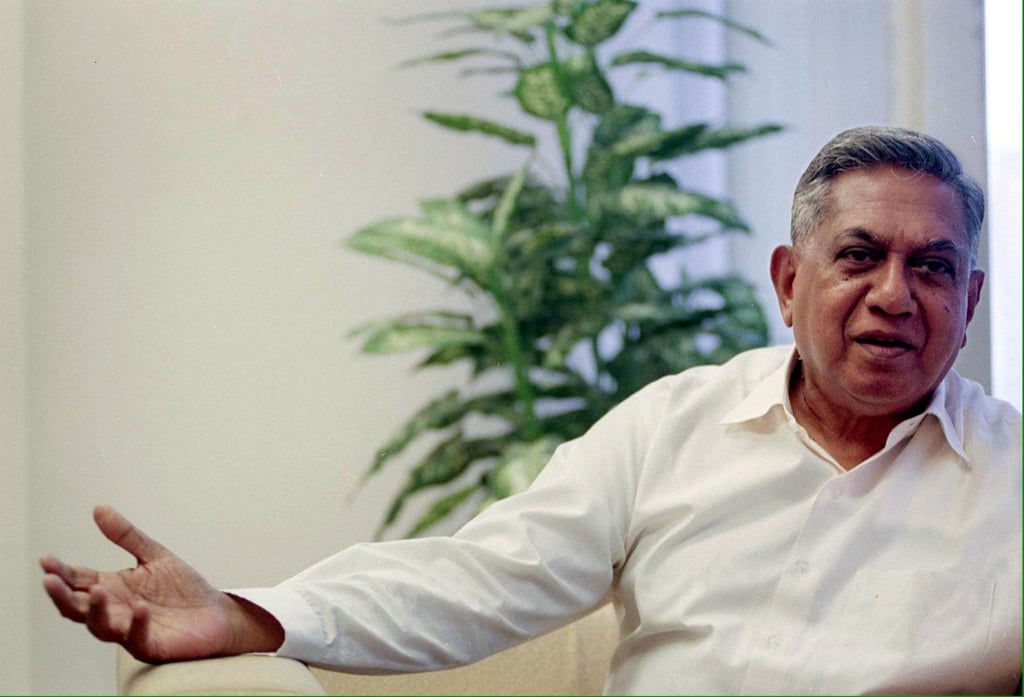
Veteran diplomat S.R. Nathan in Singapore in 1999, shortly before he became the country’s sixth president. Photo: AFP

Three-quarters of Singaporeans are ethnic Chinese. Hence, Singapore is seen in some quarters in Indonesia and Malaysia as a subversive Third China.

Advertisement
Advertisement
Select Voice
Choose your listening speed
Get through articles 2x faster
1.25x
250 WPM
Slow
Average
Fast
1.25x