Ayodhya’s revamp reflects India’s widening religious divide as Modi mobilises millions ahead of election
- The ancient city is being transformed to accommodate a temple for Hindu deity Lord Ram, as Modi’s BJP seeks to capitalise on nationalist fervour ahead of the general election
- Muslim locals fear they will be driven from the city they have called home for decades, as Hindus flock to Ayodhya in anticipation of the temple’s inauguration

For Pradeep Gupta, memory is a blessing. When he closes his eyes, he travels back to the morning of December 6, 1992, standing in his slippers and bathed in dust and limestone, as a Hindu nationalist mob razed the Babri Masjid, a 16th-century grand mosque in the ancient north Indian city of Ayodhya.
Gupta, who was 14 at the time, still remembers the taste of that limestone – “a taste beyond happiness”, he insisted, “that I cannot describe even after 30 years”.
The echoes of the whipped-up Hindu nationalist movement and mass mobilisation towards Ayodhya to reclaim the purported birthplace of the Hindu deity Lord Ram still reverberate in Indian politics.
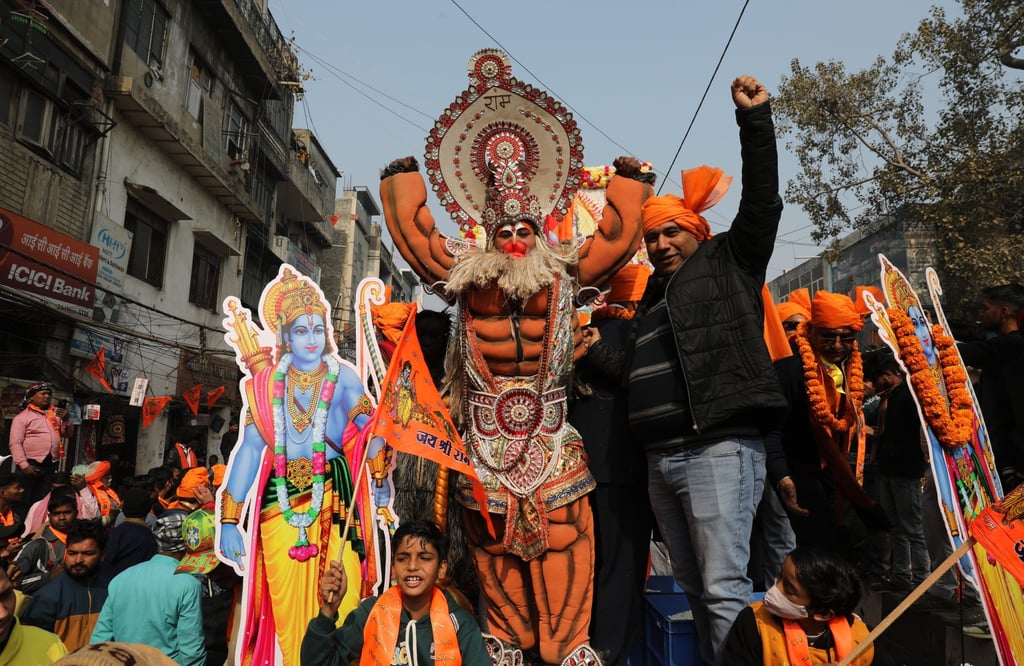
Prime Minister Narendra Modi’s Bharatiya Janata Party (BJP) rose to power in large part based on the promise to build the Ram Temple in Ayodhya, construction on which began in 2019 following a top court’s judgment in a bitterly fought legal battle.
Now, more than 30 years later, the BJP and other Hindu nationalist groups have planned a mass mobilisation ahead of the crucial general election coming in April and May.
The 2,500-year-old town has been dug out, partly demolished, and is being revamped to host millions headed to Ayodhya, 690km away from the capital New Delhi, for the rushed inauguration on January 22 of the under-construction temple.
“I never thought I’d see this day in my lifetime,” said Gupta, 55. “The city has been remade like a Muslim never lived here. Ram Lalla [infant Ram] is coming back home, finally.”