The Philippines has exerted tremendous effort in conducting internal security operations since it gained its independence from the United States. Given the country’s reliance on Washington’s security umbrella until the 1990s, its military never effectively developed the capabilities for territorial defence operations. Indeed, the Korean war of 1950-1953 is the only overseas conflict in which Philippine military forces were deployed in combat operations.
This preoccupation with internal security seemed sufficient until the emergence of territorial disputes in the South China Sea during the 1990s. Aggressive actions such as the Chinese occupation of Mischief Reef in February 1994, the Scarborough Shoal dispute in 1997, the Reed Bank incident in 2011 and the more recent Second Thomas Shoal incident in 2024 were strong indications that territorial defence could no longer remain secondary to internal security in the country’s national security priorities. For the past 30 years, successive governments have set out to modernise the armed forces, with limited success.
Although military modernisation provides incremental capability upgrades, it is insufficient to build a force capable of territorial defence. The armed forces’ drastic shift in strategic posture – from internal security to territorial defence – necessitates a military transformation that surpasses modernisation. Whereas modernisation involves evolutionary change aimed at improving what an organisation is already doing, transformation is a more comprehensive process that seeks to gradually change how military forces fight through “new combinations of concepts, capabilities, people and organisations”.
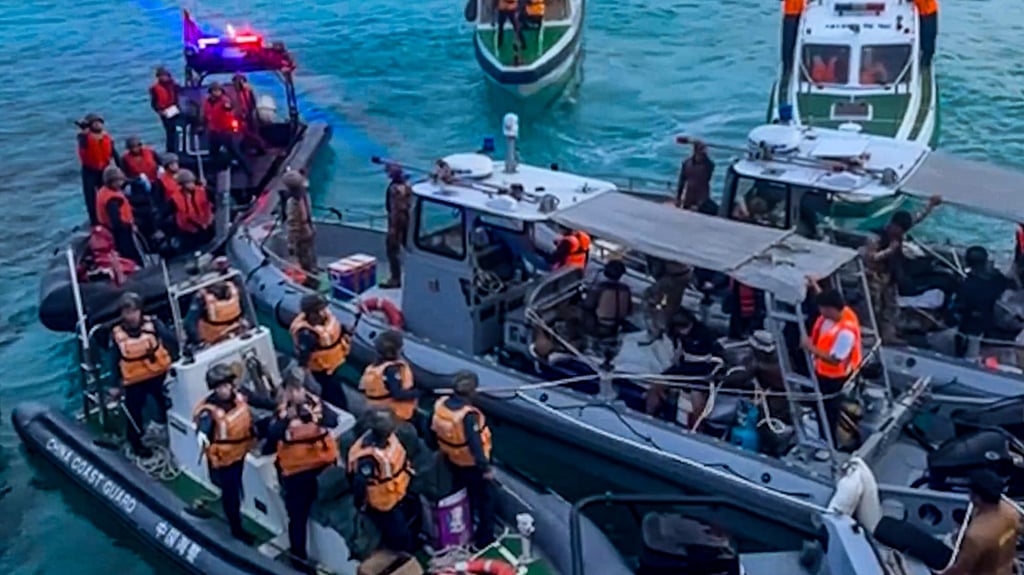
Chinese coastguard personnel aboard inflatable boats block Philippine naval boats during a confrontation at the Second Thomas Shoal in the South China Sea on June 17, 2024. Photo: Armed Forces of the Philippines
There is remarkably little debate about the purpose and direction of military change in the Philippines. Existing research has highlighted the role of defence spending and military platforms in upgrading the armed forces’ capabilities, but this is insufficient if the objective is to create a 21st century military force that is more lethal, jointly integrated and adaptive to the changing character of warfare – exemplified recently by the use of new technologies and multiple frontiers, including the cybersphere, in the Russia-Ukraine war.
Consequential changes in doctrine and force structure are necessary if there is to be military transformation in the Philippines.
Doctrine is a critical element of military transformation. It specifies “how military forces should be structured and employed to respond to recognised threats and opportunities”. In 2018, the Philippines mandated a set of doctrinal changes through its National Defence Strategy 2018-2022. It is reasonable to expect the Comprehensive Archipelagic Defence Concept (CADC), adopted in 2024, to anchor the armed forces’ current doctrines and sustain the shift from internal security to territorial defence articulated in 2018.
The CADC emphasises greater and more elaborate roles for the Philippine Air Force and Philippine Navy, which would require the development of new doctrines providing the fundamental principles guiding the employment of military forces in coordinated and integrated action against external security threats. However, the armed forces has yet to articulate clear doctrines in this area, making it difficult to evaluate progress.