In a world where the tools of formal diplomacy have been cast aside in favour of interest-driven deal-making, interactions between states have assumed new and more flexible forms. Once dominated by elaborate formality and often generating empty positions and declarations, states are turning to more informal mechanisms that grant space for private diplomacy and create new opportunities for stability and peace, even if they do little to reinforce international law.
This shift in modality partly reflects the disintegration of the rules-based order by which states were bound to a set of principles and agreements anchored in the charter of the United Nations. It is driven by a new populist political culture that is repelled by institutions considered elitist and doesn’t feel bound by any rules. It is a reversion to the norms of international diplomacy before 1914: highly personalised, unpredictable and almost as much about families as about states.
In a negative sense, this means that states are free to pursue their interests without restraint, as the recent actions of Russia and Israel prove. The multitude of mainstream forums that once constrained them have been weakened to the point of irrelevance. One notable example is the new constellation of states in the Brics formation, mainly binding countries of the Global South with Russia and China in a challenge to Western primacy.
This new diplomacy is a hybrid; often drawing on ideas incubated informally and conveyed through private channels
More positively, the relative freedom that states now have offers opportunities for creative networking and agreement on new issues of common concern. We see this in the evolution of trade corridors across Central Asia and the South Caucasus linking Asia with the Gulf. New groupings of states are evolving, built less around geopolitical affinity and more around geoeconomic necessity.
This new diplomacy is a hybrid; often drawing on ideas incubated informally and conveyed through private channels. The most notable example is the public and private composition of US President Donald Trump’s Gaza deal, which involves a stabilisation force drawing on military help from countries both from the Middle East and beyond, and a “Board of Peace” dominated by private business interests, presumably with profit in mind.
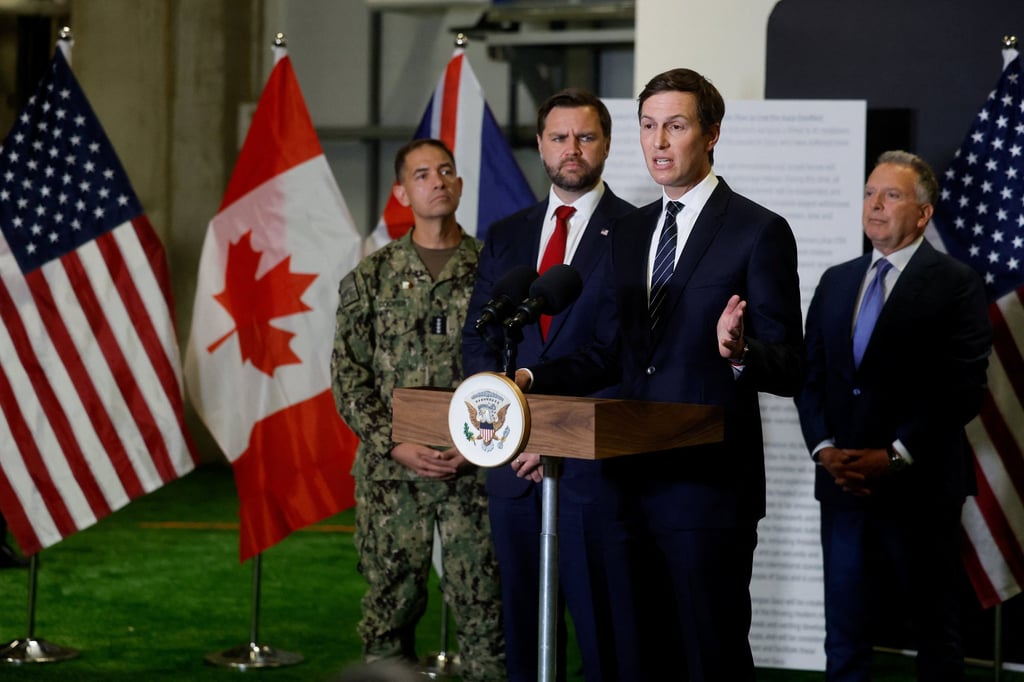
The new diplomats weaving the fabric of this new international order are often unelected advisers and private citizens. Trumtp has led the way, appointing a bevy of envoys from the world of real estate and his family circle. It was astonishing to watch Trump’s son-in-law, Jared Kushner – flanked by his daughter Ivanka and his real estate buddy Steve Witkoff – address a massive crowd in Israel after securing the ceasefire deal in Gaza.
They often operate alone, unencumbered by their diplomatic service. In a media interview, Israeli civil society activist Gershon Baskin described how he managed to advise Witkoff on negotiating with Hamas by intercepting him outside the men’s room at a private conference in Doha.
Jared Kushner speaks to members of the media next to US Vice-President J.D. Vance and US Special Envoy to the Middle East Steve Witkoff in Kiryat Gat, Israel, on October 21. Photo: Reuters