Advertisement
Chinese smart eyewear makers shine at CES with focus on challenging Meta
‘The rise of smart glasses is riding directly on advances in AI,’ LLVision founder and CEO Wu Fei says
3-MIN READ3-MIN
2
Listen

Wency Chenin Las Vegas
Dozens of Chinese makers of smart glasses dazzled the exhibition floor at the recent CES trade show in Las Vegas, where they showed lightweight, artificial intelligence-powered eyewear aimed at a category that has been largely defined by Meta Platforms’ Ray-Ban Display.
At the four-day annual trade show, which concluded on Friday, Chinese brands made up most of the roughly 60 smart eyewear exhibitors. Their products ranged from audio-first frames designed for all-day wear to augmented reality (AR) glasses that overlay digital information onto the real world.
Exhibitors included Rokid, which debuted its audio-centric, no-display product called the Rokid AI Glasses Style supported by a mix of US and Chinese large language models; Xreal, which unveiled new AR wearables such as the Xreal 1S and the video gaming-focused ROG Xreal R1; and RayNeo, which introduced its X3 Pro Project, featuring eSIM support that allowed the glasses to run without a smartphone link.
Also at CES were LLVision Technology, which showcased its Leion Hey2 translation-focused glasses; Even Realities, which featured its newly launched 36-gram Even G2 smart eyewear with a companion smart ring; and Alibaba Group Holding, which showed its Quark AI Glasses. Alibaba owns the South China Morning Post.
Other exhibitors included Meizu, Sharge, INMO, projector maker Xgimi and earphone brand Shokz.
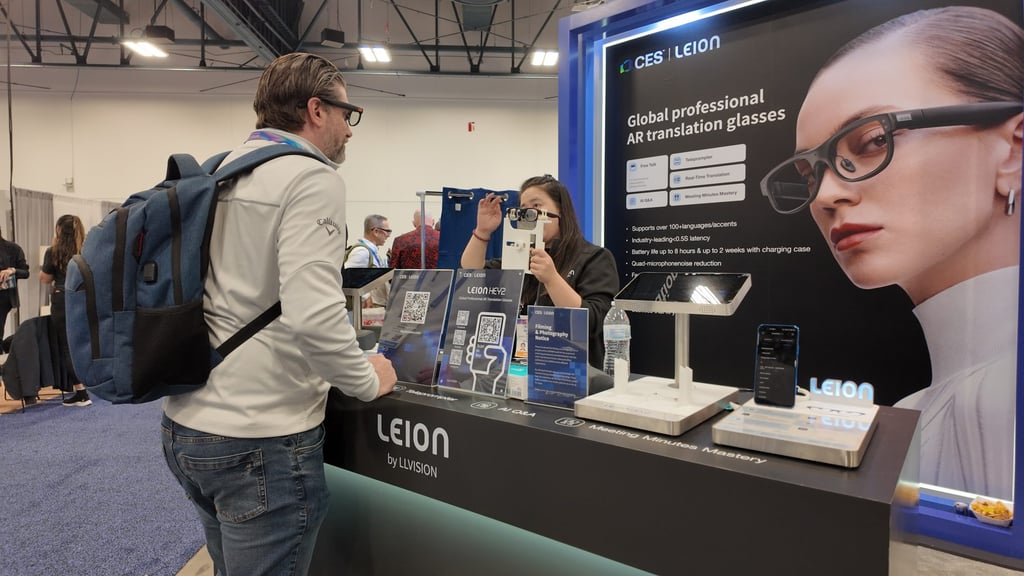
Chinese firms’ strong showing at CES underscored how large language models (LLMs) and multimodal AI had made it possible to embed intelligence into a fast-developing range of consumer hardware and wearables. Some already considered smart glasses as potentially the next major personal computing platforms after smartphones.
Advertisement
Select Voice
Select Speed
1.00x