Advertisement
Robotics
Tech

Inside Unitree’s landmark IPO: what to know about China’s humanoid giant

Listing, if approved, would be a bellwether of investor appetite for so-called embodied AI companies

3-MIN READ3-MIN
Listen
Students view a humanoid robot based on the Unitree G1 platform in Zagreb, Croatia, on February 25, 2026. Photo: Xinhua
Wency Chenin Shanghai
China’s Unitree Robotics has filed for a long-awaited initial public offering (IPO) on Shanghai’s Star Market, seeking to raise about 4.2 billion yuan (US$607.8 million).

Widely seen as a bellwether for China’s emerging humanoid robotics industry, Unitree’s listing, if approved, could become a landmark test of investor appetite for so-called embodied AI companies.

Here is what you need to know about Unitree, including how it makes a profit while peers are still burning cash, its shareholder structure, supply chain details and its client portfolio.

Who is the founder?
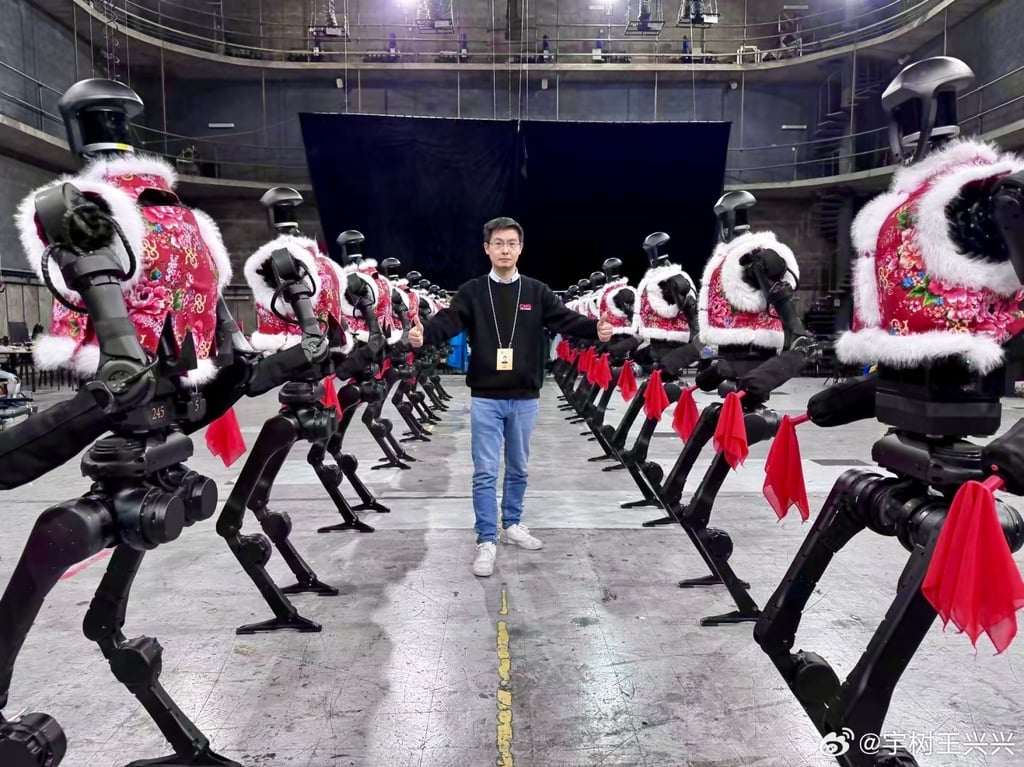
Founder Wang Xingxing is firmly in control, with a 23.8 per cent direct equity stake and nearly 69 per cent of voting rights.
Advertisement
Born in 1990 in Ningbo, Zhejiang province, and educated at Zhejiang Sci-Tech University in Hangzhou and Shanghai University, Wang founded Unitree in 2016. He is said to be a very hands-on CEO, deeply involved in research and development (R&D), personally interviewing candidates and overseeing nearly every aspect of operations. He made headlines when he was seated in the front row at President Xi Jinping’s high-profile business symposium in February 2025.
A photo posted by Wang Xingxing, CEO of Unitree Robotics, shows him with the the company’s H1 general-purpose humanoids ahead of a Chinese New Year television performance. Photo: Weibo

Who are the investors?

External shareholders include Meituan, HongShan China (formerly Sequoia China) and Matrix Partners China, holding roughly 9.6 per cent, 7.1 per cent and 5.5 per cent, respectively. Tech giants including Tencent Holdings, Alibaba Group Holding, Ant Group, Xiaomi and ByteDance have also invested, directly or indirectly, alongside industrial players such as BYD and Geely, as well as state-backed funds from cities including Shanghai and Beijing. Alibaba owns the South China Morning Post.

Advertisement
Select Voice
Select Speed
1.00x