Advertisement
Breakthrough or hype? How WeRide aims to steer past rivals in crowded robotaxi field
WeRide says its world model has slashed costs to support global expansion, but investors question if it can deliver a lasting advantage
4-MIN READ4-MIN
Listen

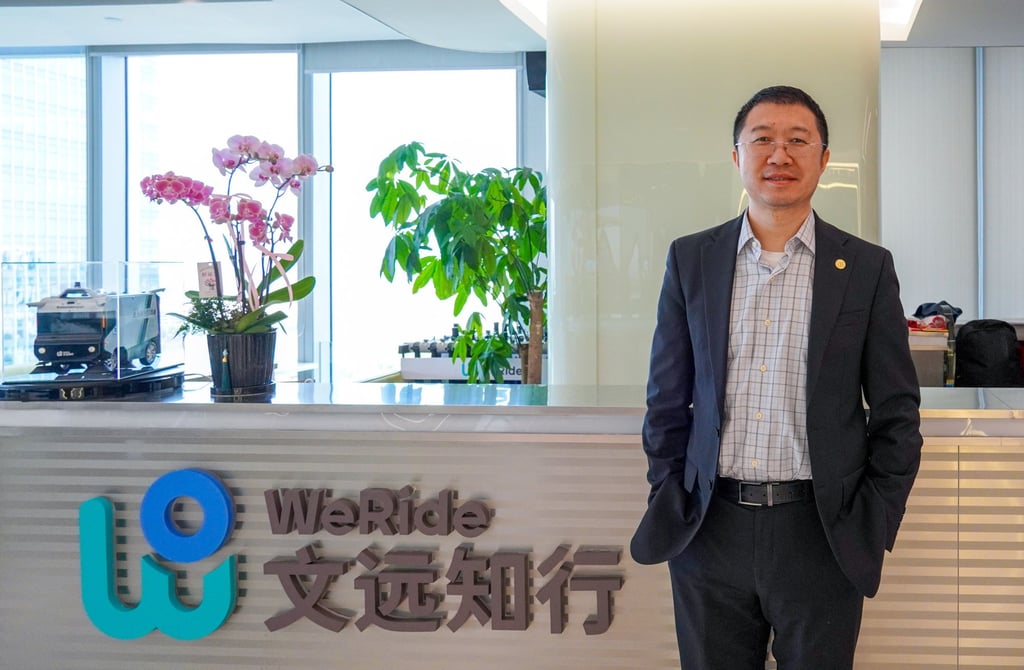
WeRide, one of China’s big three robotaxi companies, has cut research and development (R&D) costs by “millions” of US dollars by using artificial intelligence to train its fleet in virtual worlds, its CEO said.
While rivals had also developed AI models simulating the physical world, WeRide’s efforts stood out as it was using its world model Genesis to support its global expansion strategy, said Tony Han.
“It’s the first real marriage between physical AI and generative AI,” Han told the South China Morning Post.
A major challenge for the autonomous vehicle industry has been the high costs associated with developing self-driving algorithms that can generalise across different markets and terrains.
In particular, the low tolerance for accidents has meant algorithms must be trained on many low-probability “edge cases” that occur in the real world, as shown by a recent incident in the US where a Waymo robotaxi drove passengers into a police stand-off.
This has pushed many of the industry’s leading players, including Waymo and Tesla, to turn to AI world models as they seek to reduce unit costs to drive fleet expansion.
Advertisement
Select Voice
Select Speed
1.00x