Kowloon Bay’s new Amoy Footbridge set to draw neighbourhood closer together
The new elevated walkway builds on a long history in the area, starting with Amoy Gardens, the residential estate at the centre of the 2003 Sars outbreak

Hong Kong is famous for its elevated walkways, which dot the city from Tsuen Wan to Mong Kok to Central, forming a sprawling pedestrian network built out over many decades.
Built by Hang Lung Properties as a community investment project, the footbridge opens at a time of meaningful anniversaries for the company and hence carries far more significance than its modest structure might suggest – from memories of the neighbourhood’s ordeal during the 2003 Sars outbreak to an illustration of how thoughtful urban planning can knit communities together.
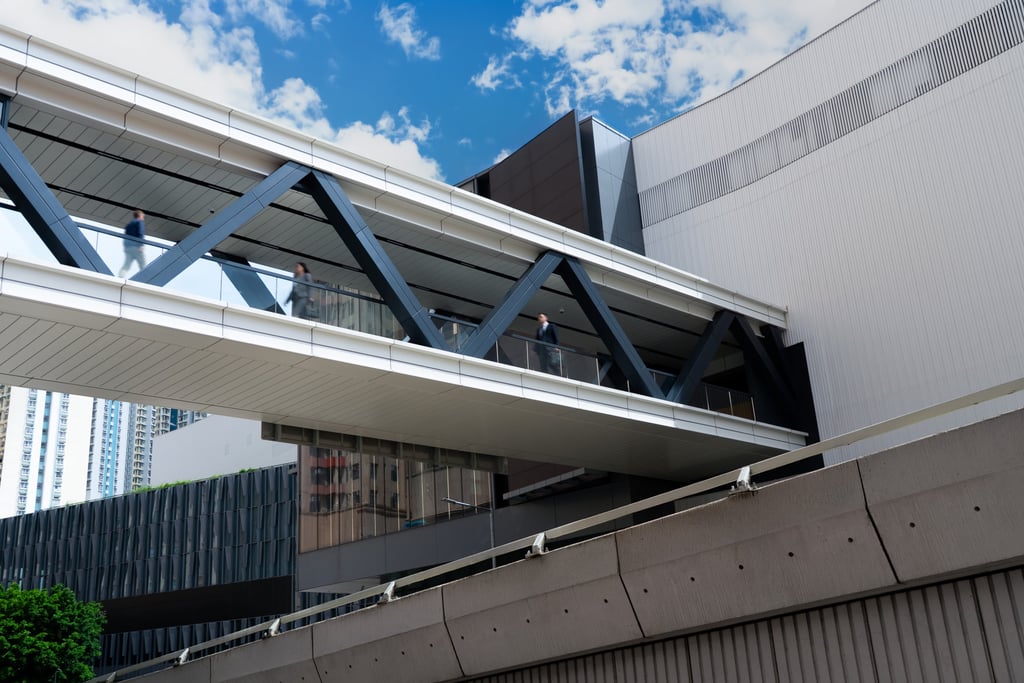
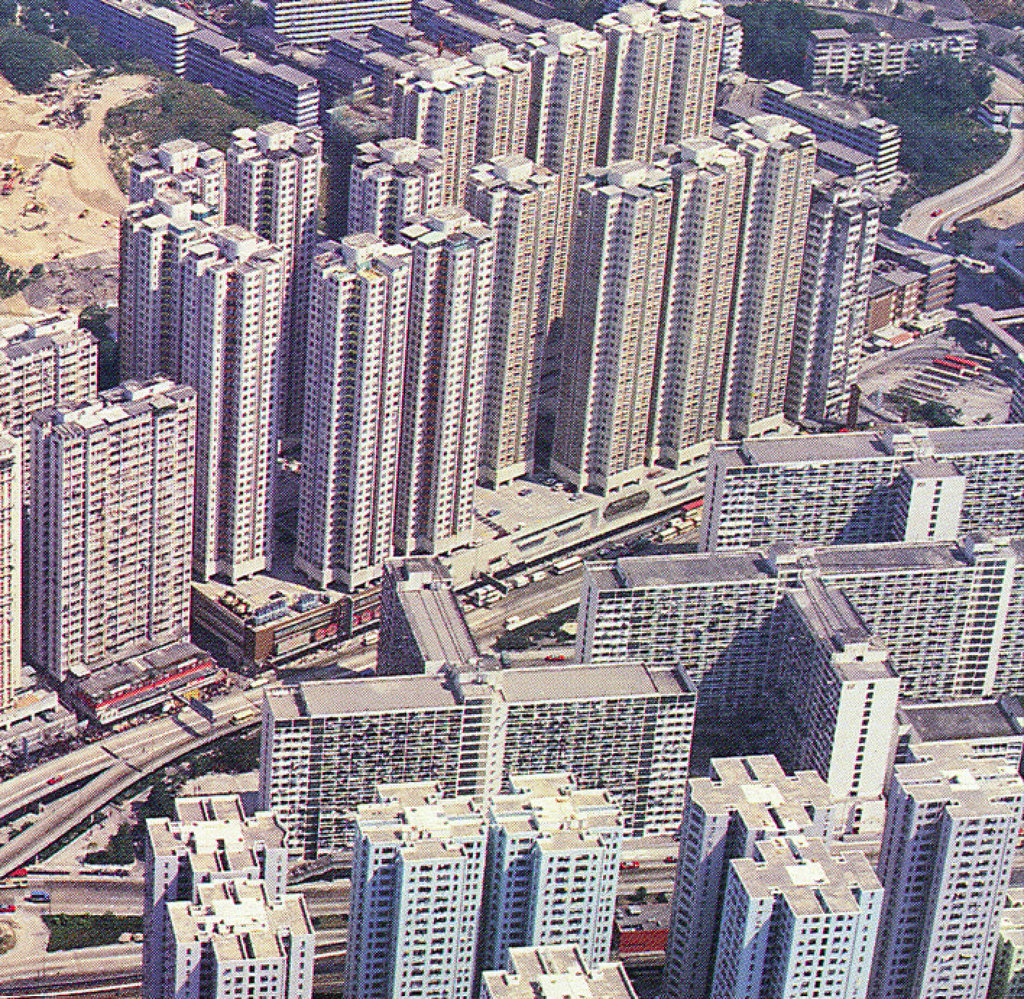
In 1977, Hang Lung acquired a 222,560 sq ft plot in Kowloon Bay, including the Amoy soy sauce factory, from the Amoy Canning Corporation. In 1981, the group opened the first phase of Amoy Gardens residential estate and Amoy Plaza shopping centre on the site. The opening of the new bridge therefore caps almost half a century of Hang Lung’s footprint in the district, aligning with the 66th anniversary of the group’s founding on September 13, 1960.
At the opening ceremony, Leung Chun-ying, vice-chairman of the National Committee of the Chinese People’s Political Consultative Conference, said residents could now move around “in a more comfortable, convenient and safe environment – whether it is raining heavily, as it was earlier today, or during the heat of summer”.
He traced the project back to an accessibility drive from his tenure as Hong Kong’s chief executive, when the local government “promoted the idea of creating barrier-free, convenient access for all”. Hang Lung Properties “responded positively”, he said, in this collaboration between government, business and the community that produced “a genuine win-win-win outcome”.
The project was enabled by public-private collaboration. In 2016, the government piloted a scheme allowing private developers seeking to build a footbridge or tunnel connecting their property to a public network to have the expensive land premium required to modify their land lease waived. The scheme was trialled in the Kowloon Bay and Kwun Tong business districts as part of the Energising Kowloon East programme. The new footbridge, delivered with the Energising Kowloon East Office and the Transport Department, is one of its results.
Forged in adversity
The origins of this public-private framework run deep, forged during one of the city’s greatest health crises. “My connection with the Amoy Gardens community began 23 years ago, during the Sars outbreak,” Leung recalled.
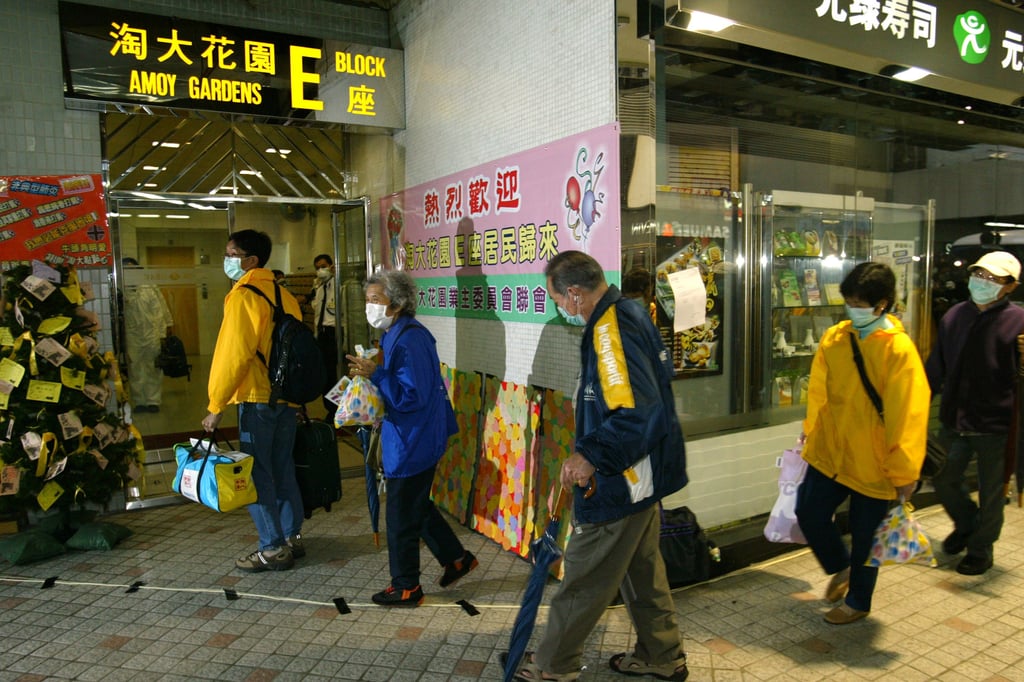
Amoy Gardens was the site of Hong Kong’s largest single Sars cluster during the 2003 crisis: 329 residents were infected and 42 died, with almost half of all cases from Block E alone. Investigations by the government and the World Health Organization concluded that dried-out U-traps in bathroom floor drains – the water seal that keeps sewer gases out of a flat – had opened a route for the virus to travel between units, compounded by a “chimney effect” in the building’s light wells that drew contaminated air upwards between flats.
In response, Leung, then Executive Council convenor and chairman of the Hong Kong Coalition of Professional Services, led a 2004 initiative to redesign Block E’s drainage with external water-seal pipes to act as insurance against the virus returning. The Coalition announced it would raise and spend HK$800,000 to retrofit Block E’s drainage system.

“The new design is like a heart bypass operation, basically by providing water shields, in addition to what’s already inside [the flats], to make sure that this possible means for the spread of Sars and other diseases is totally and effectively dealt with,” Leung said at the time. Additional pipes fixed to external walls supplied a constant trickle of water to stop the traps drying out, requiring about a day’s work per flat with no need to replace drains inside homes.
Crucially, the coalition gave the design away for free. “What we are going to do is to make this design totally public,” Leung announced in 2004, offering it to other buildings after a Buildings Department survey found that sewage systems in some 6,000 private buildings were defective or substandard.
Persuading residents to agree to the retrofit fell largely on the shoulders of former district councillor Yip Hing-kwok, who was present at Monday’s ceremony. As chairman of the Amoy Gardens Owners’ Joint Committee during the crisis, Yip worked to secure household consent across the estate.
The mutual trust forged between government, developers and residents during those crisis years laid the foundation for future civic partnerships – and Leung’s later policy focus as chief executive – ultimately paving the way for public-private initiatives like the Amoy Footbridge.
Small links, big impact
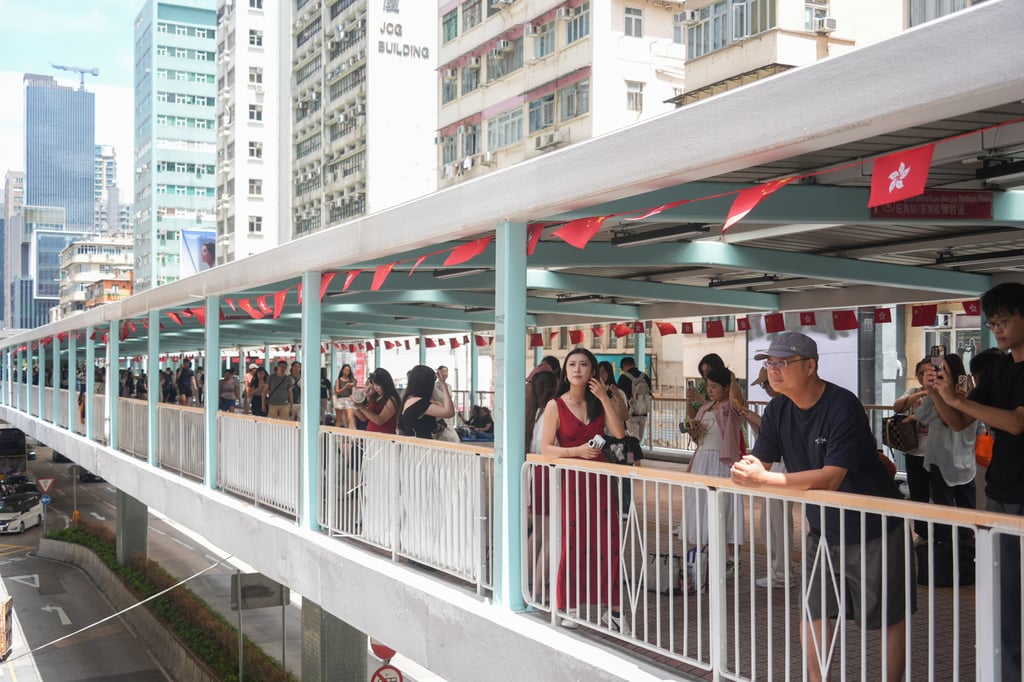
A hundred metres of covered walkway is the sort of thing that often goes unnoticed in a city as frenetic as Hong Kong. But these unremarkable pathways are among Hong Kong’s basic building blocks: the Highways Department was maintaining 1,171 footbridges and 564 subways as of June 2026, a network built piece by piece over many decades. Academics who study that layered system say that small pieces of infrastructure often punch above their weight.
Sunny Choi, assistant professor at The Hong Kong Polytechnic University’s School of Design, said Kowloon Bay is exactly the kind of neighbourhood where an elevated link earns its keep, with a ground plane “overwhelmingly dominated by vehicular infrastructure, including heavy traffic arterial roads, bus bays, loading docks and continuous motor flows”. That makes elevated links essential “primary catalysts for neighbourhood walkability”. A well-placed link, “completely restructures how residents navigate between commercial, residential and cultural anchors,” she said.
Others in academia agree. “In a dense urban fabric like Kowloon Bay, localised interventions like the new footbridge demonstrate how micro-connections can effectively knit together previously fragmented commercial, residential and civic nodes,” said Yung Yau, professor of Lingnan University’s Department of Sociology and Social Policy.
Huang Jianxiang, honorary associate professor at the University of Hong Kong’s Department of Urban Planning and Design, said footbridges, tunnels and interconnected concourses “not only support commercial vitality but also encourage walking and help reduce pedestrian/vehicle conflicts and traffic accidents”.
Choi highlights Hong Kong’s most famous elevated networks as proof of concept. The Central-Mid-Levels Escalator “began as a transit solution” but “transformed an entire hillside into a vibrant, human-scaled ecosystem,” Choi said. Its success, on her reading, lies in what it does not do: pedestrians moving between the CBD and residential blocks pass by scenes of ordinary street life instead of being sealed inside their estate’s podium.
Hong Kong did not invent such systems, Huang said, “but it has become an outstanding example of how an extensive, interconnected pedestrian network can function within a dense urban environment”.
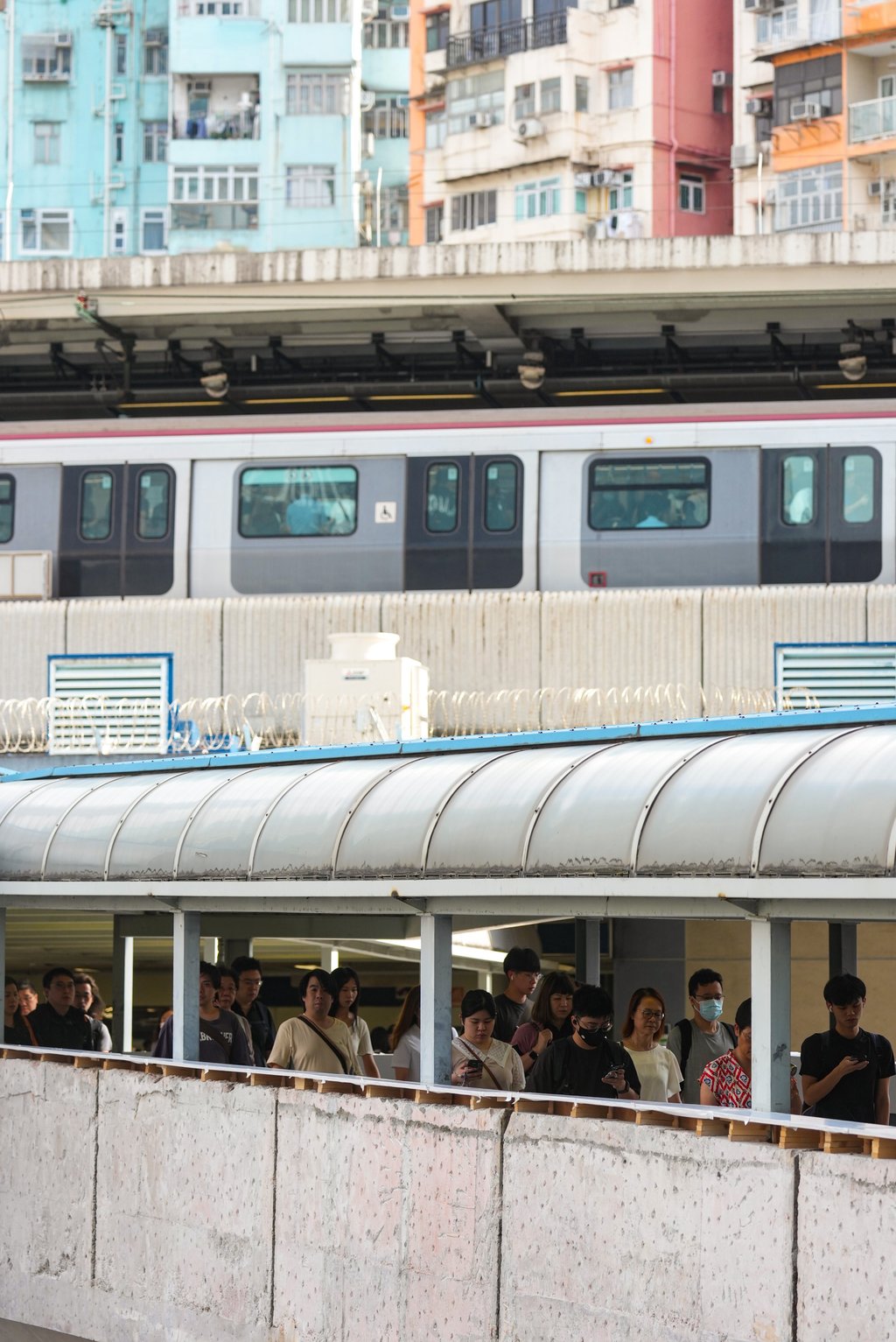
However, experts caution that lifting pedestrians off the pavement does come with trade-offs. Yau warned that siphoning foot traffic upwards can drain street-level businesses and leave mobility-impaired residents overly reliant on lifts during severe weather. To counteract this, Huang suggests footbridges double as inclusive public spaces hosting informal gatherings, while Choi advocates for ground-level shade canopies and open-air stairs to keep both tiers active.
Ultimately, as the Amoy Footbridge opens to daily commuters, its success will depend on how naturally it integrates into the community’s routine. As Huang noted, “Once the physical infrastructure is in place, the success of a footbridge depends as much on its management as on its design.”