Advertisement
Art Basel
Special Reports

How Wong Kar-wai’s noir films inspire Nicole Eisenman’s Hong Kong view

Ahead of her first Asia solo exhibition, held at Hauser & Wirth, the artist trades global headlines for moodier, introspective canvases

4-MIN READ4-MIN
Nicole Eisenman, whose work often offers a humorous take on sociopolitical issues and events. Photo: Brigitte Lacombe
Aaina Bhargava
In preparation for her first trip to Hong Kong, artist Nicole Eisenman has been watching a lot of 1990s Wong Kar-wai films. One in particular, Fallen Angels (1995), fully captivated the artist. “It’s the night time … the whole movie feels so dark,” says Eisenman of the neo-noir crime drama. “I know it sounds ridiculous, trying to learn about a city by watching a movie, but my idea of Hong Kong is very tied up with Wong Kar-wai right now. Everything seems to take place at night, and this darkness is reflected in the exhibition.”

The show in question, also called “Fallen Angels”, is Eisenman’s first solo presentation in Asia and is at Hauser & Wirth Hong Kong from March 24 to May 30.

It’s a surprising first for the celebrated artist who’s had numerous solo exhibitions at various galleries and institutions – such as her retrospective “What Happened” at Whitechapel Gallery in London – and at large-scale presentations such as the Whitney Biennale in 1995, 2012 and 2022.
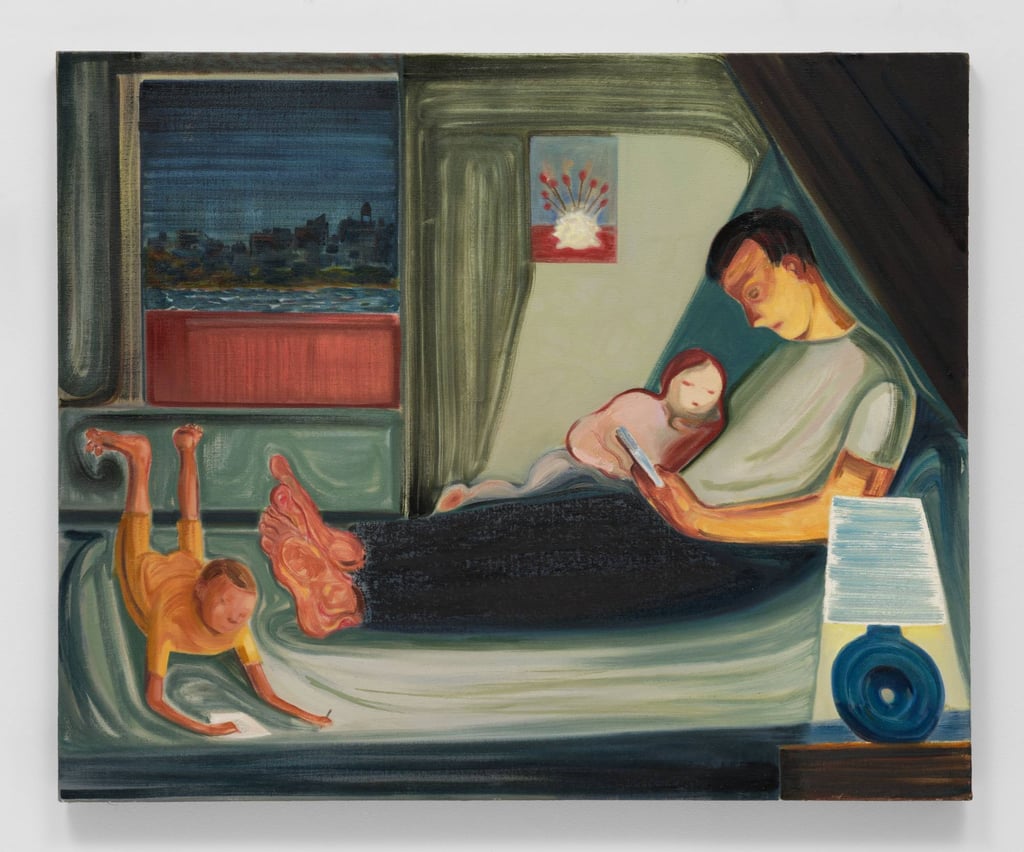
Hope Street with Freddy and George by Nicole Eisenman. Photo: Handout

Touted as one of her generation’s most significant painters, Eisenman is acclaimed for her formalist skills and painting techniques used to depict contemporary life, which often read like crowded tableaux. Beyond her technical capabilities, it’s her allegorical, often humorous take on sociopolitical issues and events that truly captivate critics and enthusiasts alike.

Advertisement

Art has been a constant in Eisenman’s life; her great-grandmother was a self-taught painter, and both her great-aunts were artists. “I grew up in a house full of my great-grandmother’s paintings and was just mesmerised by that,” Eisenman recalls. Her own proclivity for painting and skill was revealed at a young age. When recounting her earliest memory of making art – finger painting in nursery school – she describes it as an image of a mountain with a road going around it in a way that made it look three dimensional.

“It broke my mind open that I could create something like that, I just slipped into that world, it was as if I was inside the painting,” she says, pinpointing her early capability to see and interpret shapes. “As I got older, it became more and more apparent that [making art] was all I was capable of doing.”

Processing by Nicole Eisenman. Photo: Handout

Eisenman emerged on New York’s downtown art scene in the 1990s. Her murals and ink drawings such as Untitled (Lesbian Recruitment Booth) and Captured Pirates on the Island of Lesbos were irreverent and subversive, incorporating humour and eroticism to break down established notions about systemic patriarchy.

Advertisement
Advertisement
Select Voice
Select Speed
1.00x