Unlocking the $10 Trillion Opportunity Hidden Behind the New Rules of Tokenization
.jpg?itok=W5qaipGb)
[The content of this article has been produced by our advertising partner.]
In today’s rapidly evolving digital finance landscape, tokenization is reshaping how assets are managed, traded, and accessed. Current tokenized assets sit at an estimation of approximately US$20 - $25 billion, while projections indicate that up to US$10 trillion of real-world assets (RWA) will be represented digitally by the end of the decade, shifting the industry debate from whether tokenization will happen to how it will be implemented at scale.
A recent event co-hosted by Amazon Web Services (AWS), Crypto.com Capital, and Cronos convened leaders from traditional finance, digital asset platforms, and venture capitals to push forward the conversation. The invitation-only conference served as a platform to bridge between capital and real-world assets, addressing how institutional capital and onchain infrastructure converge across Web2 and Web3.
TradFi Meets DeFi: Institutional Perspectives on Tokenization

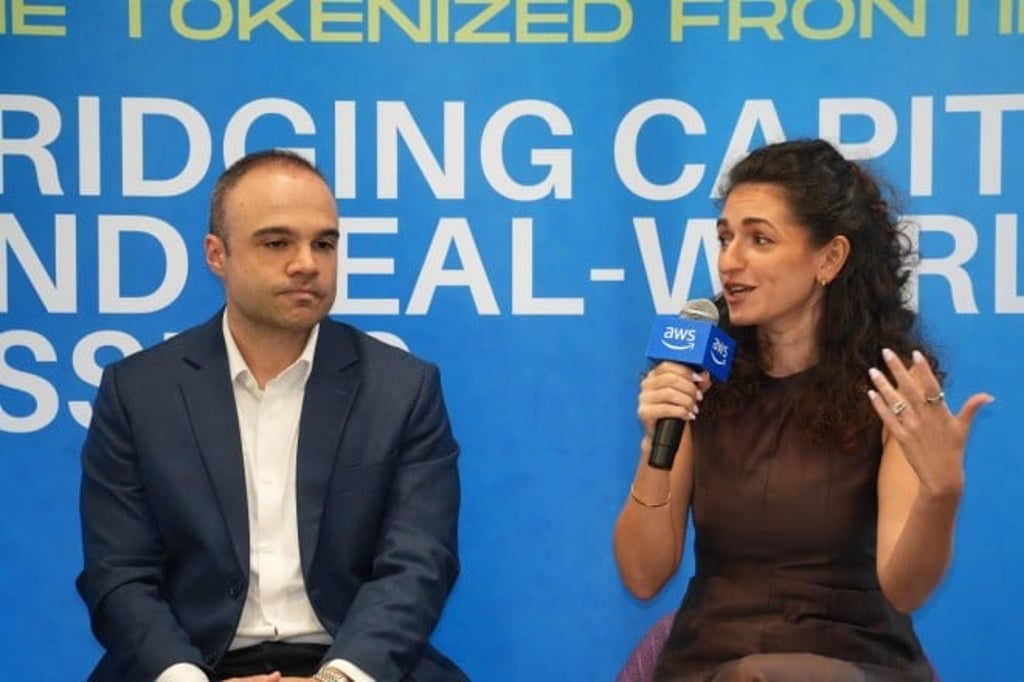
When it comes to the choice between public and private blockchain networks for tokenization initiatives, Tommy Chan, Head of DeFi Investment at Crypto.com Capital, best described the conundrum: "Private and public blockchains serve different use cases with a unique value to offer. However, what makes public blockchain irreplaceable is their ability to deliver open distribution to global users while avoiding centralized control. This ensures they will remain the most important space for crypto innovation."
Echoing this sentiment is Valeria Zafar, Head of Commercial Product APAC at Kinexys Digital Assets, Kinexys by J.P. Morgan, who explained the reasoning behind the firm’s multi-network approach. “Not every application needs to be on a public blockchain, some private networks are intentionally maintained for governed use cases precisely because there is no need for those particular applications to be public. Controlled private environments allow efficiency, transparency, programmability, all blockchain benefits without sacrificing the governance our institutional clients require,” Zafar remarked.
This pragmatic approach, however, does not come at the expense of public blockchain innovation. Through the recent launch of JPM Coin on the Base blockchain, which enables 24/7, near-instant USD transfers for institutional clients, J.P. Morgan signals that even established financial institutions see the value of public infrastructure as essential components of a connected, on-chain financial ecosystem. Merging the liquidity of traditional commercial banking with the programmability of blockchain, clients can execute payments on-chain without sacrificing the stability of regulated currency.
Beyond the Concept: Navigating the Obstacles that Remain
Despite the enthusiasm, panelists were also cautious about the obstacles to widespread adoption. A primary challenge lies within navigating complex and fragmented regulations across different jurisdictions, which demand early and sustained engagement from legal and compliance teams that can in turn erode efficiency. Interoperability adds another layer of difficulty, which is why the industry needs to come together to establish standardized guidelines and cross-network solutions to allow assets to move seamlessly across platforms and borders.
Another issue is the complexity of running two systems at once: tokenized platforms often operate alongside traditional infrastructure, and until both the asset and the money used exist entirely on-chain, the full benefits will not be realized. Products like JPM Coin solve the payment side of the equation, because even though an asset may be tokenized, an asset without payment will continue to move through slow, outdated systems. Therefore, it is important for institutions to recognize that not every asset benefits from tokenization and avoid solutions in search of problems.
Moreover, as institutions venture onto public chains, new risks emerge. Transparency diminishes in permissionless environments, thus requiring robust ‘anti-money laundering’ and ‘know your customer’ screening while maintaining user privacy. The potential for leverage loops, such as on-chain rehypothecation and recursive borrowing, also introduces systemic risks that could amplify market volatility. Ultimately, scaling tokenization requires more than technological maturity, but a fundamental rethinking of governance and risk.

Few technologies pair as naturally with blockchain as artificial intelligence. Tommy Chan, Head of DeFi Investment at Crypto.com Capital, illustrated the complementary nature of the two fields. "AI and crypto come hand in hand. Crypto operates 24/7, and AI agents also function 24/7. As human beings, we need to sleep, but we can offload work to AI agents for crypto trading or news monitoring,” Chan said, “Both crypto and AI require cloud service providers like AWS to support their fundamental layer."
For traditional institutions exploring tokenization, AWS offers critical building blocks for tokenization. Through Key Management Service for secure wallet, and Nitro Enclaves for confidential computing that protects sensitive data, AWS addresses the core security and compliance requirements of tokenization. Beyond individual services, AWS provides architecture patterns and best practices, like reference diagrams for custody, wallet, issuance, and settlement components, giving institutions a proven blueprint to follow.
Road to Scale: Shaping the Next Era of Finance
What the event made clear is that Web3 is not a standalone industry. It is simply a new way of doing things, much like the internet before it. Eventually, every financial institution and business will leverage blockchain technology in some form to reduce costs and improve efficiency. The key is knowing where to start, focusing only on areas that will drive value for clients and build from existing strengths. Look closely at current services and identify the pain points, before going after the real commercial opportunities hiding beneath the surface.
As regulatory frameworks mature and technological barriers continue to fall, the convergence of traditional finance with blockchain infrastructure promises to create a more transparent, efficient and accessible capital environment. With partners like AWS to provide the secure, scalable foundation necessary for building innovations, the industry is steadily moving closer to realizing the full potential of tokenized real-world assets. Leadership in the next era of finance will not go to the loudest voices, but to those who build thoughtfully and collaboratively, while never losing sight of what actually creates value.