Microbiome leader redefines healthcare beyond the gut
A biotech pioneer introduces innovative diagnostic kits designed to slash costs, speed up results, and support timely intervention.

[The content of this article has been produced by our advertising partner.]
Every year, more than eight million people around the world anxiously wait for accurate diagnoses of debilitating gastrointestinal (GI) diseases, such as inflammatory bowel disease (IBD). Yet definitive diagnosis often requires time-consuming, costly tests and invasive procedures – barriers that can discourage patients from seeking help early, when intervention is most effective.
ddPCR works by partitioning a sample into thousands of nanoliter-sized droplets, with each droplet functioning as an independent PCR reaction. This “digital” method enables absolute quantification of nucleic acids, providing a direct and highly accurate count of target molecules.
“Our goal is to enhance personalised healthcare globally,” Cheung says. With Enterosight®, patients need only provide a stool sample – avoiding invasive procedures such as colonoscopies, multiple blood and tissue tests, and even CT scans.
“The beauty of this innovation is that it tests multiple biomarkers in a single reaction,” he adds. “The technology is verified through clinical trials conducted by over 20 centres around the world. It achieves 88% sensitivity and 89% specificity for IBD diagnosis. Compared with conventional diagnostic procedures, it reduces cost of diagnostics by more than 90%,” Cheung adds.
Hong Kong’s tech ecosystem and global connections have played a crucial role in advancing gut microbiome research. “We aim for global application of the Enterosight® technology,” Cheung says. “The gut microbiome function is shaped by geography, lifestyle, diet and host genetics. Hong Kong’s strategic position as a bridge between East and West has allowed us to validate and understand microbiome processes across different ethnicities, helping us maximise the global relevance of this technology and address a major unmet need.”
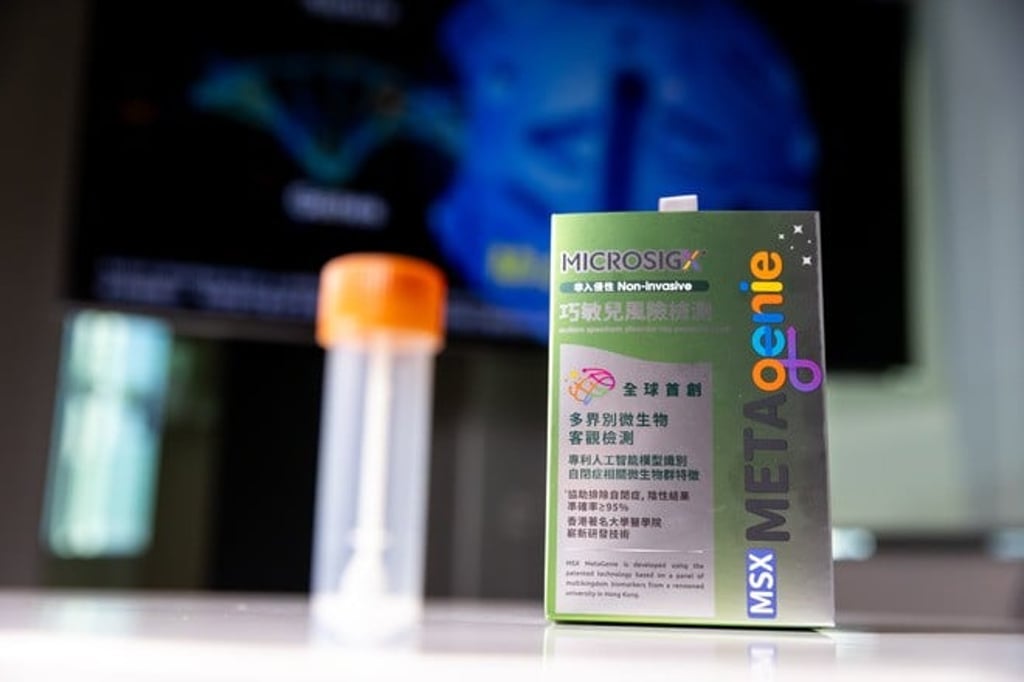
MagIC’s research team has taken its ddPCR-based innovation a step further by developing a groundbreaking diagnostic tool for autism spectrum disorder (ASD) – a development with the potential to transform pediatric care worldwide. The number of ASD diagnoses is rising rapidly, reaching crisis levels in many regions; Hong Kong alone has reported more than 22,000 cases. Early diagnosis and intervention are essential for effective treatment before symptoms escalate, reducing family stress, and optimising healthcare resources.
To meet this challenge, the team has again tapped into the power of the gut microbiome to detect early risks of conditions such as ASD through a simple stool test. This world-first technology received the Breakthrough Device Designation from the U.S. Food and Drug Administration in July 2024.
Beyond Hong Kong, team has been working with hospitals and universities in mainland China and forging collaborations in Australia and the U.S. says Jim Chiu, MagIC’s Business Development Manager.
“Keep Up” with gut microbiome tech
As an international hub for research and development, Hong Kong continues to attract global pharmaceutical interest – especially when innovations like Enterosight® demonstrate strong clinical potential. Cheung believes the city’s robust intellectual property protections embolden companies to develop and commercialise new technologies locally before expanding to global markets.
For MagIC, “Keep Up” means staying in sync with nature’s microbial rhythms – continuously refining its AI models with every new stool sample, every new dataset, and every new partnership. By staying one step ahead of diseases like IBD and ASD, the team hopes to ignite new possibilities in personalised healthcare and bring hope to millions worldwide.
As Hong Kong’s largest I&T ecosystem, HKSTP is home to more than 2,600 tech companies and nearly 25,000 dedicated innovators.
Resources and photo by : MagIC