Empowering teachers to build the classroom of the future
- Teachers are seen as the key drivers for nurturing computational thinking skills in children
- The CoolThink@JC programme, created and funded by The Hong Kong Jockey Club Charities Trust, trains teachers to use more active learning methods

[Sponsored article]
In the innovative and effective student-centred learning environments created by teachers in the CoolThink@JC programme, students embrace an active and collaborative role in their learning. They have more autonomy and a greater opportunity to use experimentation to solve problems that are without standard answers. This approach is different from a more teacher-centred classroom setting, where students play a more passive role by listening to the teacher and taking notes.
Teachers, who stand at the frontline of the classroom, are the key agents for driving change in learning.
With the full backing of the CoolThink@JC programme – created and funded by The Hong Kong Jockey Club Charities Trust to nurture computational thinking in students by promoting coding education to primary schools across Hong Kong – and through its comprehensive training, many teachers are rethinking their teaching methods and adopting new instructional strategies.
Mindset change to build a future classroom
“Teachers are responsible for shaping the future development of students in the everyday classroom setting,” says Leung Siu-tong, a member of the CoolThink@JC Steering Committee and Honorary Chairman of the Hong Kong Aided Primary School Heads Association.
“Inspiring students to be digitally creative has become imperative. Teachers need to constantly upgrade themselves to keep up with the complex and fast-changing future. The teaching and learning process enables teachers to grow together with their students.”

CoolThink@JC’s extensive and practical teacher training has been instrumental in informing teaching practices and empowering mindset shifts among teachers.
“Through teaching computational thinking, I realised that teaching benefits the teacher and students alike – when encountering new knowledge, we both need to learn and acknowledge the fact that there are limitations to what we know,” says Fung Long, a CoolThink@JC Fellow and Vice-Principal at Sham Tseng Catholic Primary School.
“When students ask about coding knowledge that I’m not familiar with, I will treat it as a learning opportunity and explore answers with students together. The curriculum of CoolThink@JC is very structured and offers a good support network to teachers.”
Ho Ka-man, a teacher at Po Leung Kuk Dr Jimmy Wong Chi-ho (Tin Sum Valley) Primary School, agrees: “My previous teaching mindset was more instruction-oriented, which meant I thought my role as a teacher was to be an instructor who knew the answer to any question.
“As a Visual Art teacher who majored in English language, I had no previous coding experience. The CoolThink@JC courses helped me to develop a better understanding of computational thinking and coding concepts,” Ho adds. “Through interactions with other teacher fellows, I acquired a great deal of experience and finally gained confidence. This experience also made me rethink my role as a teacher and revamped my teaching mindset. I changed from an instructor-like presence to becoming a facilitator who would try to find ways to solve problems together with students.”
More than 85 per cent of the trained CoolThink@JC teachers report that they are teaching the programme’s curriculum in a more student-centric manner, according to a survey commissioned by HKJC and carried out by SRI International.
Innovative teaching in practice
Deviating from traditional classroom teaching methods, a student-centred CoolThink@JC lesson employs active learning that features four learning and practising steps – to play, to think, to code and to reflect.
The implementation of this core pedagogy in the programme is seen in the design of its comprehensive professional development for teachers.
The Education University of Hong Kong, a co-creator of CoolThink@JC, offers four Professional Development courses to the programme’s teachers to develop their computational thinking knowledge. Professor Kong Siu-cheung, a member of the CoolThink@JC Steering Committee and Director of the Centre for Learning, Teaching and Technology at The Education University of Hong Kong, says the courses employ the same approach used to teach students, which encourages active collaborative learning.
“The courses enable teachers to understand the benefits of such an approach, the potential challenges their students will face in their coding journey and the mindset needed to overcome the difficulties encountered during the shift from the traditional classroom to the innovative classroom,” Kong says. “Teachers are then able to adapt their instructional strategies flexibly while working together with students to solve problems.”
The professional development of teachers is widely recognised as a vital component of future-proofing education. Initiatives beyond an individual school level can give teachers opportunities to learn best practices from each other.
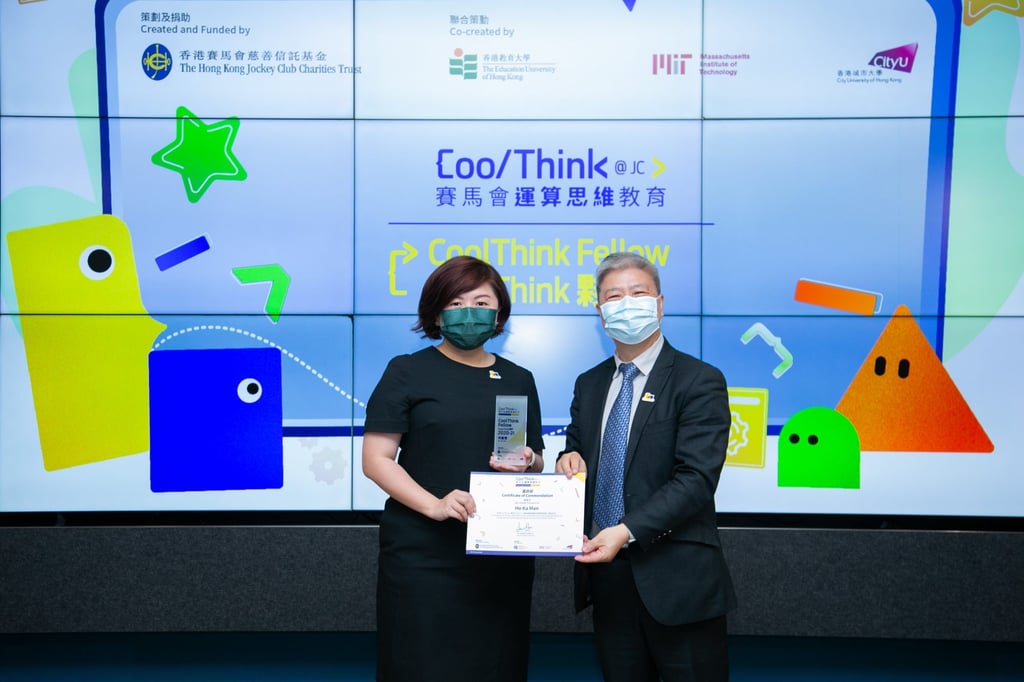
Empowering teachers
Ultimately, the value of computational thinking training for teachers goes beyond just the technical skills for coding. “It is key for our younger generation to be more creative, more innovative and more competent in collaborative problem-solving in order to be better equipped to face the challenges of the 21st century,” says Daniel Lai, Programme Director of CoolThink@JC.
“The Trust, through its proactive approach to initiate CoolThink@JC to introduce computational thinking into primary schools in Hong Kong, has successfully trained and empowered more than 1,000 teachers, who are identified as key agents to drive changes in the classroom,” Lai says.
Equipped with this new skill set, teachers – as a perfect example of how individuals are capable of taking their performance to the next level by embracing new knowledge – should be more than ready to enlighten and develop the next generation.
Seeking to inspire digital creativity among students and nurture their proactive use of technologies for social good from a young age, CoolThink@JC is a computational thinking education initiative created and funded by The Hong Kong Jockey Club Charities Trust, and co-created by The Education University of Hong Kong, the Massachusetts Institute of Technology and City University of Hong Kong.
Since its launch in 2016, the CoolThink@JC project has developed a three-year curriculum for upper primary school pupils with 14 class hours per school year. It has supported 131 primary schools and 810 teachers in Hong Kong, and targets to enable almost 100,000 upper primary school students to benefit from computational thinking learning.