A smart way to predict online buyers’ next purchase
- A new study proposes a new budget-conscious model for more accurate basket recommendations in online retail

[The content of this article has been produced by our advertising partner.]
When it comes to e-commerce, China stands unmatched. As the country’s online retailers like Alibaba, JD.com, and Pinduoduo compete both domestically and overseas, the key to winning market share may lie in providing users with seamless and hyper-personalised digital experiences.
From suggesting a shirt that matches the previously purchased jeans to predicting next week’s groceries, recommendation systems are paramount to creating customised retail experiences. While algorithms called next-basket recommendation (NBR) systems have made these suggestions more and more sophisticated, it is still common for users to see irrelevant products on the screen.
As consumers rarely buy items in isolation but shop in bundles, either to save on delivery costs and time, to reach minimum purchase quantities for a discount, or simply due to habit, keeping products in the virtual basket or cart before checking out is the norm. So far, the existing recommendation systems have only considered product choices at the item level and basket level by incorporating purchase patterns and history with users’ sequential behaviour across transactions.
“One critical factor that is often overlooked is the price,” says Francisco Cisternas, Senior Lecturer of Marketing at the Chinese University of Hong Kong (CUHK) Business School. “Price is a key factor in consumer decision-making, yet incorporating price into recommender systems is challenging due to its complexity, which varies across consumers and product categories.”
In a recent study titled Basket-enhanced heterogeneous hypergraph for price-sensitive next basket recommendation, Dr Cisternas and his co-authors introduced a novel approach that integrates price sensitivity, dubbed the basket-augmented dynamic heterogeneous hypergraph (BDHH). “We aimed to address this gap by incorporating price sensitivity and enhancing the connections among users, items and baskets to better align recommendations with real-world shopping behaviour,” he says.
Recommendations that enhance user experience
In developing the model, Dr Cisternas and research assistant in the same department, Zhou Yuening, along with Wang Yulin at Dalian University of Technology, Cui Qian at China’s largest movie ticketing app Maoyan and Guan Xinyu at China’s tech giant Tencent, construct a network where users’ past preferences, items and shopping baskets are all connected, especially considering prices, in a dynamic, evolving web.
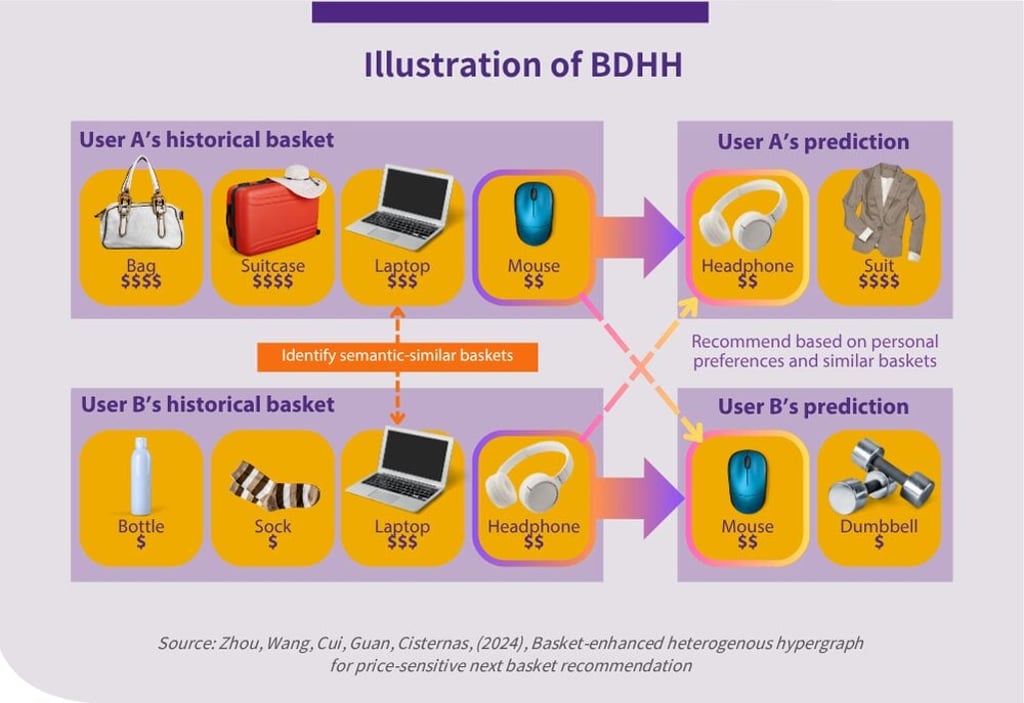
In practical terms, the system can understand that a particular user often buys a particular cereal when it’s on sale, or that another consumer tends to switch brands of liquid detergent depending on price fluctuations. This ability to recognise deeper purchasing patterns enables smarter basket predictions that align with individual budgets and tastes, which could then translate into an enhanced shopping experience for users.
“E-commerce platforms increasingly aim to deliver highly personalised experiences, and integrating the BDHH model can help achieve that by accounting for users’ price preferences,” says Dr Cisternas.
“Our empirical results showed that incorporating price sensitivity leads to better prediction accuracy compared to benchmark models, indicating its practical value. However, key challenges such as data availability, scalability, and maintaining model performance in real-time applications should be considered in future settings.”
Benefits for e-commerce
Beyond offering smarter product bundles to consumers, the benefits of BDHH could extend to the bottom line of businesses, too, especially when it comes to widely used online marketplaces.
For instance, accurate predictions of product combinations can aid in inventory planning and management, ensuring that frequently co-purchased items are stocked together, reducing both out-of-stock and overstock situations. Insights from the BDHH model can also inform targeted promotions and discounts, focusing on product combinations that resonate with specific customer segments.
As e-commerce continues to evolve, incorporating more sophisticated recommendation systems that increase customer satisfaction could also translate into higher rates of loyalty for brands and marketplace apps.
A step closer to understanding consumer behaviour
Beyond its immediate applications, the findings of this paper open the door for further exploration into consumer psychology and behaviour modelling. It raises questions about how factors like price perception, loyalty or external events like inflation or supply chain issues could be integrated into even more robust systems in the future. To keep up with these factors that influence shopping trends, Dr Cisternas highlights that machine learning models must be designed with adaptability and real-time learning in mind.
“Consumer behaviour is indeed dynamic, and static models can quickly become outdated. Approaches like online learning or time-aware embeddings can help maintain model relevance over time,” he adds.
Dr Cisternas also notes that the study could provide us with insights into other sectors where consumers make decisions. “Travel, subscription services and healthcare sectors also involve cost-sensitive choices. Our approach can support personalised recommendations and pricing in these areas by accounting for context and user-specific preferences.”
In the future, the research team is eager to explore other dimensions which could improve recommendation techniques. “Looking ahead, we are interested in exploring other dimensions such as promotional sensitivity, brand loyalty or temporal purchase patterns into recommendation techniques,” he adds.

Dr Francisco Cisternas is a Senior Lecturer of Marketing at CUHK Business School. He received his PhD in business administration (marketing) from Carnegie Mellon University and a BS in industrial engineering and MS in operations management from the University of Chile. His research focuses on modelling the interactions between the digital and physical channels using big data. His research applications include financial, sports and retail industries. Dr Cisternas’ work was awarded two research grants from the PNC Centre for Financial Services and Innovations and was distinguished with the Dipankar and Sharmila Chakravarti fellowship for his contributions to research in marketing.