Five Technology Predictions That Will Transform How We Live and Work by 2026

[The content of this article has been produced by our advertising partner.]
From AI companions fighting loneliness to quantum-safe security, these emerging trends will reshape business and society
The technology landscape is approaching a fundamental transformation. As we stand at the threshold of 2026, five key trends are emerging that will change how we work, learn, and connect with each other.
These predictions point to a future where "AI is in the human loop, not the other way around," creating opportunities to solve problems that truly matter while addressing unintended consequences of our hyperconnected world.
AI companions will redefine human connection
Loneliness has reached epidemic proportions, affecting 1 in 6 people worldwide. Social isolation increases death risk by 32%, while loneliness increases dementia risk by 31% and stroke risk by 30%. The crisis is particularly acute among the elderly, where 43% of adults aged 60 and older report loneliness.
The solution lies in companion robots that provide genuine emotional connection. Clinical evidence supports this approach: studies of companion robots found that 95% of dementia participants who regularly interacted with these companions had beneficial interactions, with measurable reductions in agitation, depression, and loneliness, plus decreased medication usage and improved sleep patterns.
"We're biologically hardwired to project intent and life onto any movement in our physical space that seems autonomous to us," explains technology research. This biological response creates the foundation for companion robots to provide consistent emotional presence that alleviates loneliness.
Research shows that between 50-80% of Roomba owners name their vacuum cleaners as if they're family members. When something moves freely and with purpose through our space, expressing what appears to be personality and intent, we instinctively respond by building relationships.
One documented case involves a disabled child whose family purchased a companion robot for support during periods when professional care wasn't available. The robot provided consistent presence and interaction, addressing critical care gaps while reducing emotional and financial burden on the family.

"The AI doesn't sit in budget meetings where leadership debates whether to optimize for cost or performance," the analysis notes. "It doesn't understand that the customer service system needs five 9's of uptime while the internal reporting dashboard can go down during peak sales periods."
Like Leonardo da Vinci, who "dissected cadavers to understand muscle structure, studied water flow to design canal systems, and observed birds to imagine flying machines" before painting the Mona Lisa, developers must become modern polymaths combining multiple disciplines.
The renaissance developer understands that systems are living, dynamic environments where changes ripple through services, APIs, databases, infrastructure, and people. They communicate with clarity that both humans and machines can build from, and they own the quality, safety, and intent of what they create.
Quantum computing demands immediate security action
Advances in error correction and algorithmic efficiency have compressed quantum computing timelines, making the window for proactive defense critically narrow. "Personal data, financial records, and state secrets are already being harvested by malicious actors betting on quantum's arrival."
Recent developments support this urgency. New quantum chips demonstrate hardware-efficient quantum error correction that reduced overhead by up to 90% compared to conventional approaches. Research shows error rates decrease exponentially with code distance, while frameworks for fault-tolerant quantum computing target 2029.
A research paper from May showed that 2048-bit RSA integers can be factored with less than one million noisy qubits, a 95% reduction from the 20 million estimated just six years earlier. "It's plausible that in about five years, there will be quantum computers capable of breaking the RSA and ECC encryption that secures the vast majority of internet communications, financial transactions, and your sensitive personal data."
Organizations must act on three fronts: deploying post-quantum cryptography where possible, planning to update physical infrastructure where they can't, and developing quantum-ready talent. Major tech companies are already deploying quantum-safe standards across key management services, certificate managers, content delivery networks, and security systems.
The UK Quantum Skill Taskforce report estimates that 250,000 new quantum computing jobs will be created by 2030, exploding to 840,000 by 2035. "Higher education alone cannot keep up with the rate of technological change."
Military innovation will accelerate civilian technology
Modern warfare has fundamentally changed. "War has changed over the course of my lifetime. Hand-to-hand conflict is now a last resort. Wars are fought from behind screens, hundreds, sometimes thousands of miles away, with controllers, keyboards, and clicks of a mouse."
Military investment in technology is surging, and the timeline from battlefield to civilian application is compressing. Historical examples include computer development for the Navy leading to business programming languages, military research giving us the internet and GPS, and radar technology evolving into air traffic control systems and microwave ovens.
The EpiPen originated from Cold War nerve agent antidote research, demonstrating how defense innovations become essential civilian technologies. This military-to-civilian technology transfer will accelerate, fundamentally reshaping infrastructure, emergency response, and healthcare worldwide.
Education will become truly personalized
The final prediction addresses education transformation. "For most of human history, only the wealthy could afford a personal tutor. That's about to change."
AI-powered personalized learning systems will democratize access to customized education that can "engage their curiosity, honor their individuality, and nurture their creativity." This represents a fundamental shift from one-size-fits-all education to truly personalized learning experiences tailored to individual needs and learning styles.
The transformation ahead
These predictions point to a future where we stand "at the threshold of a profound transformation in human-technology relationships" that will create "massive opportunities to solve problems that truly matter." The convergence of aging demographics, advanced AI capabilities, quantum computing maturity, defense innovation acceleration, and educational transformation creates what experts call "the perfect conditions" for revolutionary change.
"We are on the verge of something fundamentally different," the analysis concludes. "We've caught glimpses of a future that values autonomy, empathy, and individual expertise. Where interdisciplinary cooperation influences discovery and creation at an unrelenting pace."
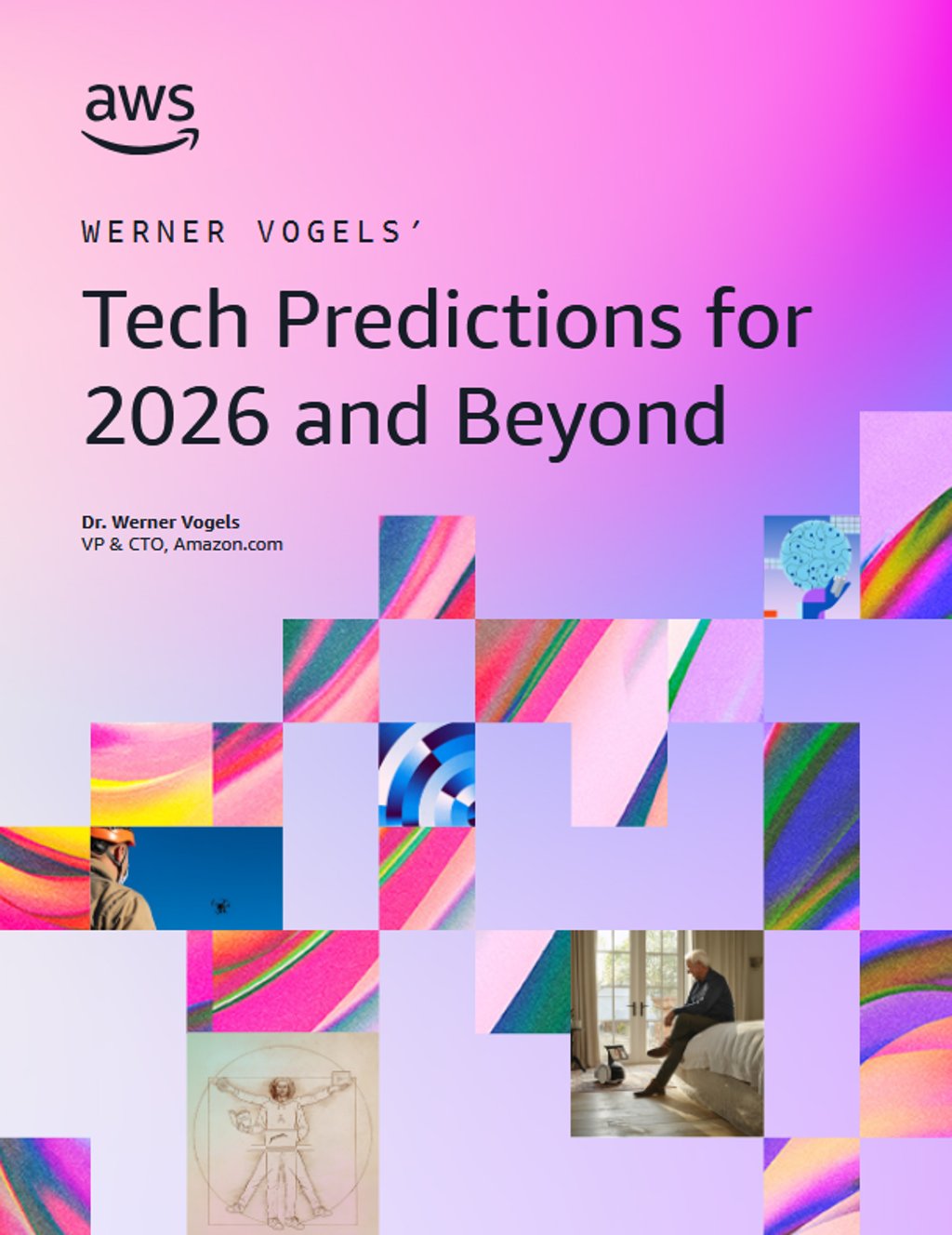
These predictions are based on analysis from "Tech Predictions for 2026 and Beyond" by Dr Werner Vogels, VP & CTO of Amazon.com. Download the ebook