AI begins to change how Hong Kong builds
- Speakers at Construction Industry Council's Master Talk say AI and robotics are starting to deliver measurable gains in productivity and site safety
.jpg?itok=MDjLKqDj)
[The content of this article has been produced by our advertising partner.]
Hong Kong’s construction sector is at a watershed moment, industry leaders say, as AI and robotics begin to deliver measurable gains in productivity and site safety, a view shared at the Construction Industry Council’s Master Talk on harnessing AI for the sector.
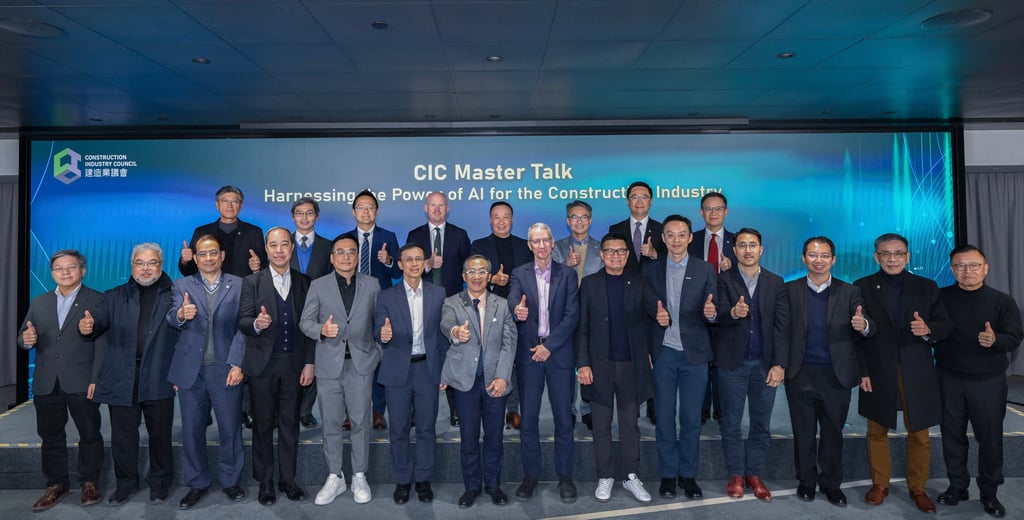
The Master Talk, held on January 22, brought together public clients, developers, contractors, consultants and tech firms to examine how AI and robotics are being applied across project delivery, infrastructure works and asset management, as well as the organisational and skills challenges that come with growing adoption.
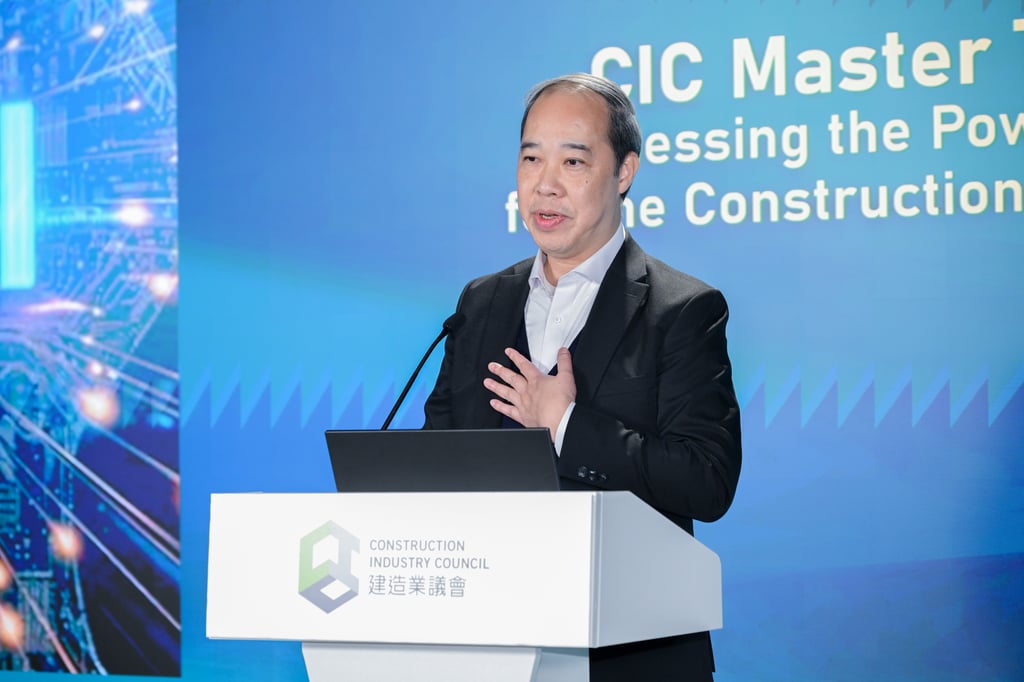
The construction industry has reached a point where limited trials and isolated pilots are no longer enough to deal with rising costs, labour shortages and delivery pressures, said Construction Industry Council (CIC) chairman Thomas Ho.
“AI is becoming part of daily practice across planning, design, safety and long-term asset management. The question now is how organisations apply it in a way that delivers results,” he told the audience.
Ho said the progress made in building information modelling (BIM) and digital twin applications over the past few years proved that the sector is capable of digital transformation when expectations are clear.
Government projects have already reached full BIM adoption, while take-up among developers, main contractors and subcontractors has continued to rise. AI, he added, is following a similar trajectory towards routine application.
“The technology is already there and is becoming more mature. What is holding some people back is leadership understanding, uncertainty about returns and whether teams are ready to work differently.”
A global AI and smart construction conference that includes an exhibition and AI award presentation is also scheduled for June this year, which will bring overseas solutions and suppliers to Hong Kong.
“The focus this year will be on helping firms advance from early experimentation, particularly small and medium-sized contractors that often lack the resources to assess new tools independently,” said Ho.
Access to funding and shared platforms is key to that effort, with existing innovation schemes having helped but not yet reaching enough of the supply chain.
Closer collaboration with tech providers is also needed to shorten adoption cycles and reduce risk for smaller firms, with public funding better used to lower entry barriers rather than support one-off trials.
Government policy is increasingly aligned with that approach, with requirements on robotics, digital tools and AI-supported systems creating a clearer business case for investment.
“The next stage will be to align those requirements more closely with skills development, procurement practices and project governance, so that technology use translates into tangible improvements on site rather than additional layers of reporting,” said Ho.
Henderson Land has reduced costly design changes on large private-sector projects through tighter design control, standardisation and BIM-led workflows, driven by process discipline rather than automation alone.
.jpg "Organisations are beginning to manage AI “agents” alongside human teams, says Fred Sheu, national technology officer at Microsoft Hong Kong.")
He said AI was beginning to alter job roles rather than eliminate them, with employees increasingly expected to direct and review automated processes. Organisations that delayed adoption, he reminded, risked losing ground to peers that treated AI as part of core operations rather than an experimental add-on.
.jpg "AI delivers the strongest results when combined with domain expertise and revised working practices, says Will Cavendish, global digital services leader at Arup.")
He said AI delivered the strongest results when combined with domain expertise and revised working practices. In design and engineering work, bespoke systems trained on project and engineering data were often required, rather than generic platforms.
Steve Lewis, partner & head of infrastructure at EY, said fragmented data remained a major constraint across construction and infrastructure delivery, inevitably slowing decision-making and limiting the use of advanced tools.
He said AI could be used earlier to organise and connect data sets, so organisations can work with incomplete or unstructured information and there is no need to wait for fully standardised data before deploying new systems.
Several other tech start-ups also presented applied AI tools already in use on construction and infrastructure projects.
Their demonstrations included camera-based systems for site safety and equipment monitoring, drone-enabled progress tracking integrated with BIM models, and predictive platforms designed to flag cost and programme risks earlier in the construction process.
Other solutions focused on integrating data across design, procurement and site operations to reduce manual reporting and support day-to-day decision-making.