Hong Kong on its way to becoming a global leader in computational thinking education
- Study finds the city is on par with Singapore, the UK and mainland China in this area of education, after making significant progress in recent years
- The CoolThink@JC programme, created and funded by The Hong Kong Jockey Club Charities Trust, distinguishes itself from other initiatives worldwide

[Sponsored article]
Computational thinking skills not only enhance problem-solving capabilities, but also are considered a necessary skill for the 21st century, as the coming future promises a range of new ideas made possible by advances in technology.
With the increasing emphasis placed on computational thinking education over the past decade, the international community has been allocating a great deal of educational resources to the subject.
“Many jurisdictions have introduced or revamped their STEM education to prepare their citizens for an ever more complex and fast-changing future. Hong Kong is no exception,” says Leong Cheung, Executive Director of Charities and Community at The Hong Kong Jockey Club.
While it became a global trend to equip the younger generation for the future by teaching computational thinking skills, the subject remained relatively neglected in Hong Kong until 2016, when the CoolThink@JC education programme was launched. This programme, created and funded by The Hong Kong Jockey Club Charities Trust, aims to provide quality computational thinking education to upper primary school students across the city.

Answering Hong Kong’s need for future-proof education
Now that this area of education is developing locally, how does Hong Kong match up with the rest of the world? According to a study conducted by SRI International, a US-based research institute, and commissioned by CoolThink@JC, computational thinking education in Hong Kong is comparable to that offered in Singapore, the United Kingdom and mainland China.
“Hong Kong, currently matched up with other jurisdictions which have benefited from a head start, has made tremendous progress in the area of computational thinking education since 2016,” says Linda Shear, an Independent Evaluator for CoolThink@JC and Director of Commercial and International Strategy at SRI Education.
“The priority of computational thinking education over other skills in technology education at a primary level, guidance from the government and comprehensive professional development are some of the features of computational thinking education initiatives shared across all jurisdictions, including Hong Kong,” Shear adds.
In the UK, for example, computational thinking was incorporated into its compulsory primary school curriculum in 2014. The same year, Singapore launched its Smart Nation Initiative to drive digital transformation, under which ICT (information and communications technology) education was redesigned to develop the computational capabilities of students. In Hong Kong, however, learning computational thinking is encouraged but not mandated within the framework of the school curriculum.
CoolThink@JC fills this gap by delivering computational thinking education to upper primary school students in the city, working together with schools to deliver lessons that can help students prepare for a new digital age.
Hong Kong’s Education Bureau encourages the implementation of computational thinking education. In 2020, it updated its supplement titled “Computational Thinking – Coding Education: Supplement to the Primary Curriculum”, which recommends that schools allocate 10 to 14 hours of teaching time to the subject in upper primary schools.
Programme’s distinguishing features
The study also highlighted the distinguishing features of CoolThink@JC that make it stand out from computational education programmes in other locations around the world.
Katrina Laguarda, Director of Teaching Quality Research at SRI Education and lead author of the study, says: “CoolThink@JC is built on a fully articulated course sequence and set of curriculum materials, with aligned professional learning, which helps to ensure that all students experience high-quality computational thinking instruction.”
She adds: “CoolThink lesson sequences are intended to be taught essentially as designed. This materials-driven approach makes CoolThink@JC unique among other benchmarking jurisdictions highlighted in the study, as others rely on commercial vendors or require teachers to select from a wide range of options, which may result in variations among teachers and schools when it comes to selecting materials.”
“It is encouraging to hear from SRI International’s benchmarking study that CoolThink@JC, with The Hong Kong Jockey Club Charities Trust’s forward-looking vision, has now elevated Hong Kong’s computational thinking education to be among the global leaders, and even distinguishes itself in areas like teachers’ professional learning and support,” Cheung says.
The high standards of the programme’s design, curriculum and pedagogical approach have earned international recognition. CoolThink@JC has won multiple accolades in the education sector, including the Seal of Alignment from the International Society for Technology in Education. The QS Reimagine Education Awards – a global competition that calls itself the “Oscars of education” – awarded the programme silver in its Engineering & IT category, and bronze in its Presence Learning and Teaching category.
According to Laguarda, other distinctive features of CoolThink@JC include the use of its materials in teaching preparation programmes for primary pre-service teachers, and its robust parent outreach and education campaign.
To raise the profile of computational thinking education in the wider community, one of CoolThink@JC’s co-creators, City University of Hong Kong, runs regular workshops aimed at educating parents on the concepts and importance of computational thinking, as well as summer camps that offer students the opportunity to learn more about this skill.
In addition, CoolThink@JC is the only computational thinking education programme featured in the study that has publicly reported on its student outcomes at the primary level, drawn from evidence-based evaluations. It has built a foundation of valuable research that includes findings from a pilot phase impact study as well as an implementation study during the programme’s scaling-up phase, both of which were conducted by SRI International.
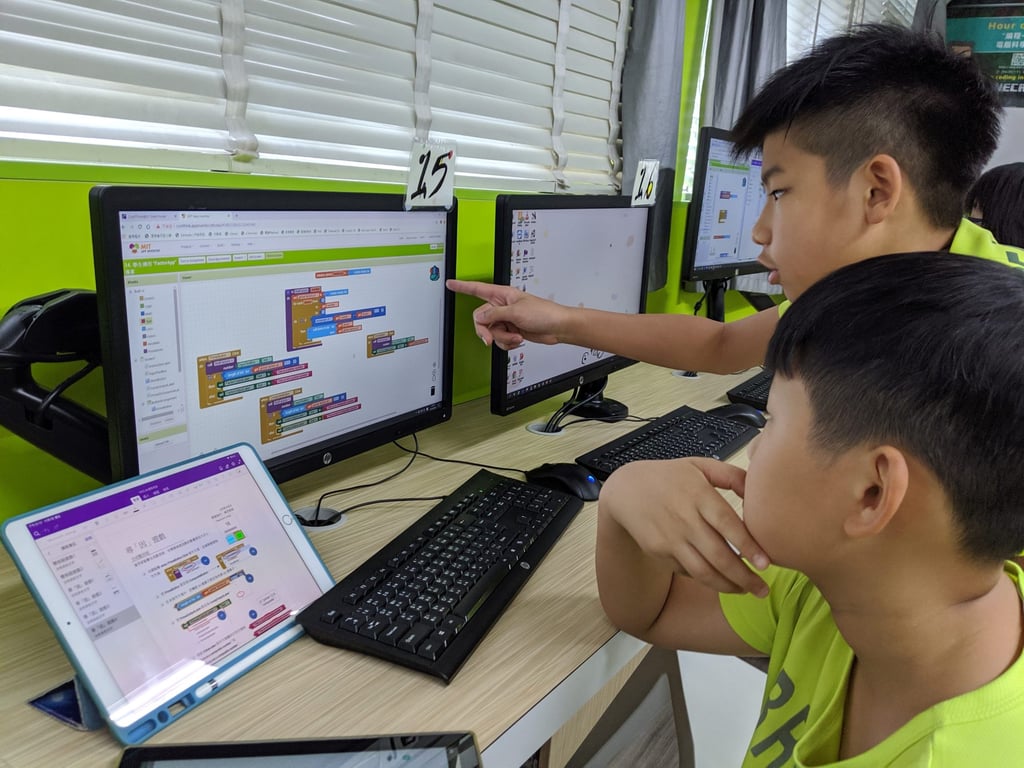
Next steps for city’s computational thinking education
While the strengths of the CoolThink@JC programme are evident, certain steps still need to be taken to solidify Hong Kong’s status as a global leader in computational thinking education.
According to Laguarda, it is necessary to position CoolThink@JC as a part of a vertically aligned computational thinking education progression that covers both primary and secondary schools. It is also necessary to plan artificial intelligence education, as Hong Kong lags behind in this area compared to other countries and territories that have already established strategies to address this necessity.
In addition, teacher networks and teacher professional associations need to be further expanded in order to leverage the experience found elsewhere in the world. Laguarda notes: “It will also be important for CoolThink@JC to continue paying attention to implementation as it scales, to ensure that more students are continuing to get the same opportunities that were proven successful in the pilot phase.”
Kai-ming Cheng, Emeritus Professor at the University of Hong Kong, says: “All of these efforts require further collaboration between cross-sector coalitions of government agencies, schools, private-sector companies, teachers’ associations and other non-governmental advocates – though this is an area that Hong Kong and CoolThink@JC are excelling in at this moment.”
He adds: “Cross-sector collaborations between schools and institutions in the community have been on the rise. These social institutions are extremely eager to participate in these different projects, and to make a positive impact on society. A new form of education, which provides students with learning opportunities outside the traditional classroom, can be created this way.”

As CoolThink@JC looks to strengthen its collaboration with different entities in order to accelerate computational thinking education in Hong Kong, it also finds itself in a prime position to help raise the city’s international standing in this area of education.
This is precisely the wish of the CoolThink@JC programme, which is ready to help Hong Kong take the next step towards becoming a global leader in computational thinking education.
Seeking to inspire digital creativity among students and nurture their proactive use of technologies for social good from a young age, CoolThink@JC is a computational thinking education initiative created and funded by The Hong Kong Jockey Club Charities Trust, and co-created by The Education University of Hong Kong, the Massachusetts Institute of Technology and City University of Hong Kong.
Since its launch in 2016, the CoolThink@JC programme has developed a three-year curriculum for upper primary school pupils, with 14 class hours per school year. It has supported 131 primary schools and 810 teachers in Hong Kong, and targets to enable almost 100,000 upper primary school students to benefit from computational thinking learning.