AI- and new-tech-powered innovations by local youngsters take centre stage at the Hong Kong Science Fair
- With a record-breaking 58,000 visits by eager members of the public over two days, the event shone a spotlight on creative and practical solutions to everyday challenges.

[The content of this article has been produced by our advertising partner.]
A much-anticipated celebration of Hong Kong’s dynamic innovation and technology (I&T) ecosystem, the Fourth Hong Kong Science Fair spotlighted youth creativity, purpose, and technological ingenuity with the power to shape the future. Connecting the public with next-generation innovators, the event underscored both the growing influence of artificial intelligence (AI) and the determination of young minds to tackle today’s most pressing challenges through technology. Over the years, the Science Fair has established itself as a platform that inspires creativity and fosters knowledge exchange.
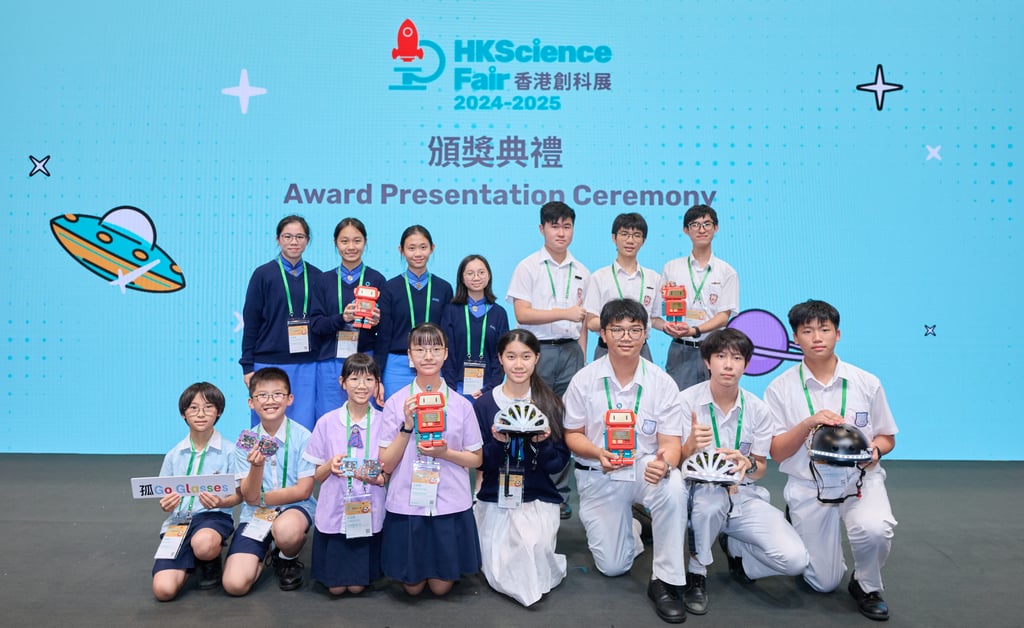
Chairman of the HKIF and Deputy Chairman of Sino Group, Mr Daryl Ng, said at the ceremony: “We believe in fostering an innovative spirit from an early age. Over the years, ‘Hong Kong Science Fair’ has been a platform that inspires creativity and fosters knowledge exchange. While AI technology is advancing rapidly, human creativity and imagination remain irreplaceable. It is encouraging to see students using technology to improve the quality of life and assist those in need, bringing joy to others.”
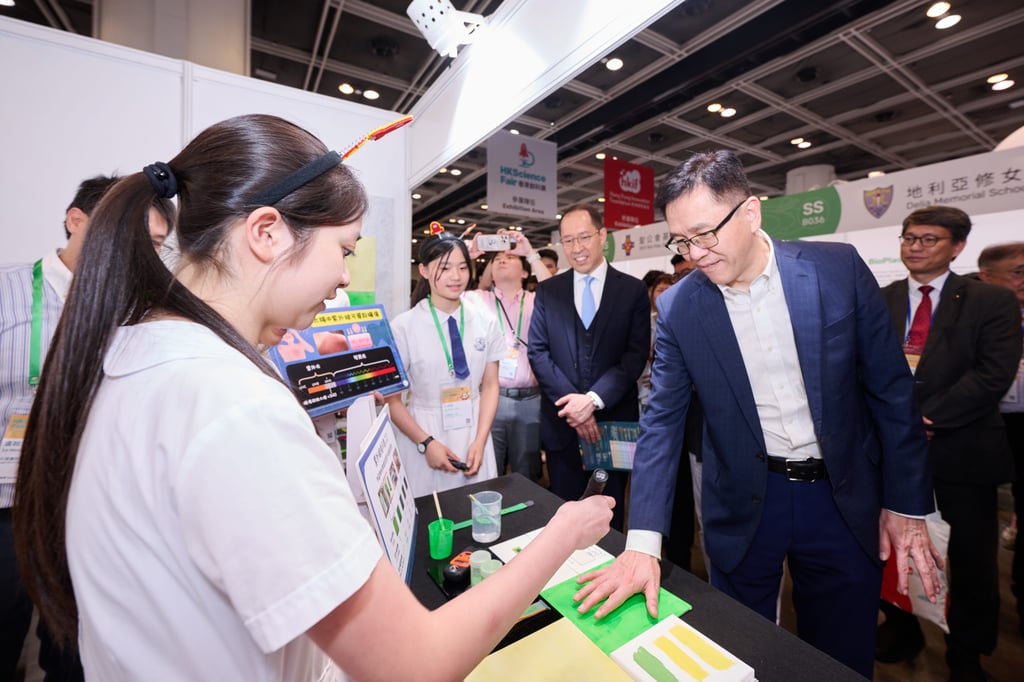
Executive Council convenor Mrs Regina Ip, and President of the Jury for the International Exhibition of Inventions Geneva, Mr David Taji-Farouki, participated in a sharing session during the ceremony.
Mr Taji-Farouki expressed his admiration for the students’ ability to incorporate AI into their project development. “It’s a natural evolution in innovation. Many teams leveraged AI to access large datasets and generate the statistics needed to advance their projects,” he noted. “They also applied AI in practical and creative ways to address the challenges they identified, demonstrating a diverse range of applications.”
In addition to AI application, Vice-President (Research) at City University of Hong Kong, Professor Anderson Shum, who was on the judging panel of the Science Fair, highlighted students’ motivation to improve the quality of life for those in need by developing highly feasible solutions to address challenges such as hearing and vision impairments, as well as other pressing issues like sustainability. “This aligns with Hong Kong’s goal to become an I&T hub,” he said.
Creative solutions to challenges
A wave of creativity and innovation – deeply relevant to daily life – swept through the event as students showcased their projects.
In the Primary Division, the Gold Award went to “孤 Go Glasses”, developed by a team from Christian Alliance H.C. Chan Primary School. These smart spectacles were designed for visually impaired individuals, equipped with an AI-powered lens called HuskyLens to identify specific locations and bus numbers, and a micro:bit device to emit audio signals. “Leveraging machine learning, we’ve been increasing the number of location images recognised by the spectacles,” explained team member Kong Cheuk Kiu. “Some visually impaired visitors tested the glasses at the Science Fair and found them helpful. They encouraged us to keep expanding the image database.”
Inspired by a traffic accident involving their peers, students from SPHRC Kung Yik She Secondary School created the “夜騎光盾”, which earned the Gold Award in the Junior Secondary Division. This smart safety helmet features a night lighting system, brake warnings, and turning signals. It's equipped with LED strips, an accelerometer to detect motion, and a light sensor to measure brightness. Team member Lin Kwing Fai recalled the dedication behind their design process: “To fine-tune the turning function for riders of different heights, three of us conducted multiple trial runs after dark – one riding the bicycle, another monitoring real-time data, and the third analysing the results simultaneously. Each trial took up to three hours.”
Two projects tied for the Gold Award in the Senior Secondary Division. One of them, “PARKnSAVE” by a team from St. Stephen's Girls' College, uses AI to enhance sustainability and space efficiency in car parks. “Initially, we designed the system purely from a user’s point of view,” said team member Kandice Wong. “But we later included the operators’ perspective and found that by installing affordable tools like cameras and navigation lights, we could help transform conventional car parks into smart ones – maximising the system’s potential benefits.”