From boardrooms to the communities
- FWD is redefining employee engagement and corporate responsibility by partnering with local NGOs to tackle the city’s needs.

[The content of this article has been produced by our advertising partner.]
More than an act of giving, volunteering is a powerful catalyst for connection and collaboration.
For FWD, a pan-Asian insurer with more than 12 million customers across 10 markets, incorporating volunteering into its corporate culture has proven to be a win-win-win for employees, the organisation and the broader community.
The results from a partnership with HandsOn Hong Kong, a charity that mobilises volunteers for social impact, are evident.
Through joint initiatives such as a recent furniture-making for families in subdivided flats and school beautification projects, FWD has redefined what it means to “celebrate living” for both its customers and employees.
Volunteering as catalyst for team building
The partnership's origins can be traced back to a challenge many companies face post-Covid: rebuilding connections among a dispersed workforce.
“We wanted something meaningful that could connect employees on a deeper level while creating a tangible impact on society,” said Julie Chow, FWD’s group chief human resources officer.
It was this vision that led FWD to HandsOn Hong Kong, with one of the recent collaborations being a volunteering programme that united nearly 200 FWD employees.
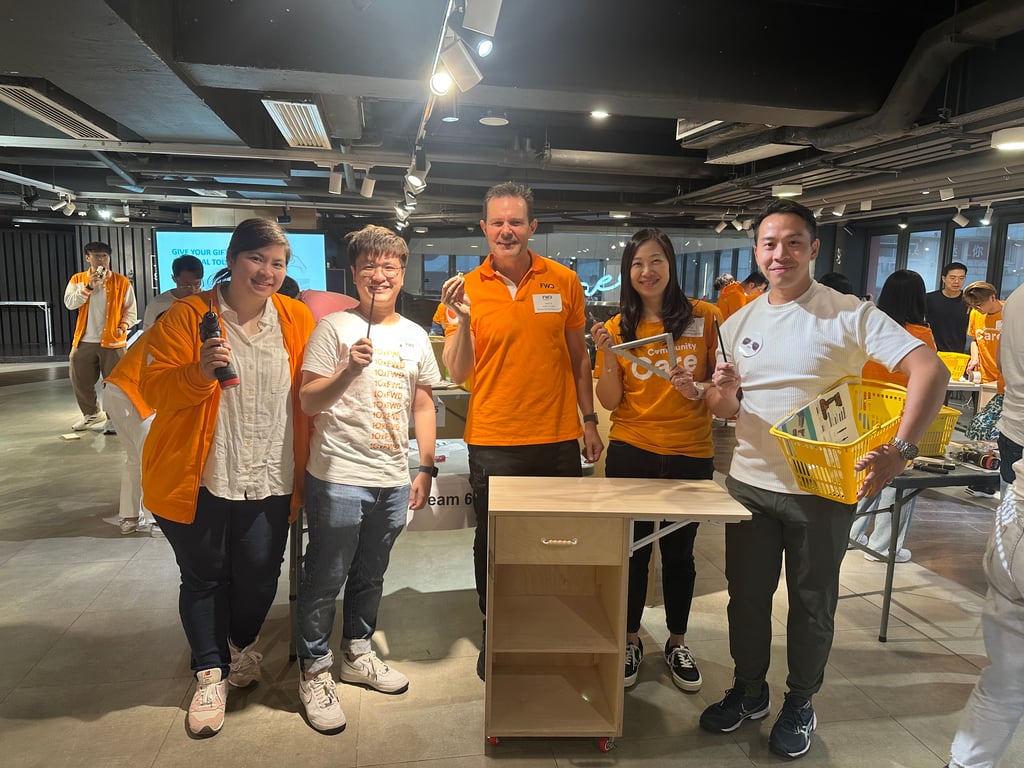
According to Chow, the experiences fostered unexpected connections.
“Employees who had never conversed before found themselves collaborating, passing each other tools, and building something meaningful together,” she recalled.
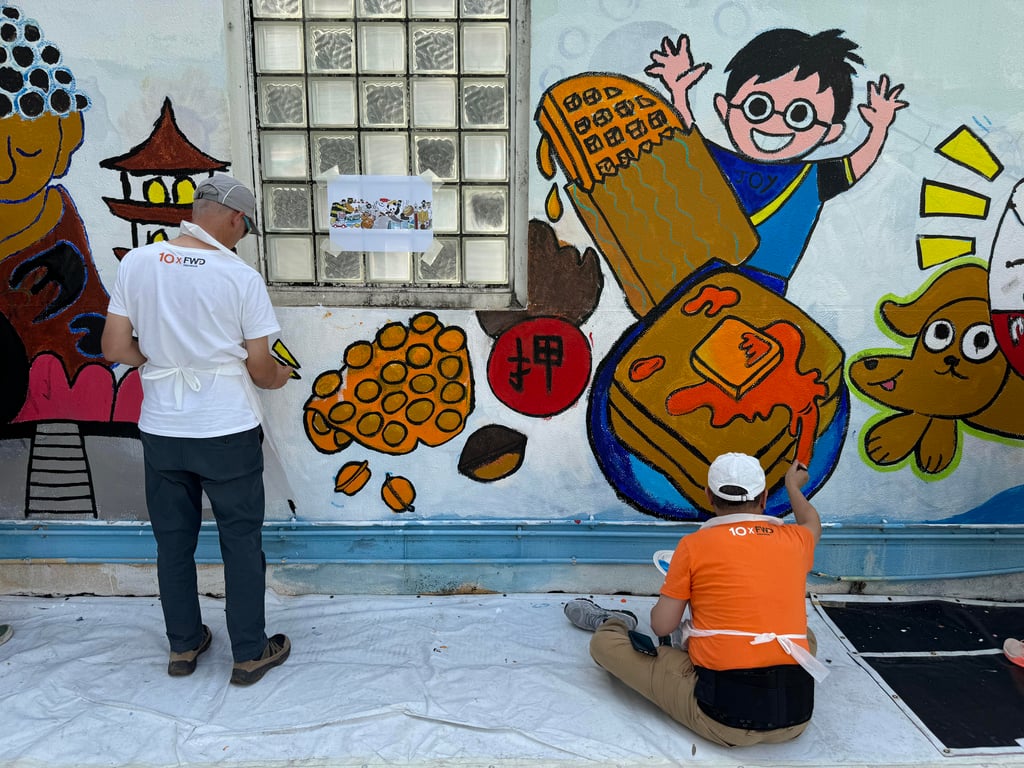
For FWD, community engagement is not an afterthought but a cornerstone of its corporate philosophy, with caring being one of its core corporate values.
“As an insurer, our purpose is intrinsically linked to societal value. We don’t see this as balancing work and volunteering – it’s integral to who we are,” said Cathy Knezevic, FWD’s group chief corporate affairs officer.
“When leaders roll up their sleeves and join in, it sets the tone for the rest of the organisation,” she said, adding that scheduling volunteering during work hours reflects FWD’s commitment to integrating Community Care into its culture.
Encouraging employees to take time out of their busy schedules to participate in volunteer work came with its challenges.
“Hongkongers often feel they don’t have enough time,” said Catherine Tong Dannaoui, executive director of HandsOn Hong Kong.
“We conducted a study and found three main barriers: people feel they don’t have enough time, don’t know where to start, and don’t believe they will make an impact. Addressing these barriers is key to getting people engaged.”
“But through corporate partnerships like this, we’re able to create opportunities that fit into people’s lives, showing them how they can make a difference.”
“This human touch is irreplaceable,” said Tong Dannaoui. “It’s about making time for others and rediscovering the power of connection in an increasingly automated world.”
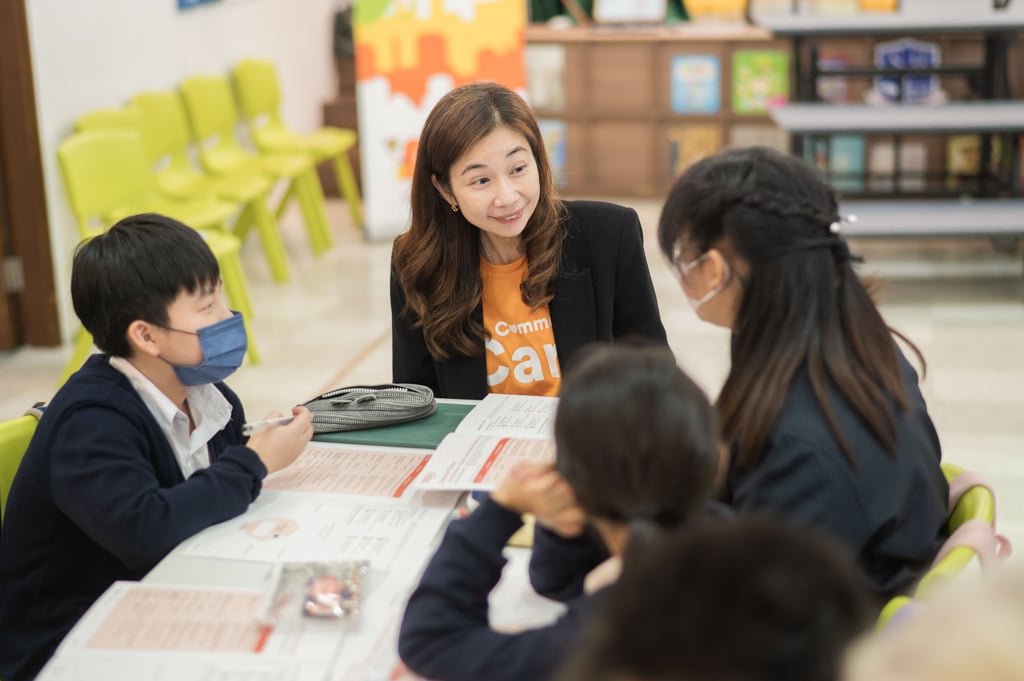
The benefits of FWD's community engagement extend beyond the impact on beneficiaries. Employees feel a deeper connection with their colleagues and a stronger alignment with the company's values.
A post-event survey revealed that over 80 per cent of participants wanted similar initiatives to continue, with many citing a renewed sense of purpose and belonging.
For Chow, these outcomes are deeply rewarding. “HR isn’t just about policies and payroll. It’s also about helping people achieve something meaningful,” she said, reaffirming her belief that people are the organisation’s greatest asset.
The programme has fostered a profound sense of collective pride. "FWD is a nurturing ground where employees can flourish both personally and professionally, all while making a genuine impact," said Chow.
Bridging the gap
The FWD-HandsOn partnership serves as a model for others, showing how pooling resources and expertise can tackle social challenges while enriching corporate culture, said Chow.
“Shared values and mutual respect are key. When both sides are equally invested, the outcomes are truly impactful,” Knezevic added.
Looking ahead, opportunities for more collaborations remain.
In terms of ideas for future initiatives and partnerships, Tong Dannaoui hints at providing skills-based support to other small charities.
“We’re always exploring new ways to create lasting change,” she said.
Empowering the next generation through financial literacy
Alongside community initiatives that support different underprivileged social groups, FWD is also advancing financial literacy education, an integral part of its broader Community Care programme.
FWD’s signature financial literacy programme, JA SparktheDream, was launched in 2021 in partnership with Junior Achievement Asia Pacific, a member of JA Worldwide which is the world’s largest youth-serving NGO since 1919. The initiative, which began in Hong Kong, has since expanded to eight markets, reaching over 25,000 students in just a few years, according to Knezevic.
Through a blend of classroom lessons led by FWD volunteers and real-world challenges, the programme equips young people with lifelong financial skills often missing from traditional curricula in schools around the world.
"There is a strong correlation between financial literacy and economic growth," Knezevic remarked.
The programme further includes a regional competition where students apply their knowledge to solve social challenges, showcasing the creativity and potential of young minds.
