What It Will Take to Recover, Rebuild, and Reinvigorate from COVID-19
At CUHK Business School’s Global Alumni Forum 2020, business leaders and thinkers shared what it will take for the world to recover, rebuild and reinvigorate amidst the disruption brought about by COVID-19
[Sponsored Article]
The spread of the coronavirus has put a dampener on economic growth and disrupted business activity around the world, but that just makes it even more important for current and future leaders to look forward and adapt as well as innovate to overcome the challenges brought about by the difficult environment.
Within adversity lies opportunity, and due to the enactment of social distancing measures, the event this year was transformed into a global gathering of CUHK Business School alumni in the form of three online webinars on consecutive weeks in as many languages. It was attended by past CUHK Business School students from China, Hong Kong, and across the globe from Singapore, Korea, to the UK and the US. For the first time, it was also opened for the stakeholders of CUHK Business School eager to find out exactly what is the “special something” that sets graduates of CUHK Business School apart from the rest.
Out with the Old and In with the New?
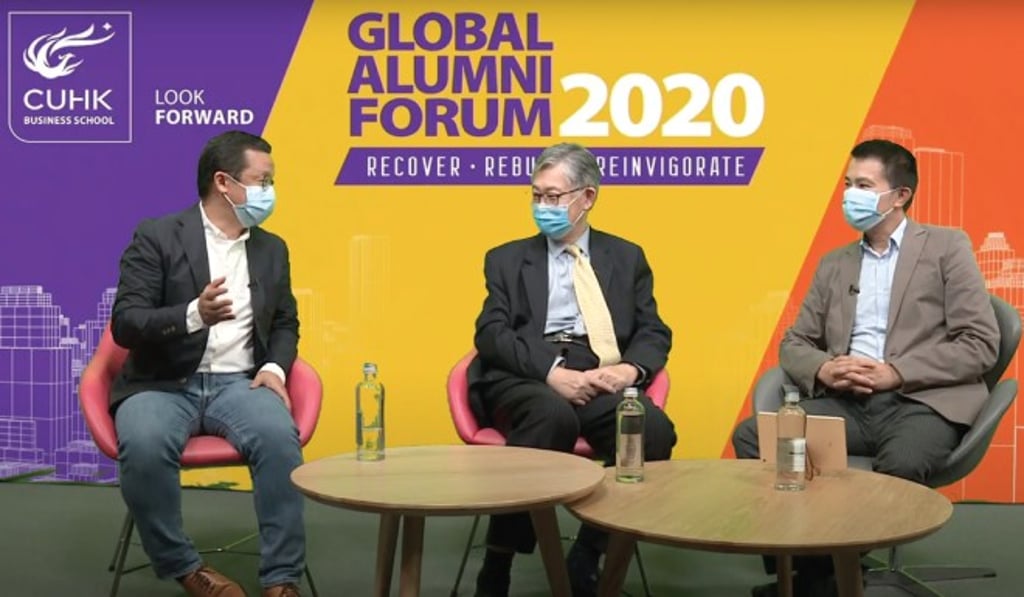
“Successful companies often indulge in their past glories, so they are less willing to change,” said Mr. Shih. “A positive thing about the pandemic is that it pushed us to improve.”
Mr. Shih said traditional industries in Hong Kong, including real estate agencies, can consider switching to an “Internet+” model, referring to using the internet to provide extra services to complement conventional business activities. For example, his company has started using virtual reality technology for online property listings.
On the other hand, Mr. Wong, who launched Hong Kong’s biggest online shopping platform, HKTVmall, said that despite his success in the “new economy”, the old and the new are actually complementary.
“For example, if you want to be an Uber driver, you still need to have an actual car. Technology just adds another layer to the existing business model,” Mr. Wong said. “The most important thing is you need to imagine what the world will be like after 10 years. We cannot stop the development of technology. But we can change ourselves to adapt to the future.”
China’s Economic Growth under COVID-19 and its Relationship with the US
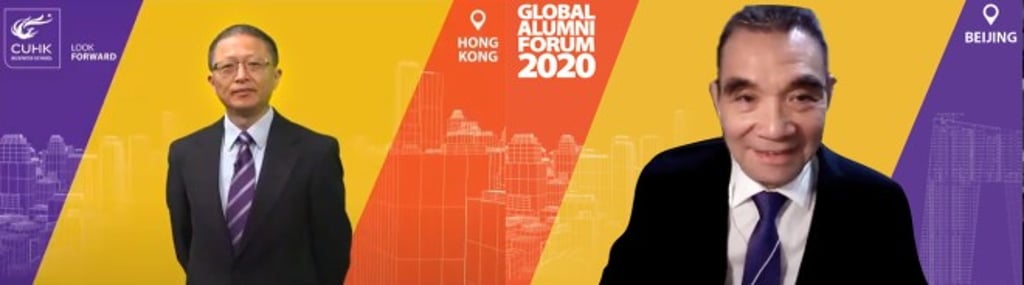
“Next year will be full of uncertainty. If the COVID-19 vaccine can be ready for not only for one or two countries, but for all those affected, then I think China’s GDP will grow at a relatively fast pace,” Prof. Lin said, citing figures published by the International Monetary Fund (IMF) that projects an 8.2 percent growth for China in 2021.
Although the fight against the coronavirus has hindered the growth of China’s economic development, Prof. Lin highlighted that it is friction between the US and the Asian economic giant that stands to affect global economic recovery on a more significant level. He said the world must be prepared that friction between the two superpowers may continue in the near term, even with the inauguration of a new US president in Joe Biden.
“The real problem between China and the US is resistance from the existing leading superpower against the fact that it is likely to be surpassed by another. The new US president may make use of more civilised rhetoric, but the essence of the problem would not change,” said Prof. Lin.
Prof. Lin pointed out that an economic decoupling between China and the US would not be advantageous to the latter nor to other western countries because China is the main market for their products, especially in technology. To cope with this ongoing friction, Prof. Lin said China should continue to maintain development at a fast pace, as well as deepen its economic reforms and opening-up policies. Above all, China must seek to increase its GDP per capita, which is an important indicator of people’s living standards and the country’s overall economic development.
The “Globotics” Upheaval

Using a new term he coined called “globotics” (an amalgamation of the buzzwords globalisation with robotics), Prof. Baldwin explained that digital technology is accelerating the evolution of white collar and professional work due to increased automation and globalisation.
This is affecting both the higher value-adding white collar jobs from legal and medical services, to journalism and finance, to more mundane roles such as data entry. And while businesses have faced offshoring and automation in the past, the current wave is different in that not only is it affecting white collar professions for the first time, but it has been accelerated by the spread of COVID-19.
The increasing sophistication and application of machine learning has also opened up these higher value jobs to be automated, since computers have made marked strides in conducting more complex tasks such as recognising natural speech and translating foreign languages in the last five years.
“Telemigration and software automation will transform almost every service job in some way but replace very few because there’s always something that they can’t do,” said Prof. Baldwin. In the short to medium term, it will create some hardships as jobs are being displaced by these new technologies faster than other jobs are being created. “The good news is that new jobs will appear, as they have done so in the past,” Prof. Baldwin said, adding that new opportunities will appear in roles that cannot be automated or offshored.
These include “human” roles such as those requiring strong creativity, grasp of ethics, the ability to deal with unknown situations, managing and motivating large groups of people, or the showing of empathy. Opportunities will also arise in jobs that cannot be done remotely, he added.