EdUHK degrees ensure high standards for future teachers

[Sponsored Article]
As part of its mission to train future primary and secondary school teachers, the Education University of Hong Kong (EdUHK) aims to provide a good balance of theory and practical experience.
The key is to introduce students to the principles of pedagogy, lesson planning, classroom management, child psychology, and methods for teaching the curriculum subjects in which they plan to specialise.
Alongside these principles, there are multiple opportunities for semester-long and short-term placements at primary and secondary schools in Hong Kong and for international exchanges.
These are crucial, not just for the exposure they give to real-life situations and different types of classroom environment, but also because they provide essential insights on what works, what doesn’t, and how things are done in other parts of the world.
Taken together, the various elements ensure EdUHK graduates emerge with the all-round knowledge and basic professional competencies needed to instruct, engage, adapt to circumstances, and impress prospective employers.
That latter consideration is currently looming large for Iris Leung Lok Yiu, a Year 5 student in the final few months of a Bachelor of Education (Honours) degree in English Language. Like her contemporaries, she is weighing up job options, but holds firmly to the belief that working in education is a way to make a clear positive impact.
“It is a chance to do something really worthwhile and to change people’s lives,” says Leung, who is putting the finishing touches to an honours project on how about life education and life planning education function in Hong Kong. “One of the best things about our programme is that we are always treated as “teachers to be’, even when taking the more theoretical psychology, linguistics or grammar courses. And we’re expected to think about the purpose of learning within the structure of any lessons we teach.”
With this in mind, a particular favourite of hers was the course on rethinking and reimagining education. It encourages students to suggest ways to make primary and secondary classes more fun and more progressive. And it asks them to design their dream school, which best represents the ideals they feel are most important.
Covid restrictions unfortunately meant Leung could not travel overseas for the usual immersion programme. However, from May to August last year, she was able to link up with a university in Wellington to regularly observe the classes of a fully online school in New Zealand. It was possible to put “live” questions to the teaching assistant and, after most classes, to speak with the teacher as well.
“I loved this part of the course,” says Leung, who is studying with the support of a government-funded scholarship. “You could feel what was happening there and see it really works. It is nice to know some countries can do online teaching so well.”
Subsequently, between mid-August and December, she taught English at a Sha Tin secondary school as a field experience assignment. For the Form 1 classes, the focus was on plural forms and phrasing questions, and there was a lot to catch up on after time missed through Covid, For Form 3, the priority was spoken English, which involved game-based tasks, steering discussions, or simply getting the children to talk.
“EdUHK tells us it's important that our students can relate what they are learning to their lives,” Leung says. “They tried hard and, sometimes, even told me what could be done better.”
For Navpreet Kaur, who is in Year 5 of a double degree which combines a BA (Honours) in Language Studies with a BEd (Honours) in English Language, the choice of programme was very much guided by future career considerations.
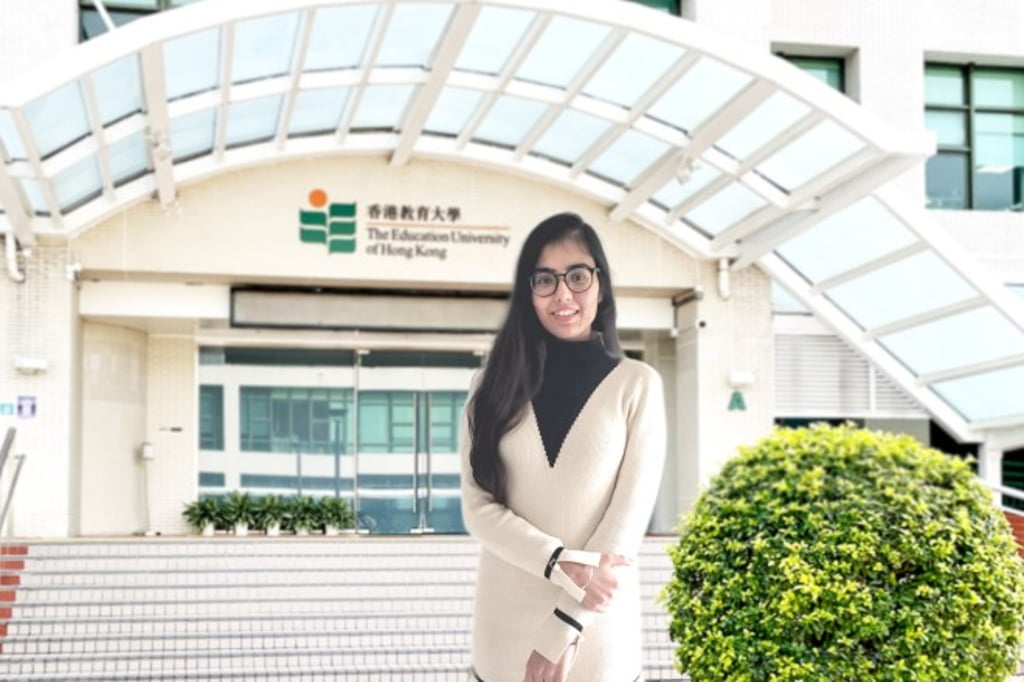
At one point, she had thoughts of being a nurse, but realised, without fluent Cantonese, it might be difficult to take that path in Hong Kong. Instead, she opted for a BA which looks at the language components of how communication works and how English is evolving, and a BEd which focuses more on the pedagogy aspects of how you actually teach.
“I’ve learnt a lot and I’m very satisfied with the way things have gone,” says Kaur, who originally entered EdUHK via the JUPAS route. “At university, we are encouraged to be innovative, but during teaching practice, the reality is that you are young and new. You have to understand there is a system and do what the other teachers ask.”
She had field experience at primary and secondary schools, both in Ngau Tau Kok, and there were certainly some unexpected challenges. For instance, the Form 5 secondary students were not that proficient in English and often needed clarification or further explanation in their first language.
“I tried to make changes if I saw things were not working,” Kaur says. “I gave ideas and useful vocabulary, and I focused on making them use English to describe their emotions. Doing that creates extra interest and motivation. It gives context and a purpose for using the language in everyday life, not just in class.”