Experts at the “Doing Good and Doing Well with EdTech Workshop” say cross-sector and cross-border partnerships help bolster EdTech development in Hong Kong
• For a robust EdTech ecosystem to emerge in Hong Kong, it is essential to foster cross-sector partnerships that involve public sector, foundations, and educational organisations, among others.
• Establishing cross-border collaborations can facilitate transfer of knowhow and build local expertise.

[The content of this article has been produced by our advertising partner.]
The untapped potential of EdTech in driving educational innovation in Hong Kong remains significant. Among the key challenges faced by many EdTech startups is their hybrid nature, which necessitates a balance between profit-making and a strong emphasis on social impact. This balance is crucial as businesses strive to establish a sustainable model. However, it has also made it challenging for EdTech ventures to raise funding.
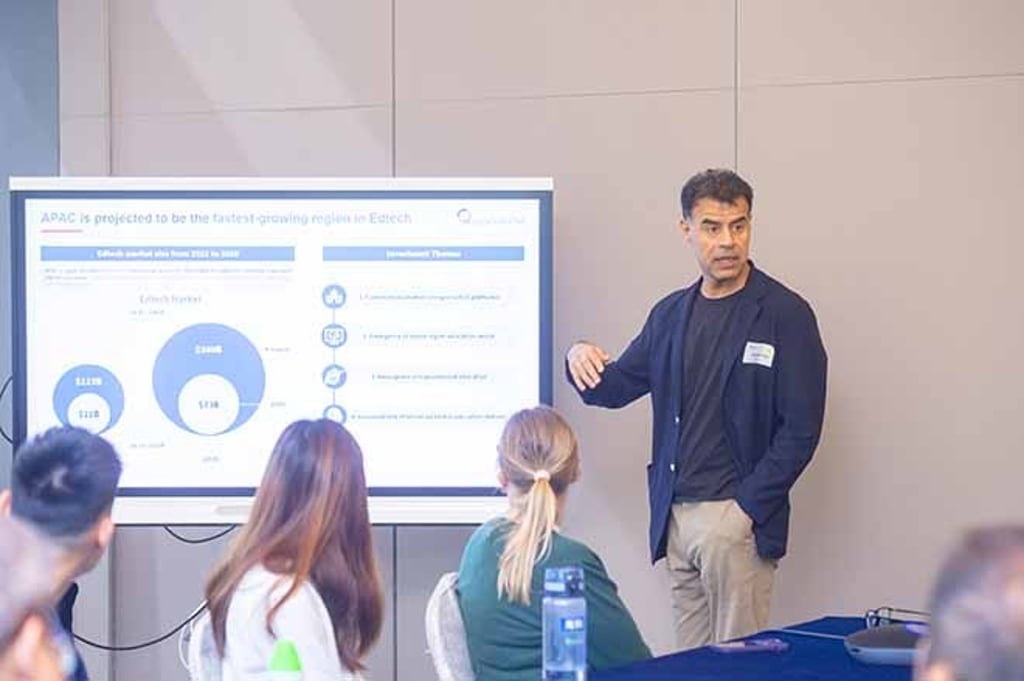
The blended nature of EdTech startups tends to reduce their appeal to philanthropic organisations, such as foundations, which traditionally only support non-profits, and to investors who are after quick and substantial returns. This observation was made by experts at the ‘Doing Good and Doing Well with EdTech’ workshop held in early November. The workshop was a part of EdTech Month 2023, an event organised by Esperanza.
EdTech ventures entail the infusion of ‘patient capital’, which includes public, philanthropic, and impact funding, to sustain their innovations. Cross-sector partnerships can efficiently fund an EdTech business at its different stages of development, from grants, credit guarantees, loans to equity funding.

Foundations and family offices
Despite the importance of education, Patrick Brothers, Co-Founder and Co-CEO of HolonIQ, remarked that both government and investors are underspending on education.
Foundations and family offices, in this context, are among the ideal partners for supporting EdTech solutions. Some are exploring or have already begun active financing in the education and EdTech sectors, for either profit-making or philanthropic purposes. Their objective is to bolster impact investing and diversify their multi-asset portfolios.
In the workshop, Chris Geary, founder of Hong Kong-based educational software and solutions provider BSD Academy, said, “Family offices and foundations, with their capacity for patient investment, can offer a range of financial structures. These can be mutually beneficial, considering their dual roles as investors and as the educational or EdTech businesses in which they invest.”

Many foundations have shown interest in EdTech solutions that can enhance and streamline the learning and teaching systems they have supported.
Among the potential approaches to partnership, one method is for foundations to tap into the potential of EdTech solutions by ensuring that the educational institutions they support can optimise the positive impact of their donations. For example, foundations can identify the challenges these schools face and the EdTech solutions that are potentially able to address them. “They can inquire if the schools are open to collaborating with these EdTech companies to further enhance learning outcomes,” said Anthony Chan, the Chief Executive Officer of Isola Capital. An institutional-grade asset management and family office platform, Isola Capital began its investment journey in the EdTech sector seven years ago.
Sandeep Aneja, the Managing Partner of the Singapore-based Kaizenvest, highlighted the increasingly adopted blended finance model. This model involves foundations providing grant capital to support market research, cover currency loss, and offer guarantees or leverage to equity investors. These foundations partner with venture capitalists (VCs) to drive greater accountability and measure outcomes more effectively. Typically, these VCs have a long-term horizon.
Validating EdTech’s effectiveness
In addition to funding issues, EdTech companies face another significant hurdle: the absence of an accreditation system to validate the efficacy of their solutions.
Geary highlighted the limited understanding of the effectiveness and evidence supporting EdTech solutions. “EdTech companies encounter challenges in acquiring and developing this evidence due to a mix of research, cost, time constraints, and a scarcity of independent partners willing to establish evidentiary programmes,” he noted. “Neither the government nor the educational community in Hong Kong has initiated steps to establish a practical system of effectiveness and evidentiary standards that EdTech companies can aim to meet.”
The validation of EdTech solutions requires a collaborative effort among various stakeholders, each contributing to the verification of the technologies’ effectiveness, safety, and suitability for educational purposes, according to Dr Li Dong, Co-founder and Managing Director of APX Capital, a global investment firm. The firm has been an early-stage investor in Zzish, a British EdTech company.
Educational institutions and educators in Hong Kong are uniquely positioned to provide valuable insights into students’ needs and educational objectives. Their input is crucial in ensuring that EdTech solutions are not only technologically advanced but also pedagogically sound, Li said. “This factor significantly influences market acceptance and the potential for growth.”
Yvette Fung, Chair of The Yeh Family Philanthropy (YFP), stressed that the value of EdTech solutions must be directly assessed by the end-users. These users could be students, teachers, school administrators, or partners involved in a specific programme.

The input from both local and/or international research and academic experts is crucial in affirming the efficacy of EdTech solutions. Their insights not only bolster credibility but also enhance the attractiveness of various approaches, Li added.
The Jacobs Foundation, based in Switzerland, serves as an exemplary model for foundations in Hong Kong. The foundation has pledged CHF500 million to promote the integration of evidence-based EdTech practices in schools and national policies. This initiative involves close collaboration with researchers, EdTech companies, policymakers, venture capital firms, and other foundations.
Localisation
With the global landscape teeming with proven and innovative EdTech solutions, there is no need to reinvent the wheel in Hong Kong. Esperanza, through its annual “Edventures Global Business Acceleration Fellowship” programme, seeks to identify these solutions and introduce them to the Hong Kong market. However, localisation can pose a challenge. Given the relatively small size of the Hong Kong market, commercial viability of localising these solutions may be questionable. This is where foundations can step in and play a crucial role.
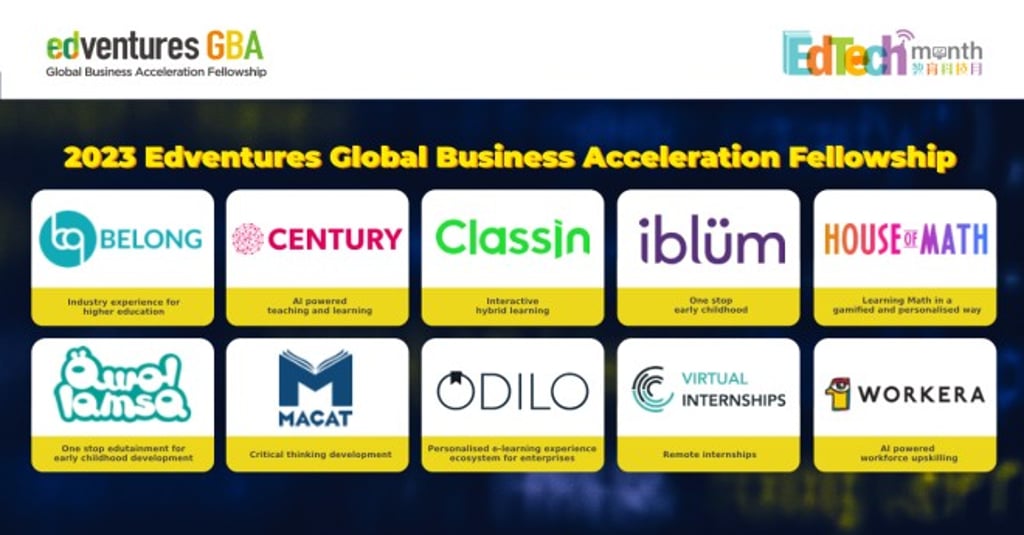
To identify promising EdTech solutions that could potentially be adopted in Hong Kong, Fung, who has been keeping up with the latest developments in the US EdTech sector, suggested that potential partners should investigate whether a specific solution has been successfully adopted outside of the US, particularly in jurisdictions with education policies and cultural contexts similar to those of Hong Kong.
“Even if these non-US jurisdictions are dissimilar to Hong Kong, we can examine how the EdTech company has managed to adapt its solutions to the new market,” said Fung. “Equally important, if its expansion into the new market has not been successful, we want to understand the reasons behind it.”
Government support
Investment firms and foundations agree that the Hong Kong government is well-positioned to take the lead in exploring feasible strategies for cultivating an EdTech ecosystem in Hong Kong.
Li of APX Capital underscored the pivotal role the government can play in establishing educational standards and policies. The government’s backing, manifested through financial support, pilot programmes, and guidelines for data security, will mould market opportunities and shape the regulatory landscape.
Fung of YFP suggested that the government can help enhance the impact of EdTech solutions by taking a more proactive role in identifying areas for broader implementation.
A first step towards this could be the formation of a brainstorming group by the government, in collaboration with local EdTech investors, to explore potential possibilities, Fung added. “Alternatively, the government could establish a collective impact group with relevant stakeholders to define objectives for Hong Kong, or perhaps initially for a specific district. This group could then proactively seek innovative or even incremental solutions to help achieve these objectives.”
Li noted that by formulating and implementing policy incentives, along with favourable regulations for impact investments and philanthropic donations, the government could potentially encourage family offices and foundations to focus more on EdTech solutions. She said, “In terms of EdTech, governments can assist family offices in evolving from being mere donors in the education sector through their foundations, to becoming active agents of change. They can do this by utilising their resources for a more sustainable educational transformation.””
Shifting the focus and approach from donations to investments in EdTech necessitates a tangible demonstration of its impact, cost-effectiveness, scalability, and potential for partnerships, added Li. “In this context, the government can play a pivotal role. It can fund research to verify the effectiveness of impact investments and venture philanthropy. Additionally, it can develop or endorse standards to measure the social and environmental impact of investments in the education sector.”
Li believed that providing relevant data could bolster the confidence of family offices, encouraging them to pursue these avenues with greater vigour.
Doing good and doing well with 2nd and 3rd generations
The Hong Kong government is promoting the concept of ‘wealth for good’ and venture philanthropy among family offices and foundations. The recent launch of the Hong Kong Academy for Wealth Legacy offers a suitable platform for these family offices to explore opportunities in the EdTech sector.
However, some observers have noted insufficient communication between the investment arm of the family office and the foundation arm. But the situation may improve organically.
Chan of Isola Capital remains hopeful that more effective synergies between the family office and the foundation will emerge, particularly through the active involvement of the next generation. Given their similar educational and familial backgrounds, many of these young individuals from elite families tend to have a shared perspective, similar educational background, cultural affinity and worldview.
In the family foundation, younger members entrusted with the task of identifying venture opportunities, including EdTech startups, can draw upon the expertise of their peers in the family office or investment arm. These individuals, in turn, utilise their global networks to gather pertinent information from others who are investing in similar businesses or exploring comparable opportunities.
“This creates a connection between the next generation members of the foundation and those in the family office or investment arm. There is genuine potential for synergies or collaboration,” said Chan.