High-tech, customised production is on track to thrive in Hong Kong: panellists at “Crafting Tomorrow: A Fresh Look at Advanced Manufacturing in Hong Kong”

[The content of this article has been produced by our advertising partner.]
- Hong Kong’s push for advanced manufacturing is being propelled by government support, innovation from top-tier research institutions and universities, and the dedication of enterprising companies.
- Efforts are gaining momentum as Hong Kong successfully lures leading global firms to establish research and development and high-tech production bases in the city.
The Hong Kong Government has escalated its backing for advanced manufacturing in the city, according to Professor Sun Dong, Secretary for Innovation, Technology and Industry, HKSAR.
In his Keynote speech at the forum “Crafting Tomorrow: A Fresh Look at Advanced Manufacturing in Hong Kong”, Sun highlighted that new industrialisation promotion, one of the four primary development strategies outlined in the 2022 ‘Hong Kong Innovation and Technology (I&T) Development Blueprint’, hinges on advanced manufacturing.
HKSAR Chief Executive John Lee outlined in his latest Policy Address several initiatives aimed at fostering new industrialisation and bolstering advanced manufacturing in Hong Kong, Sun said. “A New Industrialisation Development Office will be set up to aid strategic enterprises and start-ups in their growth and development in the city. It will also help the manufacturing sector upgrade and transform through the effective use of I&T.” Furthermore, a fund of HK$10 billion has been earmarked to support qualifying companies in setting up production facilities in Hong Kong.
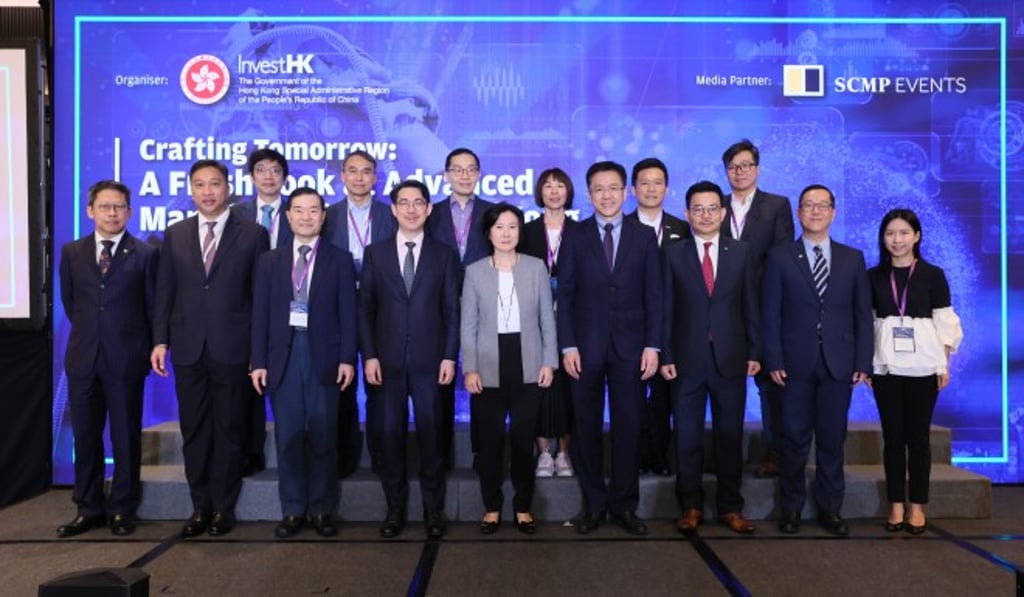
Support from the government has contributed to the rapid expansion of Hong Kong’s advanced manufacturing and I&T ecosystem. The city boasts the Science Park, Cyberport, multiple InnoParks, an AMC, and leading research universities. The government is planning to establish a second AMC, the Hong Kong Microelectronics Research and Development Institute, and the Microelectronics Centre. It’s also contemplating a third InnoHK research cluster, focusing on advanced manufacturing, materials, energy, and sustainable development to foster global R&D collaboration. In addition, Hong Kong’s ecosystem is bolstered by its top-tier testing, certification sector, and robust accreditation system.
Another keynote speaker at the forum, Chairman of the Federation of Hong Kong Industries (FHKI), Steve Chuang, said Hong Kong industrialists have been preparing for advanced manufacturing. A 2022 FHKI’s survey revealed that 27 percent of respondents were well-versed in IoT applications for manufacturing and 44 percent were familiar with them. He added that half of the surveyed companies plan to leverage 5G IoT to accelerate production. The planned construction of a supercomputing centre is set to further strengthen Hong Kong’s digital infrastructure and 5G capabilities.
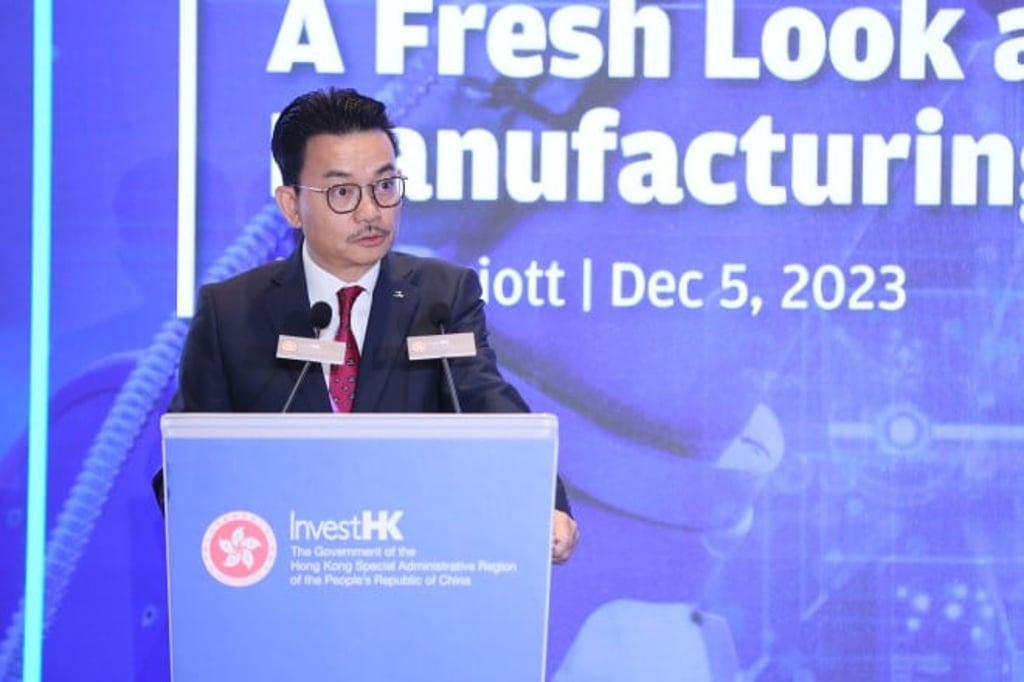
Experts like Professor Sun and Chuang shared insights at the forum organised by InvestHK and co-hosted by the South China Morning Post. This forum served as a platform for thought-leaders, I&T experts, and government officials to exchange views shaping Hong Kong’s industries’ future. It also marked the launch of “Crafting Tomorrow: A Fresh Look at Advanced Manufacturing in Hong Kong”, a publication co-published by InvestHK and PwC.
This publication offers comprehensive updates on the city’s latest developments of advanced manufacturing that employs cutting-edge technologies such as robotics, artificial intelligence, IoT, and 3D printing to enhance production efficiency and sustainability.
Robust ecosystem
Hong Kong’s burgeoning ecosystem for advanced manufacturing helps attract overseas companies to establish a presence in the city. International pharmaceutical powerhouse, AstraZeneca, is set to establish a R&D centre in Hong Kong. And Contemporary Amperex Technology (CATL), the world’s foremost manufacturer of electric vehicle batteries from Mainland China, has recently signed an agreement to launch a R&D centre at the Hong Kong Science Park.
At the forum, Simon Yeung, Co-founder and COO of Time Medical, announced that the medical equipment manufacturer is set to initiate production in the city. Time Medical aims to consolidate its R&D, logistics, and advanced production of state-of-the-art equipment, such as MRI and CT Scan systems, in Hong Kong. Yeung expressed appreciation for the Hong Kong Government’s support and investment in I&T. He noted, “Efficient support from government departments, including Customs, enables our just-in-time production with high-cost components.”
“We’re set to enhance our production by integrating 5G Internet of Things (IoT) and artificial intelligence in Hong Kong,” Yeung said. “The ‘Made in Hong Kong’ brand is highly regarded globally, instilling confidence in our quality.” The company operates factories in China and India.
Meanwhile, fellow panellist Dr George Lam, Co-Chairman of the Hong Kong Aerospace Technology Group, noted that Hong Kong has developed an optimal ecosystem for advanced manufacturing, with purpose-built facilities like those at Tseung Kwan O’s InnoPark. The company has recently inked a deal to manufacture commercial satellites for the Middle East market.
“Our production has been enhanced through collaboration with the Hong Kong Science and Technology Parks (HKSTP),” Dr Lam said. He added that the Advanced Manufacturing Centre (AMC) at TKO InnoPark supports their small-scale, highly customised commercial satellite production. Dr Lam also mentioned that the AMC offers warehousing and smart logistics support.
As part of the Guangdong-Hong Kong-Macao Greater Bay Area (GBA), Hong Kong offers another advantage. Dr Lam shared, “The GBA, with its smart cities requiring aerospace data, presents an ideal market for the aerospace sector.”
Northern Metropolis
The development of the Northern Metropolis and its central project, the San Tin Technopole, will help reduce land supply constraints hindering Hong Kong’s advanced manufacturing growth. Located near Shenzhen’s I&T zone in China, this initiative, which features the Hong Kong-Shenzhen Innovation and Technology Park, will allow Hong Kong firms to capitalise on synergies with Shenzhen, according to Dr. Jimmy Chiang, Associate Director-General of Investment Promotion at InvestHK.
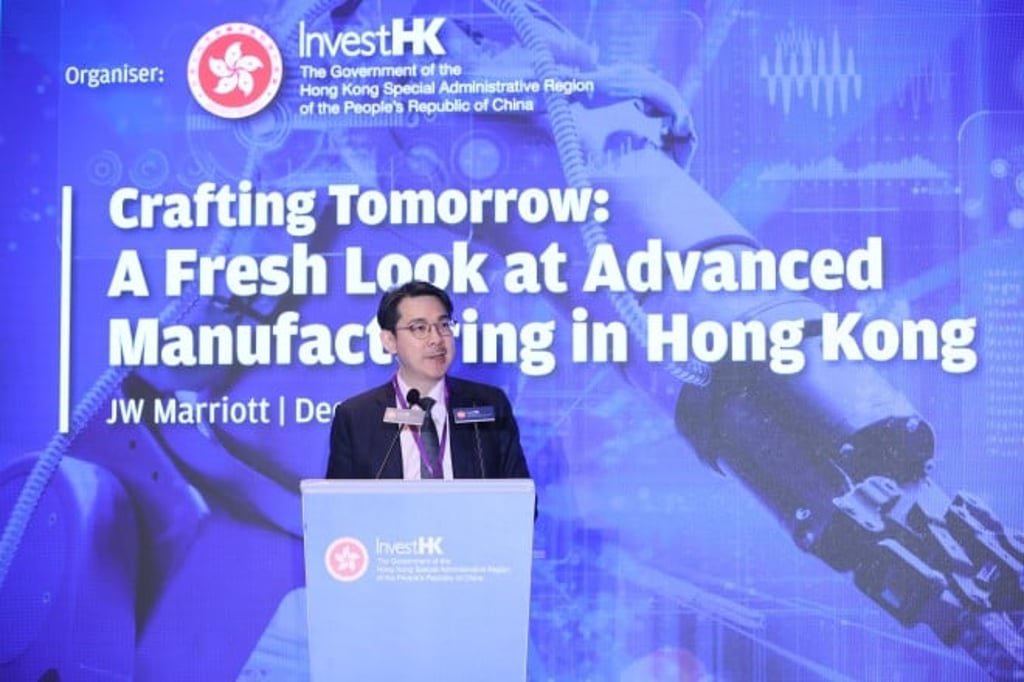
The panellists highlighted Hong Kong benefits from a robust talent pool. The city’s world-class universities and research institutes attract innovative and entrepreneurial youth, both locally and globally. Many of these graduates further their R&D efforts and commercialise their innovations by founding startups in the city. According to recent estimates, Hong Kong is home to nearly 4,000 I&T startups.
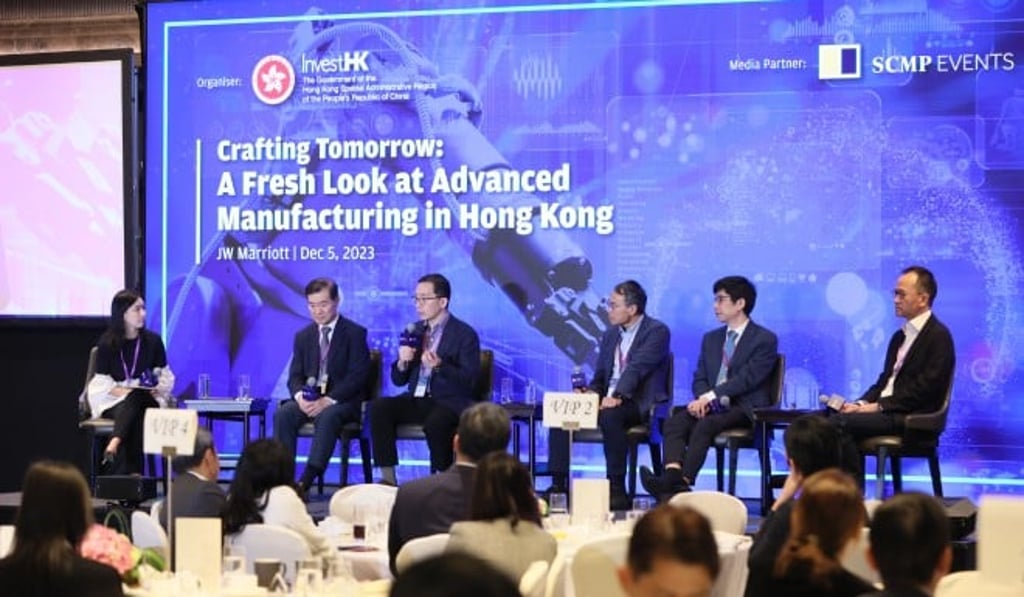
Roy Chan, a PwC Hong Kong partner and co-author of the publication, underscored the robust demand for specialised manpower across all levels. At present, Hong Kong’s R&D and I&T sectors employ approximately 46,000 individuals. Chan projected that, in alignment with ongoing development, the total I&T workforce will expand to 100,000 by 2030. He emphasised the need for downstream manpower in advanced manufacturing, including technicians and production support. To meet this demand, he suggested that the city enhance its vocational and professional training education capacity.
To alleviate shortage of technical manpower, the government has announced the introduction of the Vocational Professional Admission Scheme (VPAS). This employment-tied initiative targets secondary school graduates from Mainland China and globally, with a particular focus on countries along the Belt and Road.
Hong Kong’s economic integration with the GBA, which will be exemplified by the San Tin Technopole project, is expected to foster increased collaboration and talent exchange, particularly in advanced manufacturing, across Hong Kong, Shenzhen, and other GBA cities. Chan, from PwC, highlights that their manpower research takes a holistic view of the GBA, anticipating that a portion of specialist and technician supply will originate from the GBA.
Sharon Sit, Assistant Director of Advanced Manufacturing in the Innofacturing Division at HKSTP, concurred with Chan. “Our focus at Science Park is to leverage our unique ecosystem’s strengths. We don’t view other cities as competition. Our role is to incubate startups, some of which transition into manufacturing. A number of these companies establish their factories in the GBA or other locations,” she said.
Chan also highlighted that several sectors in Hong Kong, including medical/health tech, AI, semiconductors, and microelectronics, are set to become I&T centric within the next five years. He noted, “Hong Kong’s robust foundation facilitates its transition to advanced manufacturing, supporting diverse sectors from food to aerospace.” The publication presents compelling case studies of prosperous companies.
Chan’s sentiment was echoed by Edmond Lai, Chief Digital Officer of the Hong Kong Productivity Council, who believed Hong Kong is well-positioned to support health tech and biotech sectors, which require extensive R&D and continuous enhancement. These sectors primarily produce in small volumes with a high degree of customisation. He said, “Clinical trials conducted by research institutes in Hong Kong are well-recognised by relevant authorities on the Mainland and the United States. Hong Kong has the advantages in smart production and customisation with robotics and AI.”
“Crafting Tomorrow: A Fresh Look at Advanced Manufacturing in Hong Kong”, co-published by InvestHK and PwC.
https://www.investhk.gov.hk/media/tsrmudkm/crafting-tomorrow-a-fresh-lo…