Tackling challenges in a fast-changing world

[Sponsored Article]
Undoubtedly change is the constant in today's world. Particularly with the alarming speed of technological advancement, different sectors of the society have no alternative but to embrace change.
That was an issue addressed at the 8th Symposium of the Centre for Leadership and Innovation (CLI) with the topic of The Future of Work: Driving Change in Organizations, held and co-organized on 1 March 2019 by the Department of Management and Marketing (MM) of The Hong Kong Polytechnic University.
Students and professionals, including Co-Directors of the CLI, Dr Bonnie Hayden Cheng and Dr Wing Lam, from MM of the Faculty of Business, were among the audience.
Two speakers at the event shared their insights on how to lead or capitalize on changes. The keynote address by Li Chan Wing of Li C.W. Consultant Limited, emphasized the importance of positive personal traits, as those mentioned in the Chinese classic The Art of War by Sun Tze.
By showing a series of videos on how people responded in challenging situations, Li illustrated human beings’ tendency to make judgements based on emotional or psychological reactions, rather than logical thinking. And the use of intuitive thinking - which lies within the functions of human beings’ right brain – is particularly useful in today’s world.
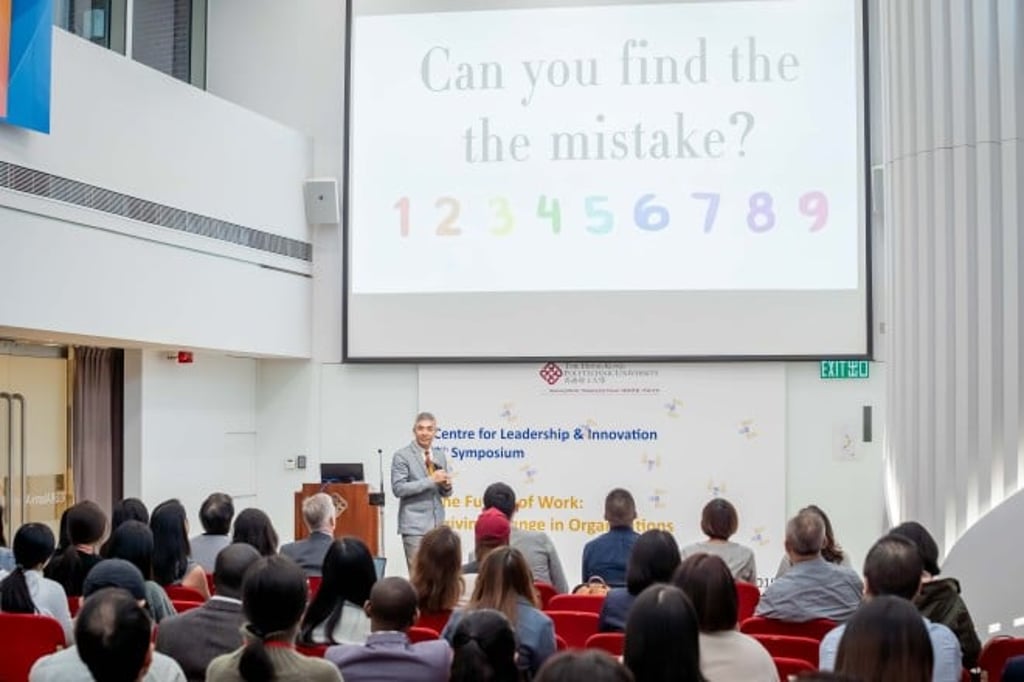
The utilization of knowledge and logical, rational thinking – the characteristic of the left brain – Li said, is not of as much significance as in the old days, especially with the rise of artificial intelligence, which has proven to be capable of replacing humans in certain tasks.
Researchers abroad pointed out that the characteristics of the brain's right hemisphere, such as empathy, is crucial in today’s economy. The Fourth Industrial Revolution that is sweeping across the world now call for skills different from those highly valued in the previous decades. A World Economic Forum report put emotional intelligence in the sixth place out of the top 10 skills projected for the workplace in 2020. It was not even on the list for 2015.
“We need to use our right brain more in addressing issues, ” said Li.
The capacity for “emotional transfer”, or empathizing with others, he adds, is important for meeting the changing management needs in the Greater Bay Area. In the economic powerhouse of Shenzhen, the average age of the population is about 33, and middle-aged managers there need to adjust their thinking or be willing to re-learn the ideas popular with the young generation immersed in the digital world to advocate changes. “That is the new challenge for managers,” he said. “Just mere slogans plastered on the walls are not enough for changing people’s minds. Emotional transfer is important for tackling cultural gaps.”
He also called on managers to think out of the box, and not be bound by existing norms or guidelines. “The world is changing fast and being able to detect change is vital for a company’s survival.”
Another speaker, Dr Liu Wu, Associate Professor of the Department of Management and founding member of the PolyU Center for Leadership and Innovation, expounded on his research in China on the growing importance of team work. “In today’s business environment, there are multiple reporting structures in multiple projects and people work for different teams,” he said. “Working in teams will become a trend due to the division of labour within companies.”
He expects the rising trend to help companies thrive in today’s new economy.
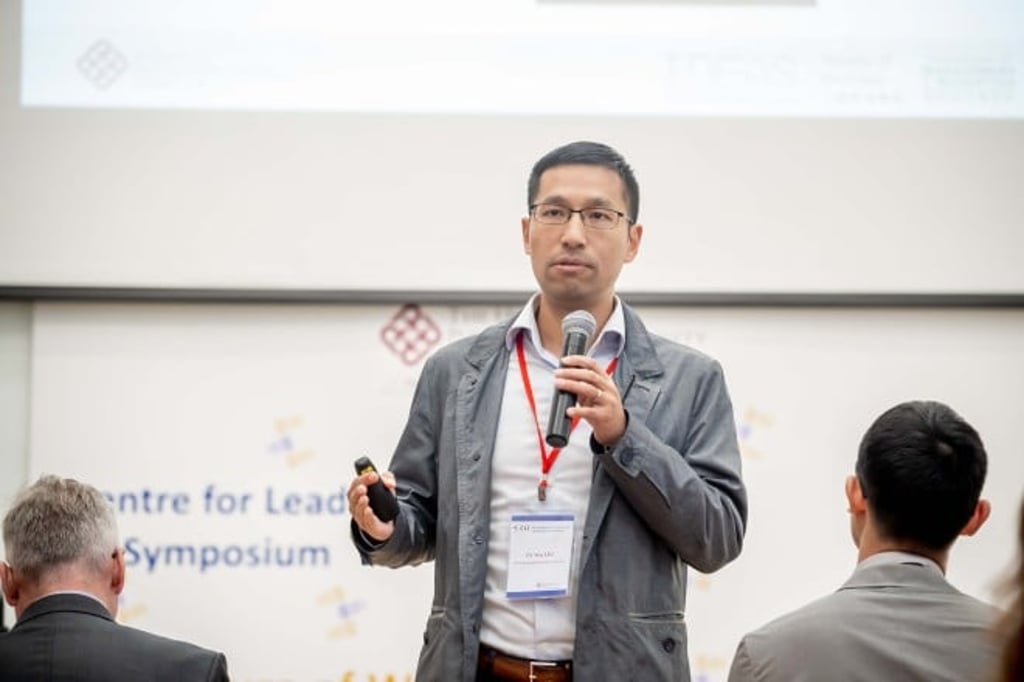
His studies involved interviews with hundreds of top and general managers and human resources officers, with the goal to find out about the myriad special arrangements made within companies as a result of negotiations between staff and management.
The result of negotiations, or in his term, W-deals (as opposed to the individual-based I-deals), cover wide-ranging work arrangements from deals on training and development, performance evaluation and criterion to flexible work locations. More importantly, he thinks they could drive innovation in a company or enhance productivity.
“The next step in our research is to collect more data on the consequences of the deals on staff, for example, whether their work performance has been enhanced,” said Dr Liu, an expert in employee voice behavior, cross-cultural management and conflict management.
Like consultant Li, he thinks the mere possession of knowledge or even a doctoral degree alone cannot guarantee success. He believes companies with the concept of W-deals are better able to cope with the rapidly-changing environment.
Both speakers cite the late founder of Apple Computers, Steve Jobs, as an inspiring entrepreneur who demonstrated an ability to influence huge populations, which contributed to the success of his company built from scratch. Quoting from his autobiography, Dr Liu said the one thing that Jobs was most proud of was being a member of the team he had built.
Li, the consultant, lauded Jobs’ ability to make his product appeal to people of different backgrounds and ages.