Advertisement
Igniting minds, building futures
Business

Beyond the Pitch: How IdeaPOP! Is Teaching Students to Build Social Innovation That Works

Paid Post:SEED Foundation
4-MIN READ4-MIN
Listen
Aveline San, CEO and Banking Head for Citi Hong Kong (front row, center), hosted the finalists and winning teams at Citi's office, joined by Ken Lo, CEO of SEED Foundation (front row, left), marking the culmination of the students' journey in turning purpose-driven ideas into real-world solutions.
Advertising partner

[The content of this article has been produced by our advertising partner.]

When the SEED Foundation began reviewing applications for IdeaPOP! 2026, a pattern emerged almost immediately. Across more than a hundred submissions from Hong Kong secondary school students, artificial intelligence featured in nearly every proposal.

That observation raised a more important question than whether students knew how to use AI. Were they learning how to apply it with judgment — and, more importantly, how to build ideas that could survive beyond the classroom and the competition stage?

For many participants, this would be the first time their ideas were challenged by people outside school — and the first time they were asked to defend not just what they wanted to build, but why it might actually work.

That question sits at the core of IdeaPOP!, now in its fifth year and title-sponsored by Citi since 2024. Running from January to July each year, the programme is designed as a multi-month learning journey rather than a one-off pitch competition. Students are encouraged to explore pressing social issues facing Hong Kong and develop solutions that are not only empathetic, but also workable. The premise is explicit: good intentions may start a solution, but without sustainability, impact rarely lasts.
 
What the IdeaPOP! Journey Actually Looks Like
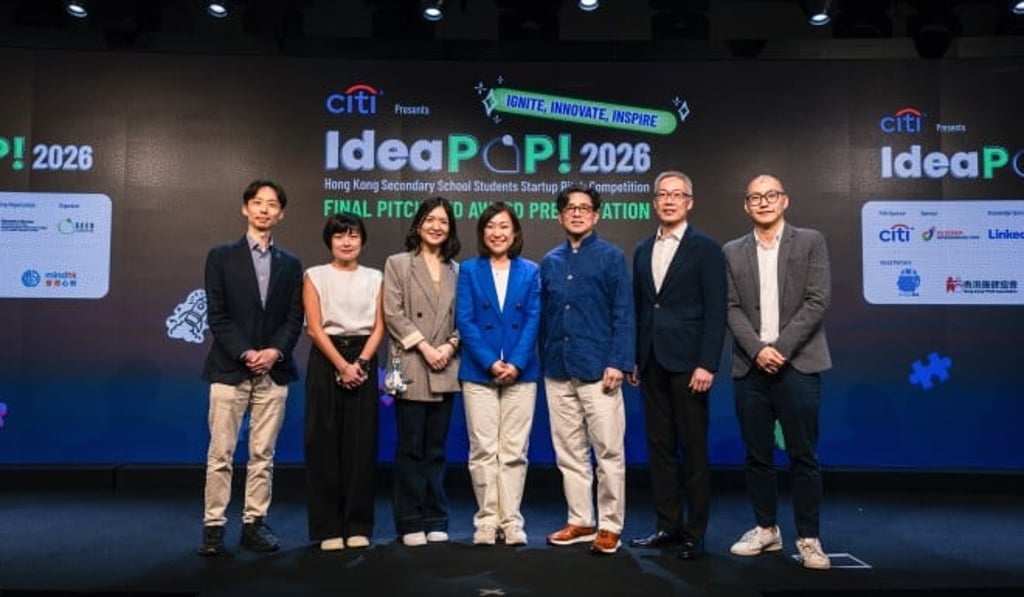
IdeaPOP! 2026 Judge Panel — From left to right: Prof. Hayden So (Director, School of Innovation, The University of Hong Kong), Ms. Grace Wong (Chief Impact & Communications Officer, Alibaba Entrepreneurs Fund), Ms. Freda Ng (Managing Director, PARKnSHOP (HK) Limited), Ms. Vicky Kong (Head of Wealth, Asia North and Australia, Citi), Mr. Ernest Leung (President and Group Chief Operating Officer, WeLab), Mr. Danny Lee (Chairman of the Board, SEED Foundation, and Managing Partner, VCA Capital), and Mr. Clifford Chow (Vice President, Lee Hysan Foundation).
The competition begins long before any final pitch. Following open applications, 80 shortlisted teams — involving more than 300 students — enter a defined programme running from early concept development through to final presentation.

Over several months, teams move through a sequence of structured stages: 12 early-stage mentoring sessions focused on sharpening problem definitions; three iterative pitching rounds in front of rotating panels drawn from business, technology and social sectors; and practical critique around feasibility, user adoption and long-term relevance. 

Before the final pitch, a Kick-start Day was held for more than 300 students, where over 70 industry professionals and social partners worked with participants to stress-test problem statements and identify gaps in their thinking. A newly introduced Deep-dive Day gave students the opportunity to engage more closely with practitioners, helping them better understand the communities and challenges they hoped to address. 

As the competition progressed, many students found their original ideas evolving significantly. Some discovered that the problem they set out to solve differed from what users truly needed; others rethought how technology should be applied. The experience mirrors the realities of entrepreneurship, where progress often comes through feedback, iteration and adaptation rather than getting everything right the first time.

This year, teams addressed four social domains — education, elderly care, disability inclusion, and mental wellness and resilience — but the expectation remained consistent: understand a social need, then develop a solution capable of creating lasting value beyond a prototype or presentation slide.
 
From Good Intentions to Workable Solutions
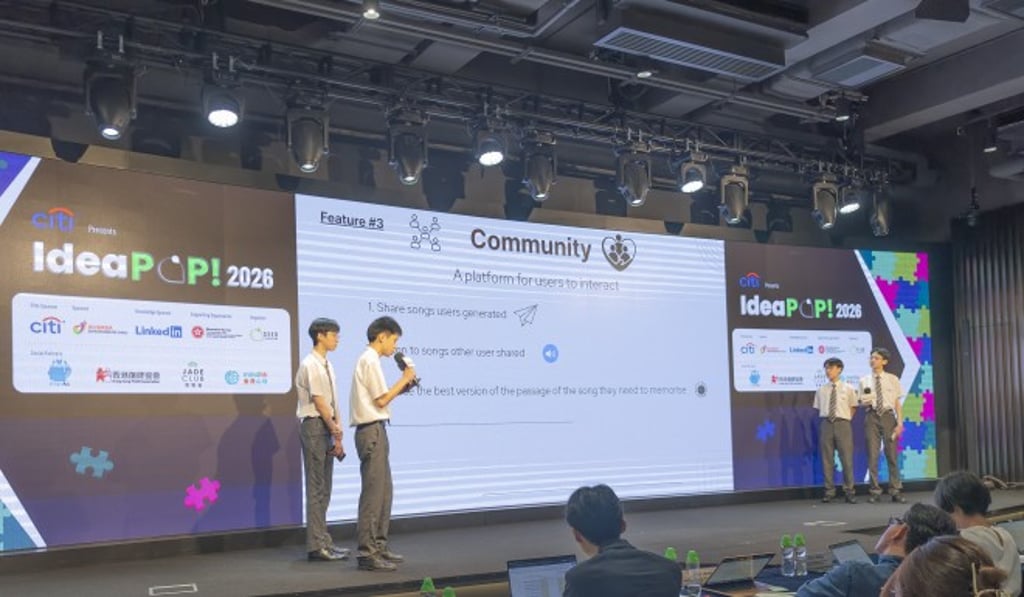
Inspired by the “sound memory method”, the champion team from Kwun Tong Maryknoll College created an AI-powered platform that converts learning content into melodies to make studying more engaging and effective.
The champion team from Kwun Tong Maryknoll College offers a clear illustration of how the programme integrates social insight, technology and practical considerations. 
The students began with a familiar educational challenge: helping learners retain difficult content. Rather than defaulting to standard digital study tools, they drew inspiration from how easily people remember song lyrics. Their solution applied AI to convert study material into melodies, turning revision into an experience designed to increase engagement and recall.
 
What resonated with judges was not the novelty of technology, but the way it addressed a genuine learning need while remaining accessible and scalable. The project reflected a central IdeaPOP! lesson: technology can spark ideas, but entrepreneurial thinking is what translates empathy into something usable.
 
Beyond the Final Pitch
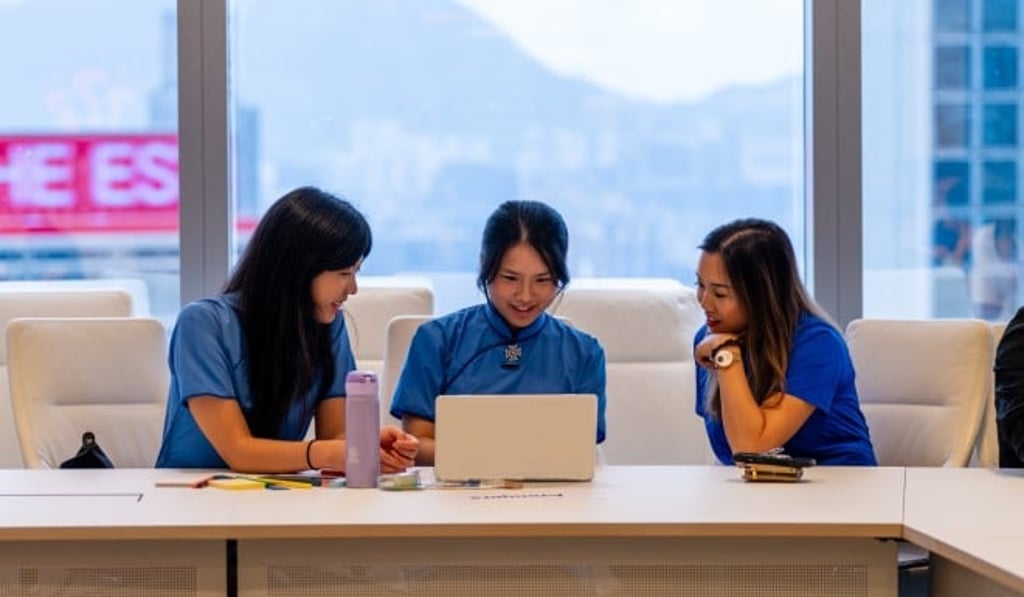
Students work with a Citi AI mentor (right) during IdeaPOP! 2026’s AI Day at Citi’s Hong Kong office, refining their ideas through hands-on prototyping and design exercises.
Crucially, the IdeaPOP! journey does not end on stage.

To reinforce real-world learning, Citi hosted a dedicated AI Day for finalist teams and the winning team at its Hong Kong office. Designed as an extension of the competition, the full-day event brought together Citi AI mentors and technology entrepreneurs to help students push their ideas further.

During the session, student teams worked on concept testing, prototype development and user experience design, examining where AI genuinely strengthened their solutions and where human judgment mattered more. Citi mentors also shared how AI is applied in professional settings to improve productivity and address operational challenges, offering students a view into how innovation functions under real business constraints.

Students also heard directly from founders who shared their entrepreneurial journeys, experiences navigating the startup ecosystem, and practical advice on dealing with challenges and setbacks.

Aveline San, CEO and Banking Head for Citi Hong Kong, said the AI Day was designed to help students translate innovative ideas into real-world applications, with a strong focus on human-centred design and the responsible use of AI, bringing their purpose-driven ideas one step closer to real-world impact.
 
Preparing Future Talent, Not Just Competition Winners
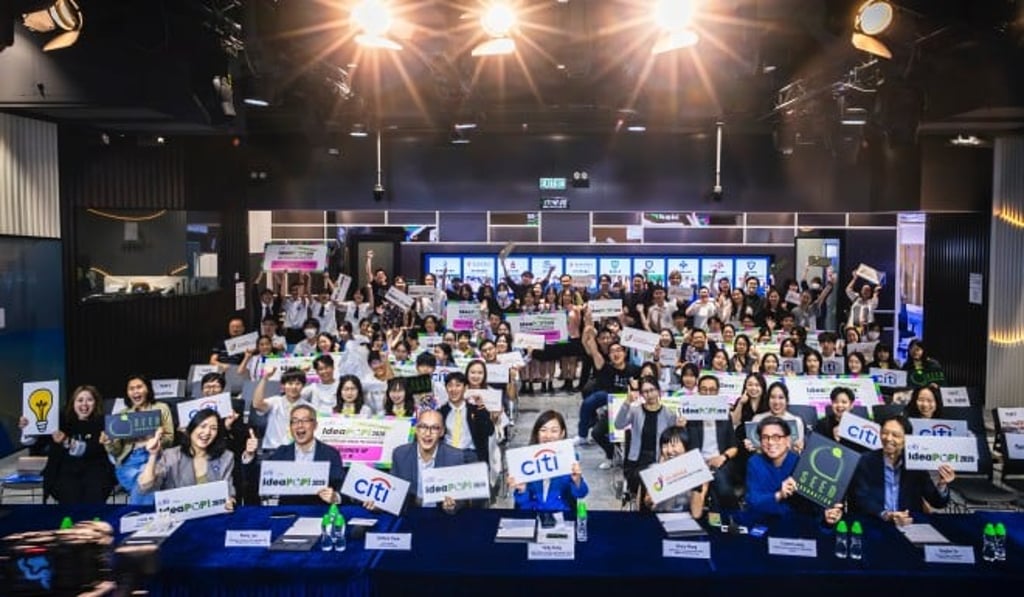
The 10 finalist teams of IdeaPOP! 2026 joined mentors and judges at the Final Pitch Day, representing the next generation of innovators emerging from a programme that has engaged more than 3,000 Hong Kong students since 2022.
Since its inception in 2022, IdeaPOP! has engaged more than 3,000 students and generated over 750 technology-based solution concepts. This year, the programme's learning ecosystem expanded further through a new partnership with LinkedIn, which enhanced the self-learning resource hub and provided students with access to professional skills development beyond formal mentorship.

“IdeaPOP! is a clear example of what SEED Foundation strives for,” reflects Danny Lee, Chairman of SEED Foundation and an experienced private equity investor. “This year's cohort didn't need an introduction to AI — they are already AI natives. What they needed was guidance to ask sharper questions, and the confidence to trust human instincts that no algorithm can replicate. That is the outcome they should chase, far more than any trophy.”

Students leave IdeaPOP! with more than presentation experience. They gain a framework for approaching complex problems — understanding that empathy may initiate innovation, but sustainability is what sustains it.

In a city seeking to strengthen its innovation ecosystem while addressing evolving social challenges, that balance matters. By teaching students how to integrate social concern with entrepreneurial discipline, IdeaPOP! is preparing a generation to tackle Hong Kong’s challenges with both conscience and competence — long after the competition itself has ended.


Advertisement
Advertisement
Select Voice
Select Speed
1.00x