Green Port Operations in Hong Kong

[The content of this article has been produced by our advertising partner.]
The journey toward green port operations in Hong Kong began 20 years ago. This can be attributed to the circumstances surrounding port operations and the foresight of management. The unloading, locating, and loading of containers is a highly industrialized endeavor. And in the case of Hong Kong such operations take place amid a densely populated metropolis.
We look at how two of Hong Kong’s leading terminal operators Modern Terminals Limited, and Hongkong International Terminals Limited (HIT) have travelled the green road so far and so quickly.
Decarbonisation
Since 2005 both operators have introduced decarbonisation measures incrementally. Chief among these measures have been:
- Electrification of RTGCs: Transitioning from diesel-powered rubber-tyred gantry cranes (RTGCs) to hybrid and eventually to fully electric ones to reduce carbon emissions.
- Autonomous Trucks: Launching a proof of concept of autonomous trucks running on electricity to enhance efficiency and lower emissions.
- Fossil-Fuel to Electric Vehicles: Gradually replacing fossil-fuel powered vehicles by electric ones to support a greener fleet.
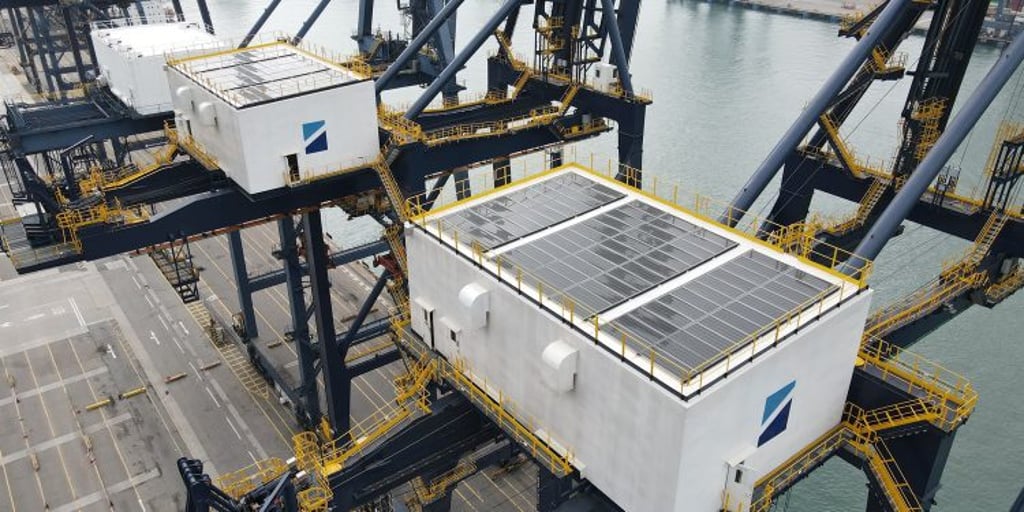
- Renewable Energy Integration: Implementing solar photovoltaic systems to harness renewable energy sources
- LED Lighting: Upgrading conventional lighting to LED technology in cranes and buildings to reduce energy consumption.
In May 2018, it deployed the first pure electric driven tractor in Hong Kong and since then a few have been operating at the terminals.
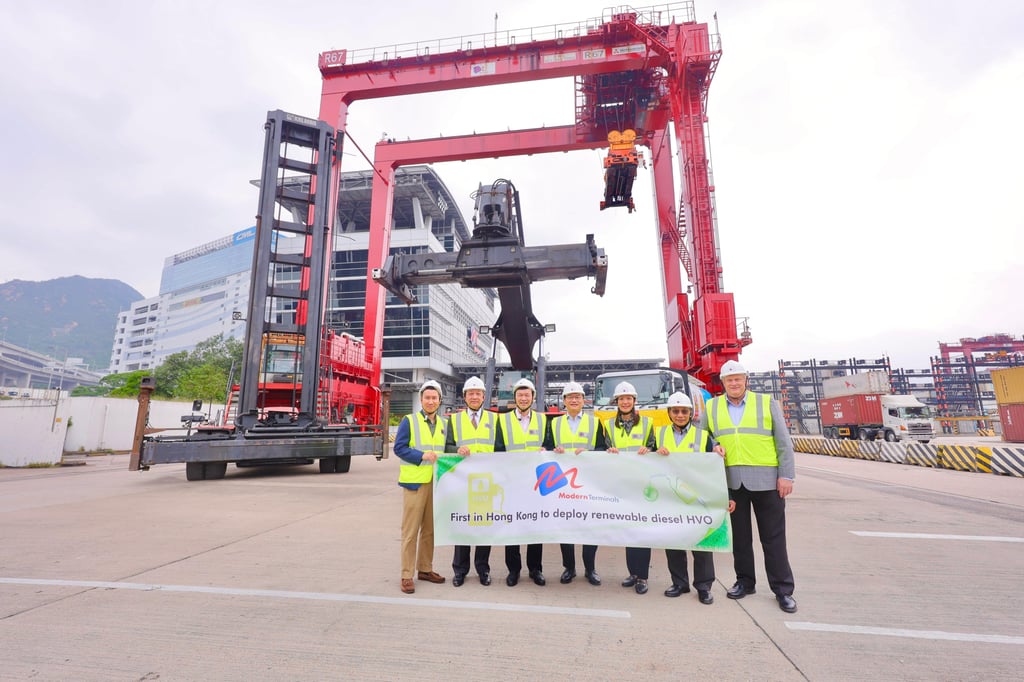
“We aim to eliminate all our direct greenhouse gas (GHG) emissions from our operations by 2030 and to become carbon neutral by 2050. Our direct emissions account roughly half of the total of our scope 1 and scope 2 emissions. To achieve our 2030 goal, we have been looking at different technologies to determine our roadmap. Currently we are looking at electrification, biofuel/renewable diesel, and hydrogen,” said Mr Lo.
HIT, as a member of Hutchison Port Holdings Trust (HPH Trust), has equally ambitious targets it intends to meet on the next phase of the decarbonisation journey, and has also already notched up a number of notable firsts:
HIT was the first Hong Kong terminal operator to reconfigure its existing diesel-powered Rubber-Tyred Gantry Cranes (RTGCs) to run on either electric or hybrid power.

“We are committed to advancing sustainability and eco-friendly initiatives within the maritime industry. The introduction of green fuels and bunkering infrastructure is poised to significantly enhance the Port of Hong Kong’s appeal to environmentally-conscious shipping lines, elevate the environmental credentials of our operations, and further solidify our position as a forward-thinking, smart and green port.”
Waste Management
The importance of efficient waste management has been a topic on the minds of most Hong Kong citizens this year. The primary aim of waste management is to create a cleaner and greener environment. Such an environment depends on reducing pollutants (water, air, soil etc). Rational waste management provides the opportunity to save energy through recycling and reuse practices. As a socially responsible member of the community, the Port of Hong Kong has this perpetual problem covered. HIT sums up its current waste management regime succinctly:
“To mitigate environmental pollution, HPH Trust appoints qualified companies to collect waste, including chemicals or hazardous materials to ensure they are handled properly.
Waste generation data is collected periodically and reviewed by the Environmental Steering Committee of HIT to ensure its waste reduction initiatives are well implemented.
Waste materials, including scrap iron, waste wire rope and tyres, are sorted and handed to licensed contractors for recycling.”
Modern Terminals meanwhile, maintains that it recycles all materials capable of recycling with only general daily waste from offices being sent to landfill.
Adapting to climate change
Despite the unstinting efforts of these two terminal operators and others of similar mind, the more general tardiness of global efforts to eliminate greenhouse gases means the world will inevitably face some consequences of existential climate change. There will be more typhoons and they will be more powerful. Temperatures will soar higher still. Without adaptation ports including Hong Kong will be among the most vulnerable to the effects.
“As climate change intensifies globally and stakeholders demand immediate action from corporations, HPH Trust will continue to integrate environmental and climate-related risks and opportunities into its strategic planning and operational decision-making. This aligns with its commitment to safeguarding the environment and enhancing climate resilience at all levels,” added Mr Chow.
“With the assistance of an external consultant, HIT has identified its key climate-related risks, as outlined by HPH Trust, to further analyse to provide a detailed assessment of various climate-related outcomes, which will serve as a framework for formulating proactive and resilient strategies for risk mitigation.”
Similarly, Modern Terminals are making plans ahead. “We have identified climate-related risks for our company and our ongoing efforts involve comprehending and prioritising those risks as well as formulating effective mitigating measures for the ones most likely to have implications for our business,” said Mr Lo. “We have also launched additional measures to help our people tackle the extreme heat.”