As hybrid working goes mainstream, how much does it cost to transform your workplace?
CBRE's Global Office Fit-Out Cost Guide provides comprehensive cost data for companies to quickly estimate and compare fit-out costs across different cities and regions as they shift to hybrid working models.

[The content of this article has been produced by our advertising partner.]
The pandemic has had a massive impact on how employees prioritise work-life balance, wellness, and the ability to work flexibly. Existing workplaces were measurably seen as underperforming compared to working from home and must change. Understanding what really makes an office attractive and productive for employees is critical. Employers must address these concerns by making appropriate changes to their office design and workplace practices to facilitate hybrid working. By creating an office environment that is conducive to hybrid working, businesses can increase employee engagement and productivity while embracing this new trend.
Post-Covid office design trends
Based on the firm's observations of office trends around the world, three new workplace configurations have emerged post-pandemic: 'Office as an Attractor’ (WFH 1-2 days a week), ‘Office as a Destination’ (WFH 3-4 days a week), and ‘Pop-Up Office’ (WFH 5 days a week). The other two conventional office layouts choices from pre-pandemic times are ‘Office as an Organisation Chart’ and ‘Self-Organising Office’, according to the report.
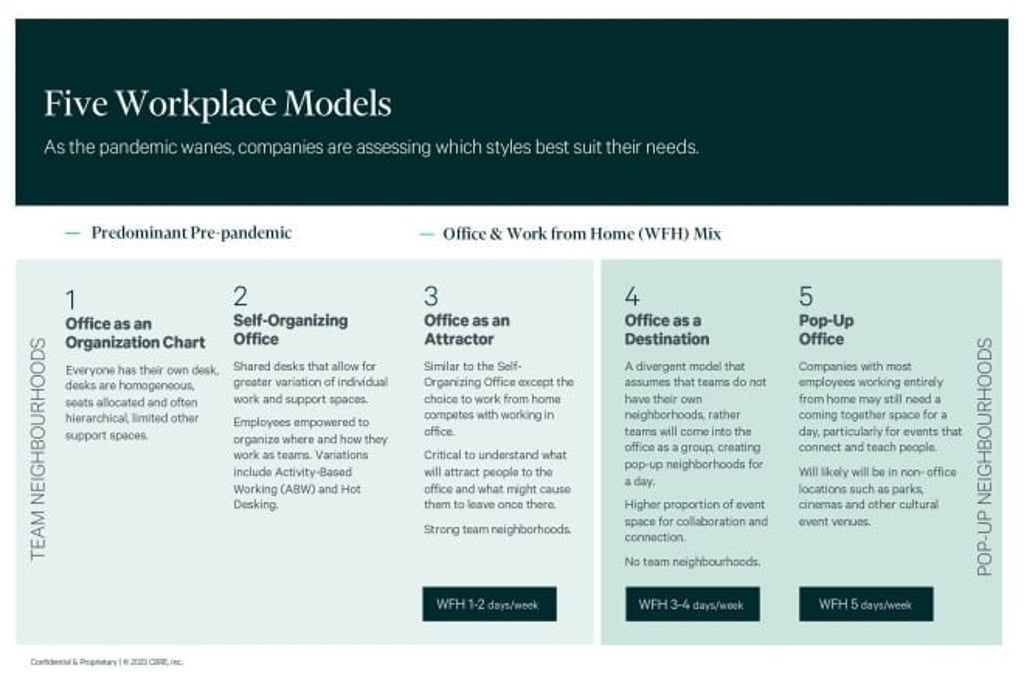
As the pandemic wanes, companies are assessing which styles best suit their needs. “For a few decades before the pandemic, we had a traditional office layout consisting of mostly enclosed offices, semi-open cubicles, communal social space and meeting rooms – it was as if you painted the organisation chart on the floor,” says Peter Andrew, APAC Executive Director of Workplace Strategy for Asia Pacific at CBRE. In more recent years, workplaces that support empowered, self-organising behaviour have emerged. This type of mostly open office plan is characterised by shared desks and rooms, with variations including hot desking and activity-based working (a diversity of quiet and collaborative desks for different activities).
Variations in work-from-home policies
Andrew says hybrid work policy varies depending on cities, industries and even companies – more than ever before “one size does not fit all”. In Australia, for example, employers tend to be more WFH-friendly because a WFH culture had already existed well before the pandemic. The ‘Office as a Destination’ (WFH 3-4 days a week) and ‘Office as Attractor’ (WFH 1-2 days a week) configurations tend to be more suitable for Australian companies.
In Singapore, the government has taken the lead in implementing what it calls the ‘Tripartite Standards’, which are a set of employment practices for Singapore-based organisations aspiring to be progressive employers. This policy includes adopting hybrid work arrangements in government agencies. Eligible public officers in job roles which are conducive to hybrid work are allowed to telecommute for an average of two days a week.
In mainland China, however, almost everybody comes to office like it has never changed; Hong Kong SAR is somewhere between Singapore and mainland China, with multinationals and large organisations taking the lead by offering options for employees to work from home for a day or two per week. Despite the ongoing tug of war between bosses and workers over how many days they can be away from their office, flexi-work is here to stay, especially where there is a scarcity of talent, such as in the telecom, tech and banking sectors, says Andrew.
“Meanwhile, younger generations, from millennials to Gen-Z, are attracted to hybrid work options and consider workplaces designed for flexibility, innovation and well-being an important part of the job offer. A work environment that performs as a cultural hub which ensures meaningful engagement with employees in line with their expectations will go a long way in attracting and retaining them,” says Seng Han Lee, Director and APAC Commercial and Platform Lead of Project Management at CBRE.
Opportunities to rethink workplace strategy
As far as productivity is concerned, multiple studies have confirmed that over half of companies report increased productivity when allowing employees to work remotely. Workers have also seen increased productivity as they spend less time commuting and take fewer sick leave days. And since fewer employees are required physically in the office for the same amount of work, some companies have seized this opportunity to consolidate their office spaces by moving to high quality CBD locations or expanding outwards to city-fringe locations, according to Andrew and Lee.
As well as integrating a blend of flexible, team and event spaces into the workplace, many companies have also set net-zero targets, expanding real estate sustainability strategy beyond energy savings to include decarbonisation and ESG criteria.
Lee notes that as an integrated consultant, CBRE can help businesses reduce their carbon footprint as part of their workplace strategy. “For example, we can advise on eco-friendly ways to construct and retrofit premises and the implementation of energy efficiency measures required for meeting green building certifications.” The acquisition of a controlling stake in Turner & Townsend last year has strengthened CBRE’s capabilities in programme management, project management and cost consultancy, he adds.
While reconfiguring physical space has profound implications for the way companies operate and develop in the future, people are still the key to success. Businesses need to explore and examine all potential scenarios and make sure they have the right workplace strategy in place. “At the end of the day, businesses need to keep in mind how to keep people productive and motivated wherever they work,” says Andrew.