CLP to power Hong Kong to carbon neutral future

[Sponsored Article]
In tackling the challenge of climate change, every industry must play its part, but clearly certain sectors bear a heavier share of the responsibility.
For instance, in Hong Kong, around 60 per cent of carbon emissions are from electricity generation, with a further 20 per cent from transport, so attention naturally focuses on what’s being done there – and with what degree of urgency – to implement plans, reengineer processes, and meet the necessary targets.
“If you can decarbonise the electricity supply and make carbon-free power available for transportation, that goes a huge way to decarbonising the broader economy,” says Richard Lancaster, chief executive of CLP Holdings, which provides about 75 per cent of Hong Kong’s total power. “The good news is that all the technology we need to do this is proven, existing and commercially available. It just requires careful coordination and planning and good collaboration between government, industry, customers and regional partners. It is a big responsibility, but we can do it, while still maintaining reliability and affordability.”
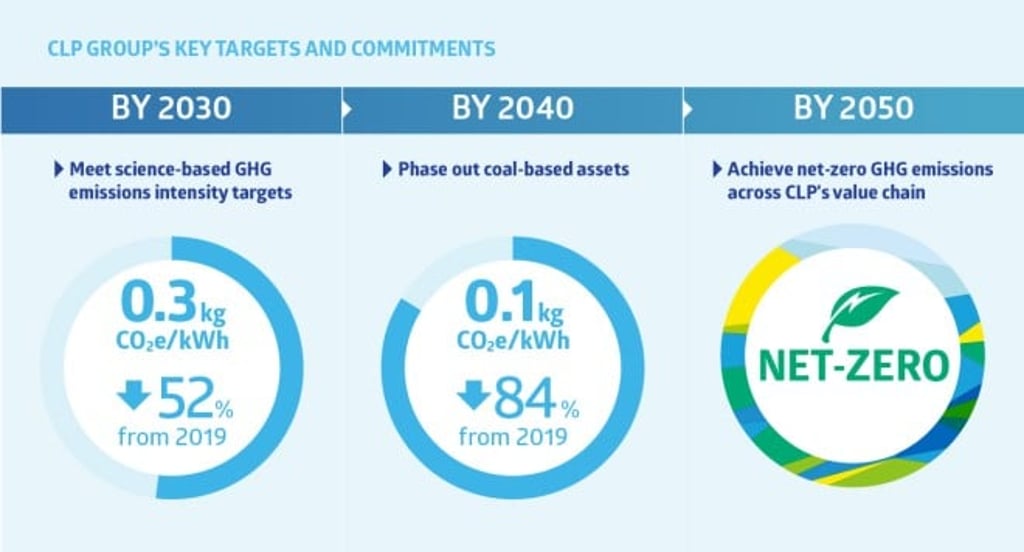
The first step was to look at geographical constraints and resources, and the need for diverse technologies to replace fossil fuels, especially coal, which CLP will completely phase out by 2040 under its Climate Vision 2050, the blueprint for the company to decarbonise its businesses in Hong Kong, Mainland China, Australia, India, Southeast Asia and Taiwan. CLP is committed to achieving net-zero greenhouse gas emissions across the value chain by 2050.
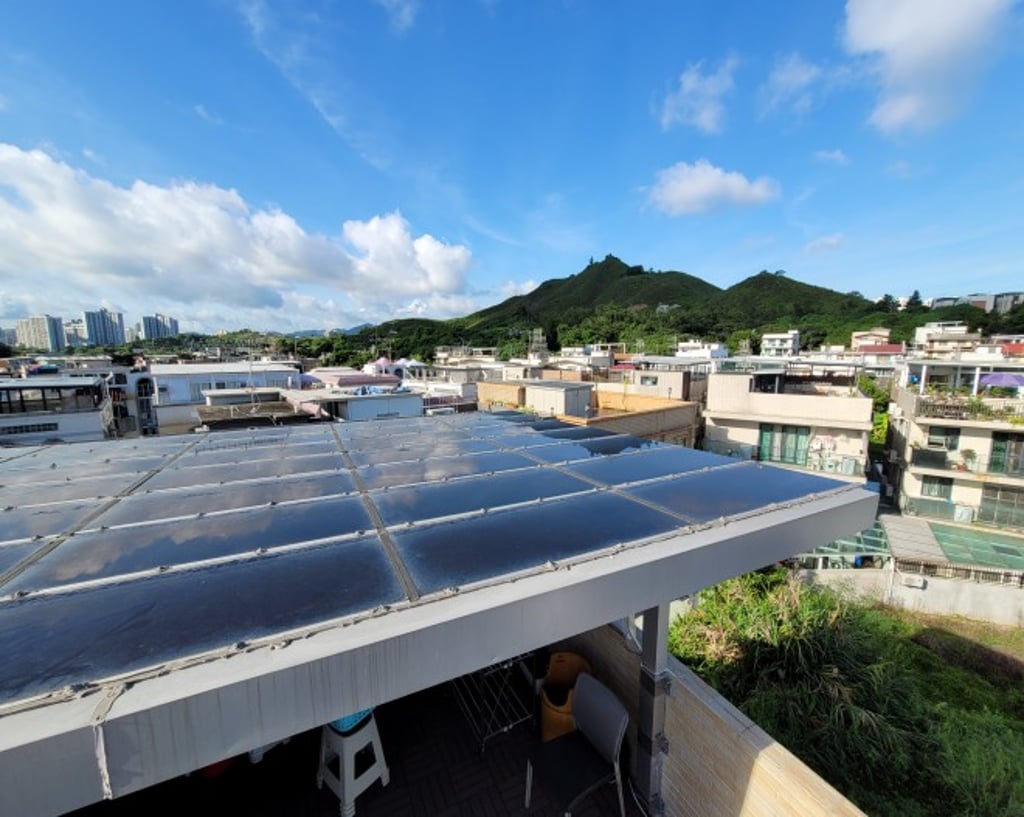
The new mix includes renewable energy sources, such as wind and solar, nuclear power, and projects to convert natural gas generators to using green hydrogen.
That, of course, requires significant ongoing investment in new or modified infrastructure, as well as close cooperation with mainland and regional suppliers to explore schemes like the joint development of offshore wind farms in the seas around Hong Kong.
The possibility was first looked into more than 10 years ago, but at the time was judged uneconomic. Now, with better and cheaper technology available, the idea is once again back on the table.
“We have identified a site off the coast of Sai Kung and are updating and redefining the project,” Lancaster says. “The wind turbines you can buy today are four times larger than a decade ago, and that has improved the economics enormously.”
Renewable energy including offshore wind and solar energy, together with waste-to-energy, could contribute a tenth of electricity needs in Hong Kong. Additionally, there is an opportunity to tap into more nuclear power from China, which has been a safe and reliable source of supply for the past 25 years.
CLP also has high hopes for green hydrogen. It doesn’t emit carbon when burnt and can be produced by separating it from the oxygen in water by using an electrolyser. In principle, hydrogen could be fed into the pipeline network, which already stretches from Central Asia bringing natural gas to Hong Kong. The goal would then be to switch initially to a blend of natural gas and hydrogen and, ultimately, to hydrogen alone.
“That’s the way I would see it happening,” Lancaster says. “We can repurpose all the infrastructure we are building today to import hydrogen, including the LNG (liquefied natural gas) import terminal and storage facilities currently under development.”
It is helpful to have a clear Hong Kong government policy and climate action plan to achieve carbon neutrality before 2050. It is also encouraging to see a common sense approach to Greater Bay Area collaboration and establishing regional frameworks to accelerate decarbonisation. And, with ever-increasing community support for green-themed initiatives, the issues associated with winning over institutional investors and other stakeholders are gradually becoming less of an obstacle.
“We have alignment here between government and the industry,” Lancaster says. “But remember too we are part of a global change in the way we produce and use electricity. That will take trillions of dollars of investment to make it happen, opening up opportunities for Hong Kong which, as an international financial centre, is in a great position to benefit.”
He emphasises, though, that to go with every plan or target - at CLP or anywhere else - there must be a real sense of urgency. In figurative terms, it is not enough simply take the foot off the accelerator. Rather, it is essential to hit the brakes hard and then reverse.
“We need to do the work now,” Lancaster says. “If we leave it to the next generation, it will be too late.”