Angkor Wat marathon: 6,500 runners race through Cambodia’s ancient Khmer empire
This year’s Angkor Empire Marathon saw participants race through misty forests and villages, and past ancient temples and rice fields, as dawn broke over Cambodia’s spectacular Angkor Archaeological Park.

Under the cloak of darkness, runners gather in their hundreds at the entrance to the Angkor Wat temple complex, in Cambodia’s Siem Reap. They wait in groups, stretching muscles to pumping house music while a little way off, apsara dancers and traditional Khmer musicians help lift the early-morning energy.
Volunteers, many of whom have been at the site since 2am, hand out bottles of water to a crowd of runners and spectators that started arriving at 3.30am, ahead of the staggered starts of the 11th Angkor Empire Marathon.
From a small stage framed by the stone carvings of mythical Nagas at the main-road end of the causeway that crosses the moat to Angkor Wat, two emcees shout out motivational phrases in Khmer and English.
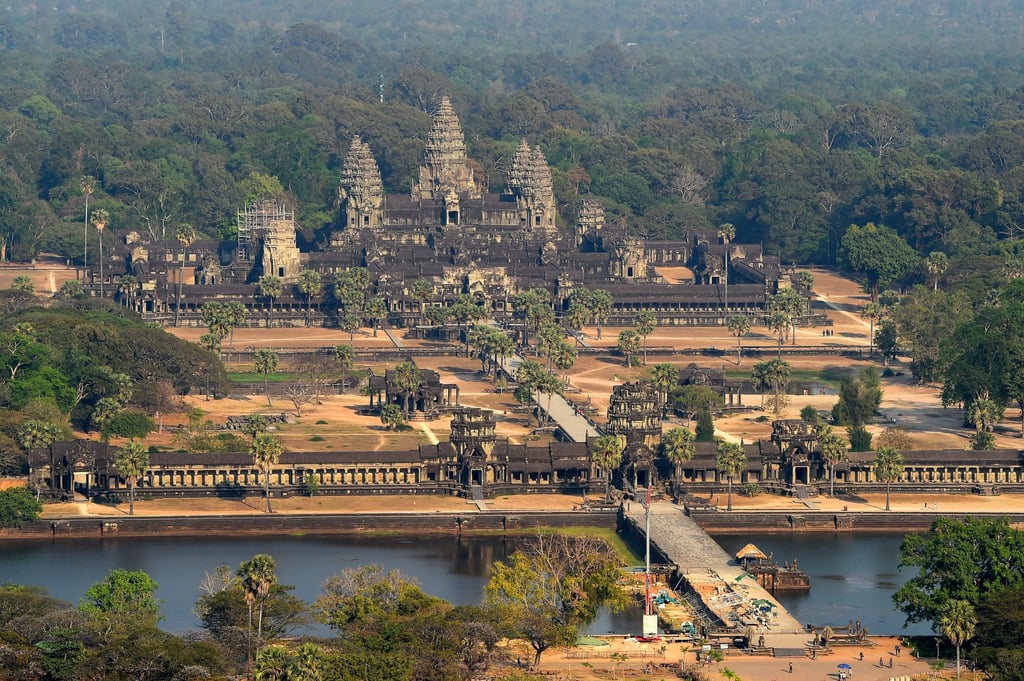
As the clock ticks down to 4.30am and the start of the first of four races – the full, 42km (26 miles) marathon – pacers make their way to the starting line, competitive racers cramming in behind, waiting for the klaxon to sound. With minutes to go, dignitaries deliver speeches from a stage, wishing competitors luck, thanking sponsors and praising the event’s success over the years.
“Angkor Wat always has such a special vibe, so it will be exciting to run among all of the ancient temples,” says Christine Hellington, 32, an Australian who recently moved from Cambodia to Vietnam and is competing in her first marathon. “I’m hoping the atmosphere will help push me through, so I can actually finish it.”
National Olympic Committee of Cambodia (NOCC) president Thong Khon, Chinese ambassador Wang Wenbin and NOCC secretary general Vath Chamroeun together light a torch with a blazing flame to officially open the event, then the klaxon sounds and the runners set off towards Siem Reap city, roared on by spectators young and old, who are lining the road.
For many competitors, such as Hellington (who did manage to complete the 42km, in five hours and 34 minutes), this marathon’s appeal isn’t just about finishing. Unlike conventional city races, in which competitors run in the shadow of skyscrapers and urban landmarks, here, runners spend much of the course among the temples, settlements and reservoirs that once formed the heart of the Khmer Empire (802-1431).