As I look out the aeroplane window on our descent into Yerevan, Armenia’s ancient capital, and see the snowy cone of Mount Ararat rising up out of ripples of cocoa- and rust-coloured earth, the ghosts of the past take shape, the mountain a solid reminder of a genocide Turkey still contests doesn’t qualify for the term: the killing of what many believe to be at least 1 million ethnic Armenians living within the Ottoman Empire in 1915-16.
The Biblical resting place of Noah’s Ark after the Great Flood, Mount Ararat is known across Christendom and in the Jewish faith as a holy site. But to Armenia, the first country in the world to officially adopt Christianity as its religion, in AD301, the mountain is even more significant. The 5,137-metre-tall stratovolcano is part of the national identity, a symbol depicted in the country’s coat of arms, and the fertile Ararat Valley is known as the cradle of Armenian civilisation.
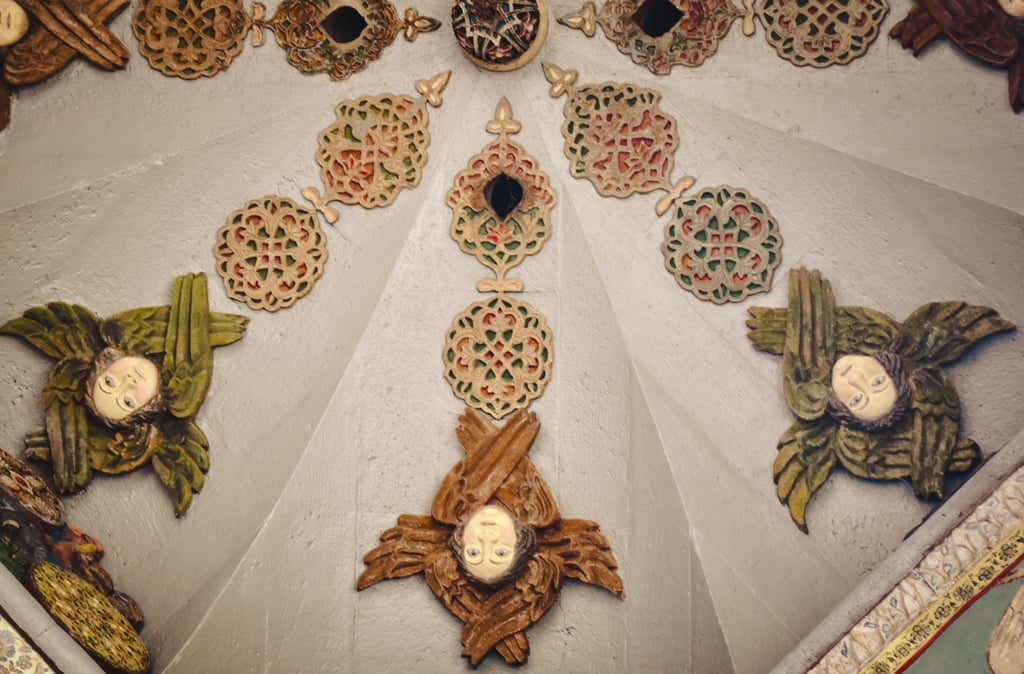
A detail of Etchmiadzin Cathedral, on the outskirts of Yerevan, said to be the world’s oldest cathedral. Photo: Victoria Burrows
Today, however, Mount Ararat lies not in Armenia, but in Turkey. The double-peaked mountain (with Little Ararat alongside, at 3,925 metres) was part of Armenia for 3,000 years but then came under the control of various empires, including the Persian and Ottoman. Several treaties signed after World War I granted the mountain to Turkey.
It may now be across the border and, as a national symbol, it is tinged with loss, but Mount Ararat still overlooks much of western Armenia. Its rich soils continue to give life to the country, including for its fruit, vegetable and nut cultivation, exports of which are booming.
The Ararat Valley, with its volcanic soils and microclimates, is an extraordinary terroir also for vineyards, including Voskeni Wines, at Sardarapat, close to the border with Turkey. The story of the brother-and-sister winemaking duo behind Voskeni echoes those of many young Armenians who are rolling up their sleeves and building a future.