Accounts of mysterious and ancient ruins overgrown by Southeast Asian jungle first reached Europe by way of 16th century Portuguese missionaries. But it would be a 19th century French bug collector who would earn his place in history for discovering the imperial capital of Angkor, whose central temple complex would come to be known as the largest religious structure in the world. The Angkor Archaeological Park now attracts more than 2 million visitors per year.
The diaries of Henri Mouhot, Travels in the Central Parts of Indo-China (Siam), Cambodia and Laos During the Years 1858, 1859 and 1860, published posthumously in 1864, described “a rival to that of Solomon, and erected by some ancient Michael Angelo”, that he believed was “grander than anything left to us by Greece or Rome, and presents a sad contrast to the state of barbarism in which the nation is now plunged”.
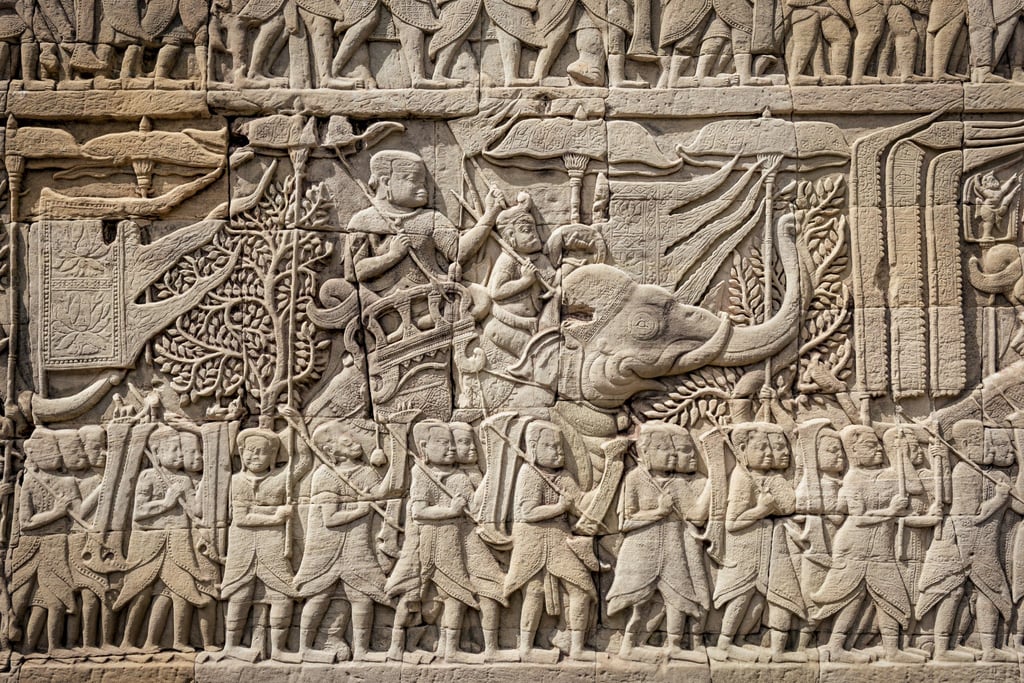
The Bayon Temple stands in the heart of Angkor Thom, the carved bas-reliefs on the outer walls depicting heroic tales and scenes of everyday Khmer folk. Photo: Getty Images
Like Marco Polo’s account of Yuan China half a millennium before, Mouhot’s descriptions of Angkor captivated the European imagination, informing the mission civilisatrice that was braided into the French colonisation of Southeast Asia. However, “the French had a problem”, says historian and anthropologist Jack Weatherford. “That is, they didn’t have anything special to show. The English had the Taj Mahal […] French travellers wrote that they should take Angkor before the English could. But it belonged to Siam at the time.”
Cambodia was made a French protectorate in 1863 and, in 1896, the Anglo-French Declaration created an independent buffer zone of Siam (Thailand) between French Indochina and Burma, which was part of the British Raj at the time. The declaration, however, didn’t prevent the French from wresting Cambodia’s “lost provinces” – including the closest habitation to Angkor, Siem Reap – from Bangkok in 1907, a line in the sand germane to the border dispute between Thailand and Cambodia that caused 43 fatalities and displaced 300,000 people this year.
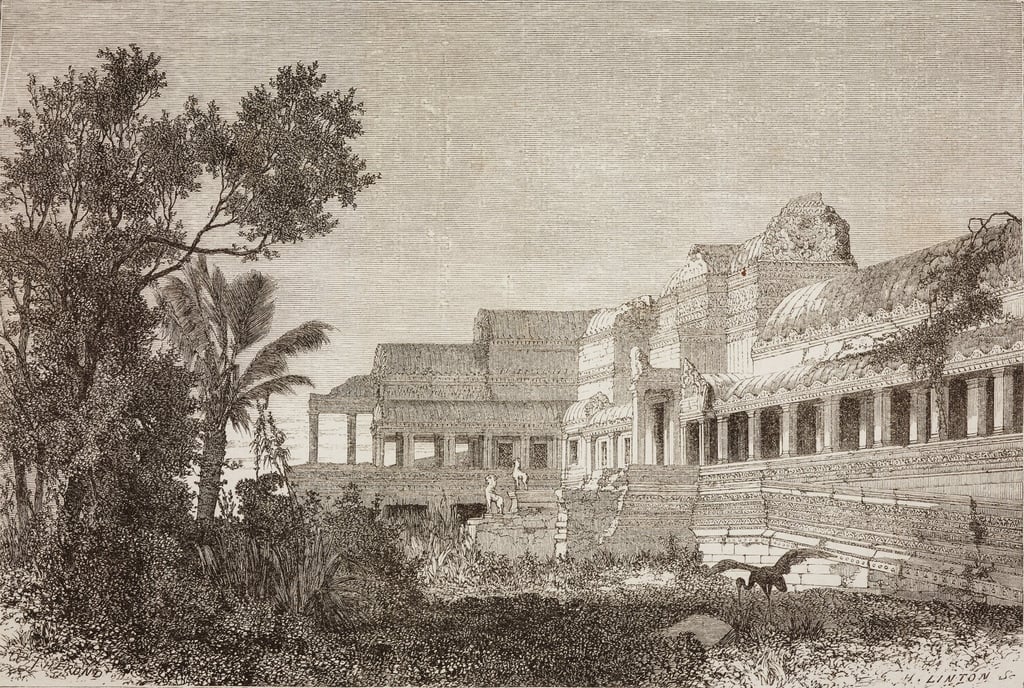
A drawing of the central portico of Angkor Wat, from a sketch by the French naturalist Henri Mouhot, circa 1858-1861. Photo: Getty Images
“So Angkor Wat became their great monument, their Taj Mahal,” says Weatherford, who has reservations about the “artificial” way the French curated Angkor for sightseers. “It’s too much shaped by the French interests. They built a park, like in Paris.”