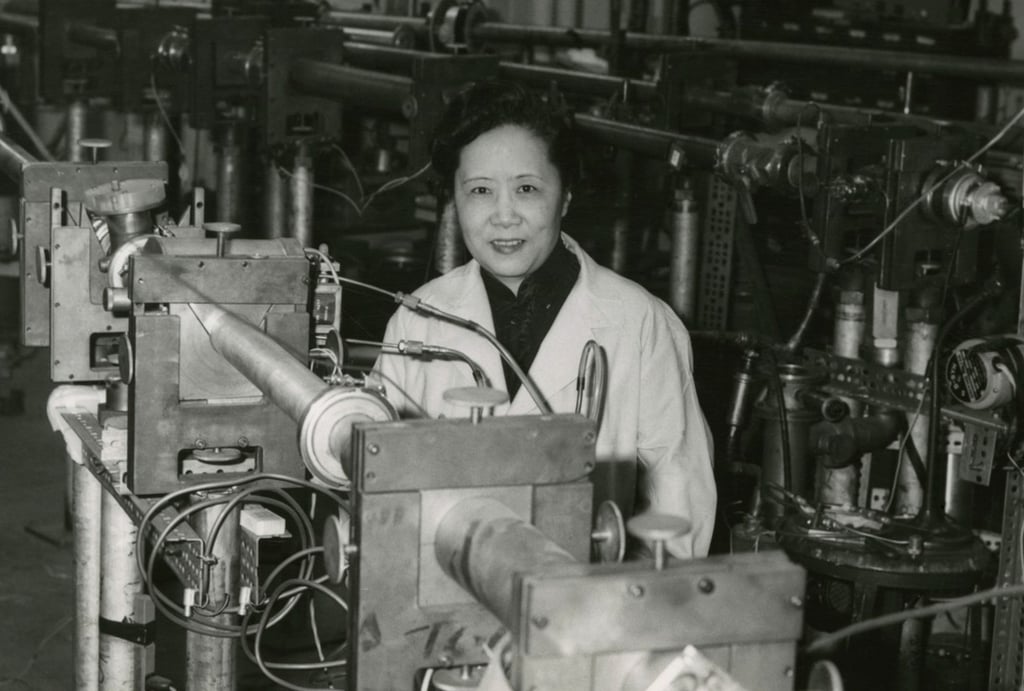
Forty kilometres out of Shanghai, not far from the historic village of Liuhe, where the Yangtze spills out into the sea, stands a three-storey bronze statue of a woman who conducted the most important physics experiment of the 20th century. Born in Liuhe in 1912, Wu Chien-shiung’s career would span seven decades, during which time she would confront Chiang Kai-shek as a student activist, cross the Pacific to become the belle of Berkeley, and play a top-secret role in the United States’ development of the atomic bomb.
Wu would cap off her research career with an experiment that overthrew a fundamental law of nature, only to be snubbed when the Nobel Prize for that discovery was awarded. She would continue working into the 1990s, and in her later years, the scientist now known as “the Queen of Physics” emerged as an advocate for women in science and worked tirelessly to improve science infrastructure in China. And all while navigating the increasingly fraught geopolitics of the time.
Today, as a bill to exclude Chinese students from American universities is being debated in the US Congress, the legacy of Wu, whose intellect and work ethic were developed and nurtured in China then fine-tuned in America, may be more important than ever.
Wu Chien-shiung, who was born in China in 1912, was one of the most consequential physicists of the 20th century. Photo: Wikipedia
Wu emerged from an environment that blended traditional Chinese culture and modernism. Wu Zhong-yi, her engineer/businessman father, and Fan Fu-hua, her teacher mother, were progressives from well-to-do scholarly families who opened the Ming De School for girls in Liuhe, emphasising not only the Analects of Confucius and Chinese poetry but also maths and sciences. Crucially, the couple, who also had two sons, recognised their daughter’s remarkable intellectual qualities.
Her father started reading articles in scientific journals to Wu before she learned to read, and allowed her to play with the quartz radios he constructed. He was not just a scholar, he was also a revolutionary who embraced boldness and took part in China’s 1911 revolution. He included “shiung”, the Chinese character for “hero”, in her name, and held up the Ming dynasty explorer-diplomat Zheng He, whose legendary seven voyages set sail from their hometown, as a “bang yang”, or life example.