How Wilson Cheng’s start-up is cutting in-flight food waste
PostMag talks to five bright and ambitious recipients of the AIA Scholarships initiative to find out what lies ahead for them: here, we meet Wilson Cheng, a computer-science student combating in-flight food waste through coding and artificial intelligence

There is a 7mm gap between the main body and the handle of an airline trolley – that is the space Wilson Cheng Wui-sum’s camera has to fit into without disrupting the in-flight service.
Cheng, 21, majors in computer science at Polytechnic University with a minor in information security. In August 2025, he and four friends incorporated a start-up that helps airlines reduce food waste using artificial-intelligence-powered devices. It is, by design, unglamorous: a compact gadget, mounted on a service trolley, running offline at cruising altitude. As trays are returned to the trolley, the device’s camera records the leftover contents and the AI-driven tracking app identifies what has (and hasn’t) been eaten – half a portion of the main course, a bread roll, a drink barely touched.
Born from a sustainability hackathon held by a local airline in 2024, his start-up’s solution addresses a pressing issue: more than US$5 billion worth of in-flight meals are wasted each year. Roughly 30 per cent of all food and drink goes uneaten, according to Cheng. He and his team placed third in the competition, and are now partnering with the airline to launch a smart waste-tracking system.
You find the problem, take it apart and try different ways to solve it
Computer science “is a problem-solving puzzle”, says Cheng. “You find the problem, take it apart and try different ways to solve it.” He has been taking things apart since childhood, his toys becoming disassembled components. In secondary school, he chose chemistry, physics and information and communications technology, then immersed himself in robotics.
Even when life throws him curveballs, he doesn’t slow down. In Form Five, he developed a weakness in his lower limbs. A walking frame came first; a wheelchair followed. He sat the Diploma of Secondary Education (DSE) on schedule anyway, and took up his undergraduate studies at PolyU. Because traditional engineering – with its labs and physical demands – would have been difficult, coding began as a compromise, but it quickly became a calling.
He admits “the adversity was daunting”, but his friends kept him going – the classmates who went through DSE with him and the members of his start-up, for which one person designs, another manages the business, a third leads strategy and a fourth oversees finance, leaving Cheng as the coding brain. “I might think something won’t work, until someone else looks at it from another angle,” he says, referring to the team’s synergistic advantages.
Cheng believes that university projects should be about more than just ticking boxes. It wasn’t until he joined the robotics club at PolyU and worked on motor-tuning for a robotics competition that he took on his first challenge outside the conventional curriculum.
Cheng’s device came from an almost comical prototype: a robotic arm affixed to the service trolley to sort rubbish in the aisle, followed by a brief phase using millimetre-wave sensors. What survived is a portable tool with a camera, used offline, at a slightly tilted angle, and an app that goes along with it as the tracking intelligence. “I wouldn’t say it was a very mechanical or very clever method,” he says. “It was simply a product of experimentation.”
But the moment the device is placed into the hands of a flight attendant, everything changes. Abstract design instantly gives way to real-world stakes. With the tracking system at work, the captured data is the true asset. Cheng’s long-term play is to leverage anonymised consumption trends, such as overall meal popularity, to help airlines stock in-flight meals with greater precision. Cabin service has “optimised so many steps, but nobody has asked whether you actually like chicken”, he says. Sustainable waste reduction, as he sees it, is a consequence of understanding preferences. “In one sentence: it is a data-driven solution.”
Cheng’s faith in data, however, does not make him an unquestioning evangelist for AI. He uses it regularly, but warily, treating its results as something to test rather than accept. “You can’t take it at face value,” he says. For him, the real question is not whether a technology is clever, but whether it is useful to the person who has to live with it. An airline’s head office may love a new tool that fulfils an environmental, social and governance mandate, but a flight attendant asked to host it on their service trolley might feel differently about its practical uses within already limited space.
For him, doing good means remaining invisible. “Truly good tech is when the user doesn’t even realise it’s there,” he says. “Ideally, zero user friction.”
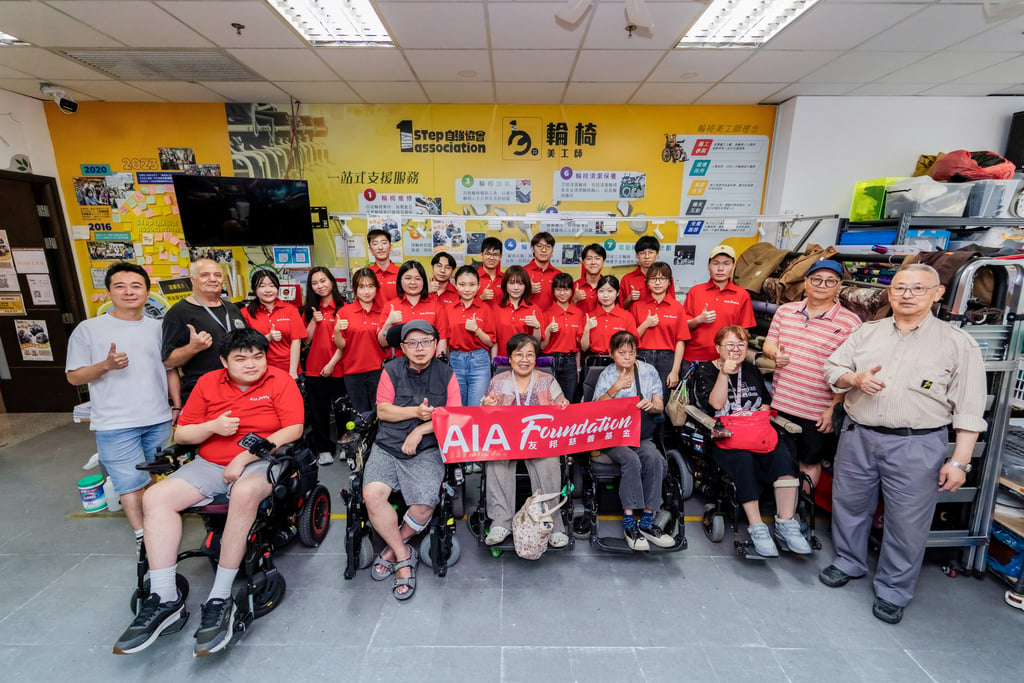
Cheng is expected to graduate in 2027, and is mapping out a career in IT and AI while continuing to work on the start-up. As an AIA Scholar, he has access to events that AIA hosts across the year, and has volunteered at wheelchair-cleaning sessions and the annual AIA Community Day, held at the Central Harbourfront, that brings together hundreds of children from underprivileged families. He moves fast in his motorised wheelchair; the kids like to run after him. Cheng appreciates these opportunities as motivation to socialise and connect with the community. Receiving financial support through the AIA Scholarships programme for his undergraduate degree has also allowed him to channel other funds towards upgrading his wheelchair and improving his quality of life.
At home, his room is filled with Snorlax plush toys because, he jokes, the Pokemon looks like him. While the comparison is playful, it’s not entirely misplaced. Snorlax is known for its ability to take hits and remain in the game. Cheng, too, absorbs the friction of a world not entirely built for him, but doesn’t allow it to define his limits. Unlike his cuddly Pokemon counterpart, however, his analytical mind never idles – it is always focused on finding the problem, taking it apart and trying and trying again.