How Atta Yu is transforming the landscape for visually impaired Hongkongers
PostMag talks to five bright and ambitious recipients of the AIA Scholarships initiative to find out what lies ahead for them: here, we meet Atta Yu, an occupational-therapy graduate co-creating inclusive environments and accessible experiences with the visually impaired

Kowloon’s Choi Hung Estate is one of the most photographed corners of Hong Kong, its rainbow facades gracing thousands of Instagram grids. But how do you translate those colours, structures and spaces into something that a visually impaired person can “see”?
Atta Yu Yee-ting, 22, a fresh graduate in occupational therapy from Polytechnic University, has an answer. Launched in 2026, CitySync – an initiative of the Inclusive Horizons project, of which Yu is a co-founder – is a community-serving cultural tour to Choi Hung Estate, built around a tactile map. Its surfaces rise and fall, with Braille indicating topography and different textures standing in for colours. As users navigate the public-housing complex, they read the map with their fingertips, assisted by volunteer guides.
“By touch, they can form a three-dimensional mental picture,” says Yu, “so that they have a much clearer sense of the place.” Her tactile maps offer a multisensory solution: 3D contours provide a physical “image” of the environment, while audio tracks narrate the history of each stop, allowing visually impaired people to “see” and experience their surroundings.
Hong Kong is not without assistive infrastructure: there are tactile elements on pavements, audio at crossings and, increasingly, tactile information on crossing posts, indicating the number of safety islands ahead. But the harder challenge, says Yu, goes beyond the routines: what happens when a person wants to step outside a familiar route, to explore?
“For visually impaired people, they can manage their daily life just fine,” she says. Regular activities are often supported by family and friends. While sighted users can easily navigate Google Maps using the app’s given directions, nearby landmarks and topography, screen readers can only translate written words, leaving visual-spatial data out of reach. “When you’re trying to convey a physical map or an image, text-based audio just isn’t enough,” says Yu.
For her, accessibility is not only about getting from one point to another. It is about building the tools that allow visually impaired people to claim fuller roles – as workers, guides, makers, athletes, teachers. Many of her visually impaired friends, she says, cycle through short-term internships, NGO placements or temporary gigs. More permanent job opportunities remain relatively limited, both in variety and availability.
But on tours in Choi Hung Estate, she watches them turn the tables and provide guidance to sighted volunteers with remarkable insight, teaching them how to describe obstacles, leading without the need for hand-holding and letting someone build a mental picture of their surroundings, a testament to their communication skills. Without full sight, “they use all parts of their body” to relay ideas, she says. What limits them, Yu came to understand, is often not ability, but access: to support, to assistive tools and to a job market with them in mind.
Yu first became aware of the city’s accessibility challenges during the Covid-19 pandemic, when she packed her weeks with volunteering to help residents with visual impairment. She met a woman in her 60s who had lost her sight later in life and needed an escort for a routine medical appointment. While the trip itself was short, the hospital was difficult to navigate; midway through, a text message arrived, ordering her into home quarantine.
Yet the woman was anything but passive. After losing her sight, she took up running, starting with 10km and gradually progressing to a half marathon. “It made her feel really empowered,” Yu recalls, “that she was able to do something she never thought she could do.”
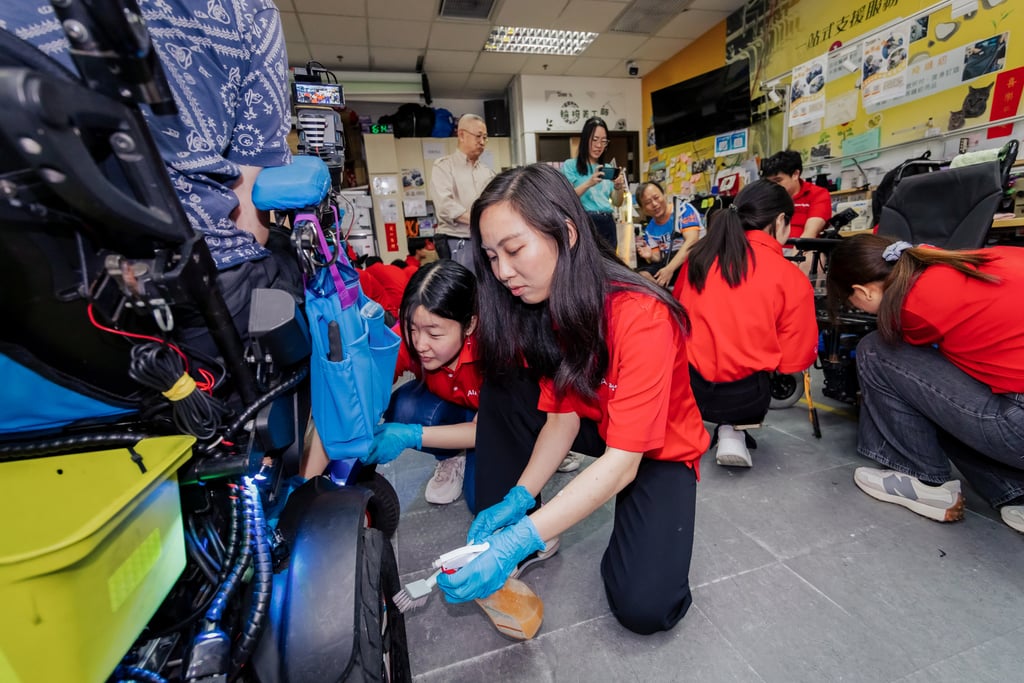
As a recipient of the AIA Scholarships, Yu’s undergraduate tuition fees were supported by the initiative’s funds, leaving her able to pursue her broader ambitions.
Service trips to rural Mongolia and China’s Yunnan province in the past two years further galvanised her to action, having met a young girl whose hands had been amputated after an electrical accident. Beyond managing basic daily tasks, the girl longed to play badminton again, a sport she loved. Yu, as the student leader of the We Care We Share Community Rehabilitation Programme at PolyU, worked with her peers to create a customised, 3D-printed cuff that allowed the girl to hold a racquet once more.
For CitySync, the AIA Scholar is planning a new route for Tai Po district. Another project she worked on features a web platform, where a user simply types in a description of an object and the software generates a 3D-printed model. Yu says she was partly inspired by a congenitally blind designer in Denmark who creates custom 3D-printed objects to assist with his daily life. To Yu, this represents practical empowerment at its finest: not waiting for a solution to be manufactured, but building one yourself. She imagines a future in which 3D printers are freely available at community centres, where users in need can produce simple tools: a cane tip, a Braille tag for a desk or a map.
During her university years, Yu went through something of a personal transformation, evolving from a reserved, shy student into an empathetic, creative problem-solver. Having originally planned to become a surgeon, Yu is embracing her new path. “When you feel like a door is closed [to you], you just need to try to open another door, even if you’re uncertain,” she says. “Each person holds their own key.”
In her spare time, she continues to open new doors – be it river trekking, traditional Chinese dance or percussion instruments. She is curious about people and how they form different perspectives all while living on the same planet, and that curiosity has shaped how she gives back to society as an AIA Scholar: not through solo work, but through collaboration and co-creation with those in need – in her words, “the true experts of their life”.