-
Advertisement
PostMag
Life.Culture.Discovery.
Architecture and design
PostMagDesign & Interiors

The origami apartment: how washi paper and precision design reshaped a Tsim Sha Tsui flat

This luminous, Japanese-inspired bolt-hole in Tsim Sha Tsui is a far cry from its gloomy, fragmented beginnings

Reading Time:3 minutes
Why you can trust SCMP
Living area of the flat in Tsim Sha Tsui designed by GAAN. Photo: Eugene Chan
Adele Brunner
Some spaces, like people, are simply waiting for their second act. For a rundown unit in Tsim Sha Tsui, this meant a total transformation into a modern pied à terre.

Frank Chan first lived in the 500 sq ft space as a boy soon after it was built in 1959. Although the property remained in his family, he had long since moved out, creating a life in Canada with his wife, Mary (who is also from Hong Kong). When the couple, now retired, decided to spend more time in the SAR with friends and family, they opted for a central lock-and-leave retreat.

“Although the location was perfect for us, the place was horrid,” says Frank. “There were structural columns and beams all over the place. We needed a coherent design for a liveable space.”
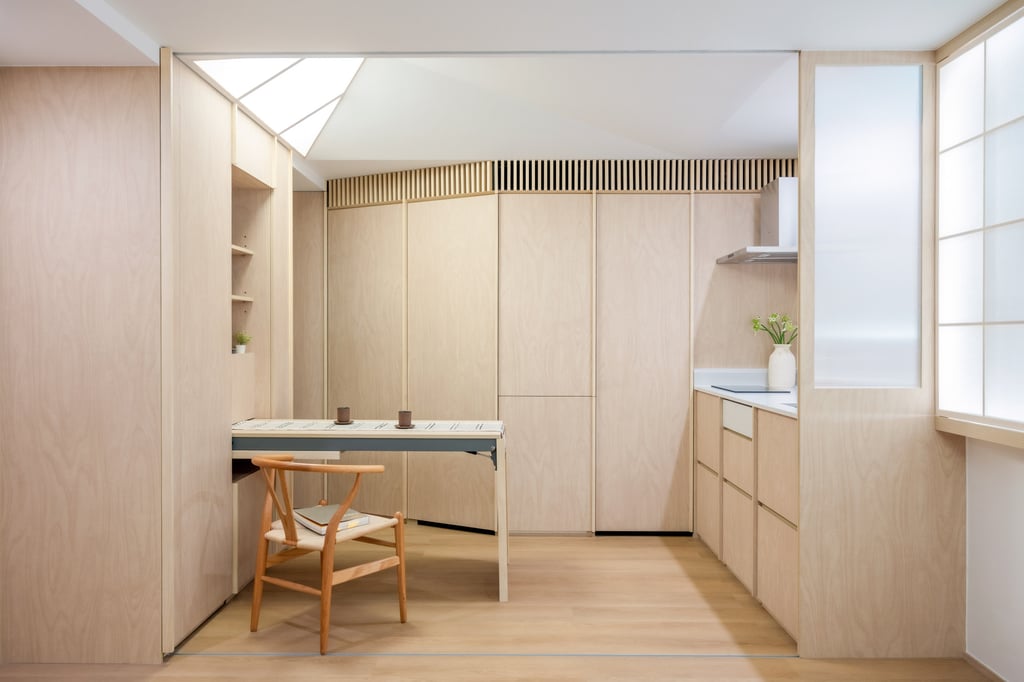
Dining area. Photo: Eugene Chan

Enter British-registered Irish architect David Magennis and architectural designer Bonnie Chau Chi-huen, who grew up in Hong Kong. The pair, who are behind GAAN, were tasked with the property’s makeover. Not only did they have to figure out how to incorporate sleeping space for six people (including a baby) as well as the full complement of washing, dining, storage and living facilities, they also faced a tight deadline: the flat had to be ready in three months for a family event.

Advertisement

The design duo’s first move was to strip everything down and start again. Drawing on the Chans’ appreciation of Japanese aesthetics, Magennis and Chau created an introverted space and transformed the neglected unit into a stylish one-bedroom, two-bathroom bolt-hole.

“The only natural light came from an unsightly lightwell but Mary and Frank emphasised the need for a window treatment that ensured they didn’t have to look at it,” says Magennis, who has been living in Hong Kong for three years, after having set up Gaan, with Chau, in Ireland in 2021.

Kitchen. Photo: Eugene Chan
He and Chau masked the problematic windows and lightwell with shoji screens, made from textured Japanese washi paper and backlit to emit a soft, ambient glow. This ingenious solution blossomed into a recurring motif: triangular “skylights” of the same mulberry-fibre paper were strategically placed above doorways, along corridors and over key furnishings. Chau and Magennis also installed a false vaulted ceiling to disguise ugly beams and impart a feeling of height. The apex of each skylight marks the centre point of the area below.
Advertisement
Select Voice
Select Speed
1.00x