The Hong Kong film industry’s output in the 1980s and 90s was kinetic, breathtaking, bursting with innovation and energy. Films of the era insisted on packing everything possible into the run time, as if they knew something we didn’t: the city’s economy was booming and filmmakers enjoyed the kind of artistic freedom and backing that was, like the period itself, never going to last forever.
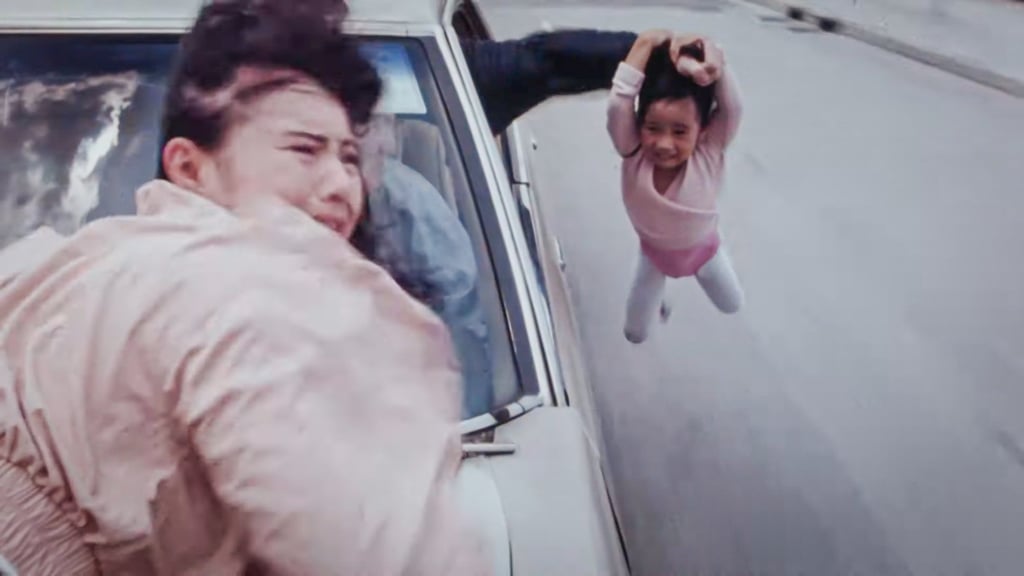
A child is dangled from a moving car while Moon Lee Choi-fung clings to the bonnet in 1990’s Fatal Termination. Photo: Golden Sun Films
One of Hong Kong’s most memorable cinema fads of the era became known as Girls with Guns and, like all the best movies from Hong Kong, gave viewers exactly what the name implied: women armed to the teeth, who could wreak just as much havoc with their bare hands. Some of the genre’s stars are now recognised globally, such as Michelle Yeoh Choo Kheng and Maggie Cheung Man-yuk. Others, like Yukari Oshima and Jade Leung, are known mostly among aficionados, even if their films were as good or sometimes better than those of more popular stars.
For a decade, these films provided their audience with some of the craziest movie experiences available anywhere, and the rise and fall of the genre, along with the reasons behind both, provide a glimpse into the workings of the wider industry at the time.
The history of Hong Kong heroines predates the Girls with Guns craze, of course. From Cheng Pei-pei’s iconic 1966 performance in King Hu Jinquan’s Come Drink with Me to Angela Mao Ying’s Golden Harvest kung fu films of the 70s, Hong Kong cinema embraced girl power long before Hollywood, too: Nora Miao Ke-hsiu appeared alongside Bruce Lee, Jackie Chan and others, not as arm candy but as a serious presence. Josephine Siao Fong-fong’s prolific career has proven her enduring appeal, and even into her 40s she remained a formidable presence, the proof of which can be found in Jet Li’s Fong Sai-yuk films of the early 90s.