Advertisement
Then & NowHong Kong’s surprising history of recycling
Believe it or not, Hong Kong was better at recycling before ‘sustainability’ became a buzzword
2-MIN READ2-MIN

Reduce, reuse, recycle; across the globe this mantra has become familiar to anyone with even a glimmer of environmental awareness. But how closely followed are these instructions, especially in Hong Kong, where effective recycling processes, rather than feel-good performative gestures, are easier said than done?
No doubt to the surprise of many today, Hong Kong was a highly efficient recycling society a century ago. Everything had a secondary use, and much like today entire families derived their livelihood from scavenging reusable materials from rubbish skips. In any society, recycling presupposes a demand for whatever it is that is being reused. Either this demand is for the specific manufactured item itself, such as glass bottles or newsprint, or for the raw material itself, which can be melted or pulped and then re-made into similar products. When secondary demand is absent, an essential component in the recycling chain breaks down.
Some recyclable items in everyday use in Hong Kong several decades ago, such as newspapers, were in short supply. With a fluctuating pre-war population of around a million people, many of whom were semi-literate and therefore not regular newspaper purchasers, there was never enough newsprint produced locally to meet secondary demand for wrapping paper in wet markets. To meet these needs, excess newspapers were imported from the other side of the world; it was not unusual to find one’s fresh fish or leafy green vegetables, bought from a roadside hawker in Causeway Bay or Yau Ma Tei, wrapped in a two-month-old copy of the San Francisco Examiner or The Sydney Morning Herald. In many poorer households, newspaper brought home with everyday market purchases provided a final practical use as a toilet paper substitute. Such recycling possibilities were abundantly obvious to an earlier generation.
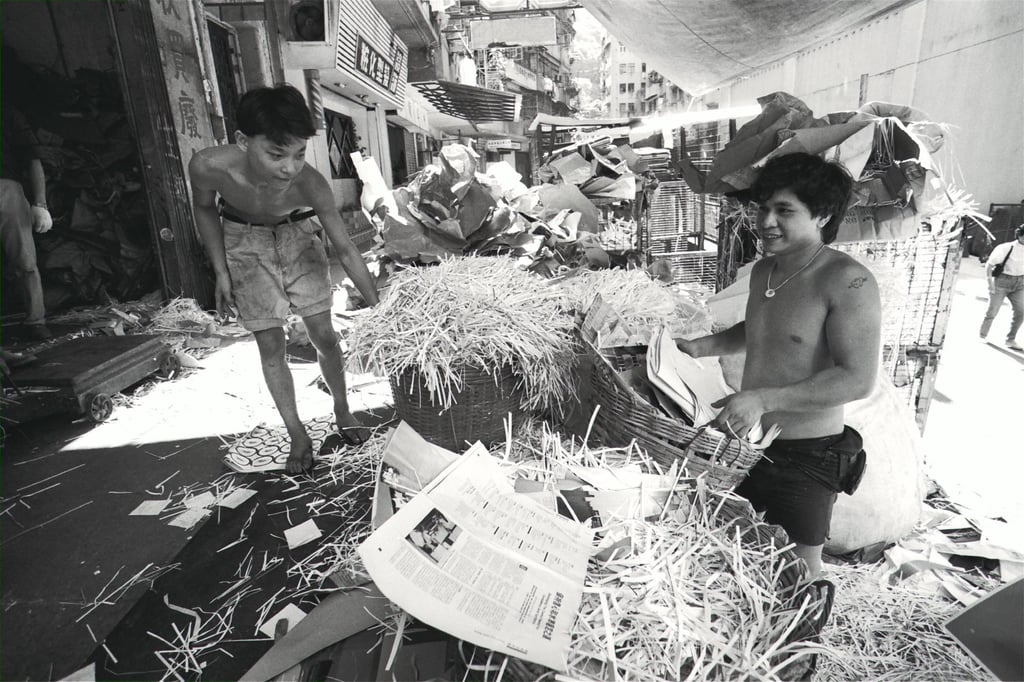
Glass bottles were used for domestic storage or sold. Soft-drink and beer bottles came with a deposit and the next ones bought were always a few cents cheaper when the empties were returned to the shop. Metal cans used for everything from luncheon meat to evaporated milk, were collected. Widespread use of kerosene for cooking and lighting purposes ensured a ready supply of large square kerosene tins, robustly made from galvanised sheet-metal and brightly marked with the manufacturer’s trademarks. Tops removed, these were fitted with wooden handles for easy transport on a bamboo carrying-pole and used for domestic water collection from municipal standpipes. Cut around the seams and hammered flat, kerosene tins were commonly used in the construction of squatter area huts.
Select Voice
Select Speed
1x
AI-generated voice