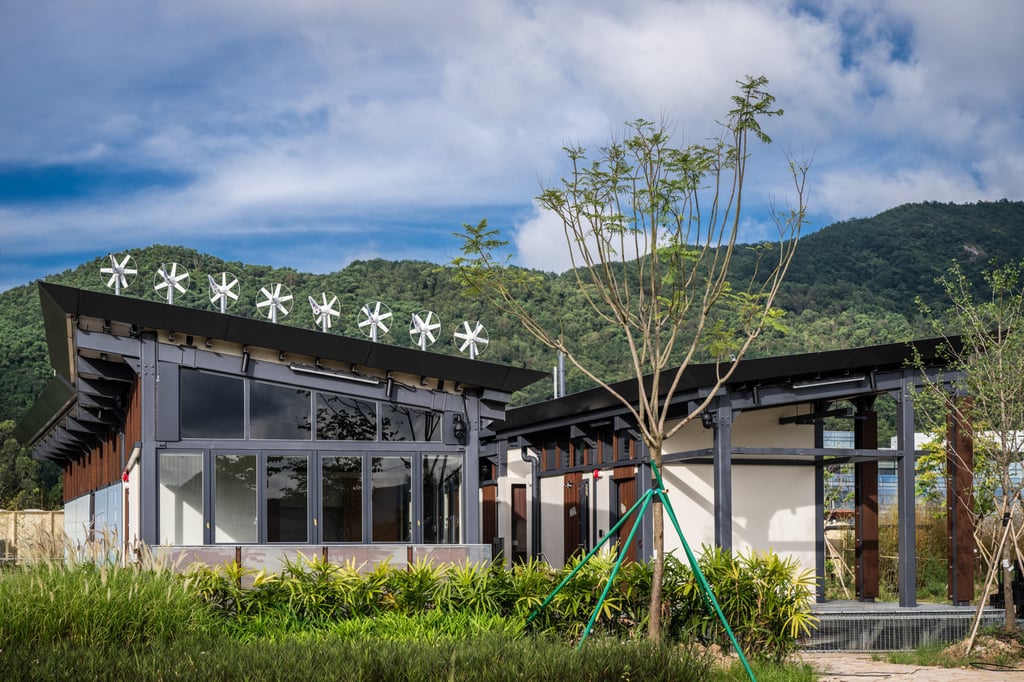
“I have always been interested in unusual projects,” says architect Corrin Chan. And what could be more unusual than a campground in an old rubbish tip?
E-Co Village, which opened last year near Lohas Park in Tseung Kwan O, is an initiative by the Tung Wah Group of Hospitals (TWGH) charity to provide a fun space for families and school groups to connect with the great outdoors while learning about environmental sustainability. Along with campsites, it includes activity rooms, a farm, a butterfly garden and an amphitheatre, all of it powered by 272 solar panels that produce more energy than the campground consumes.
E-co Village in Tseung Kwan O, Hong Kong. Photo: AOS.Architecture
The project, done in collaboration with architectural firm Spence Robinson and One Bite Design Studio, won the Hong Kong Institute of Architects’ Sustainable Architecture Award at the end of 2024, but it began nearly eight years earlier, when TWGH learned that its existing campsite in the northern New Territories would be repurposed for the government’s Northern Metropolis development. The charity turned to Chan, whose studio, AOS.Architecture, has a long record of working on educational, social and environmental projects, including schools, a vertical farm concept and a TWGH-run community centre in Sheung Wan.
“I said to them, ‘Instead of just a camping ground, can we make it more?’” Chan recalls. She notes that the site given to TWGH is one of the 13 landfills that Hong Kong has closed because they are full. Only three remain. “We can’t just live the way we have, with endless consumption,” she says. “We need to make a change and this was a symbol of that. We wanted to transform garbage into a garden – waste into something useful, meaningful and impactful for people.”
We wanted to transform garbage into a garden – waste into something useful, meaningful and impactful for people
Corrin Chan
The concept of the E-Co Village emerged from that line of thinking. The form it took was governed by the sensitive nature of the site, which has undergone a 30-year “aftercare” period that began in 1995, when the Tseung Kwan O Stage I landfill was closed. The mountain of decomposing waste is capped by a geotextile polyethylene liner, a synthetic drainage layer and soil, with special facilities to capture and treat the methane released by the rubbish.
All of this meant that the E-Co Village needed to tread lightly on the surface, with no large structures that would require piling, and limited infrastructure for water and sewerage. “There were a lot of limitations – most people would run away from a site like this,” says Chan. “But we were curious.”