
Advertisement
Banking & finance
OpinionHong Kong Opinion
Zhang Wan
Nie Zhengyu
Opinion
Zhang WanandNie Zhengyu

Chinese treasury futures launch cements Hong Kong as premier yuan hub

It marks Hong Kong’s transformation from a yuan payment channel and funding pool into a comprehensive centre for yuan assets

3-MIN READ3-MIN
Listen
An electronic board at the Hong Kong exchange displaying news of the launch of China government bond futures at Exchange Square, Central, on August 3. Photo: Jonathan Wong

When the Hong Kong stock exchange launched five-year China government bond futures on August 3, it did more than simply expand the city’s derivatives product suite.

As the only China government bond futures in the offshore market, the contract deserves attention as it finally gives international investors an exchange-traded tool to hedge against yuan interest rate exposure, strengthening Hong Kong’s ability to price yuan assets, manage risk and serve global investors.
The launch comes as the international monetary system is becoming more diverse. International use of the yuan is gradually expanding beyond trade settlement to investment, financing, pricing and reserve management. Meanwhile, heightened geopolitical tensions and volatile government bond yields in major developed markets have prompted investors to seek greater diversification and portfolio resilience. These dynamics strengthen the case for yuan-denominated financing and investment.

Chinese government bonds, which have a low correlation with many overseas assets, offer diversification. Central banks and sovereign wealth funds continue to use them to diversify their reserve holdings, while insurers, pension funds and global asset managers are gradually increasing their participation.

From June 2017 to May this year, global holdings of Chinese interbank bonds increased from 800 billion yuan to 3.2 trillion yuan (US$474 billion), of which about 2 trillion yuan was invested in Chinese government bonds.

A global currency needs more than a large pool of investible assets. It also needs reliable pricing benchmarks, liquid secondary markets and efficient risk-management tools that allow investors to enter and exit positions efficiently and pursue different investment and hedging strategies.
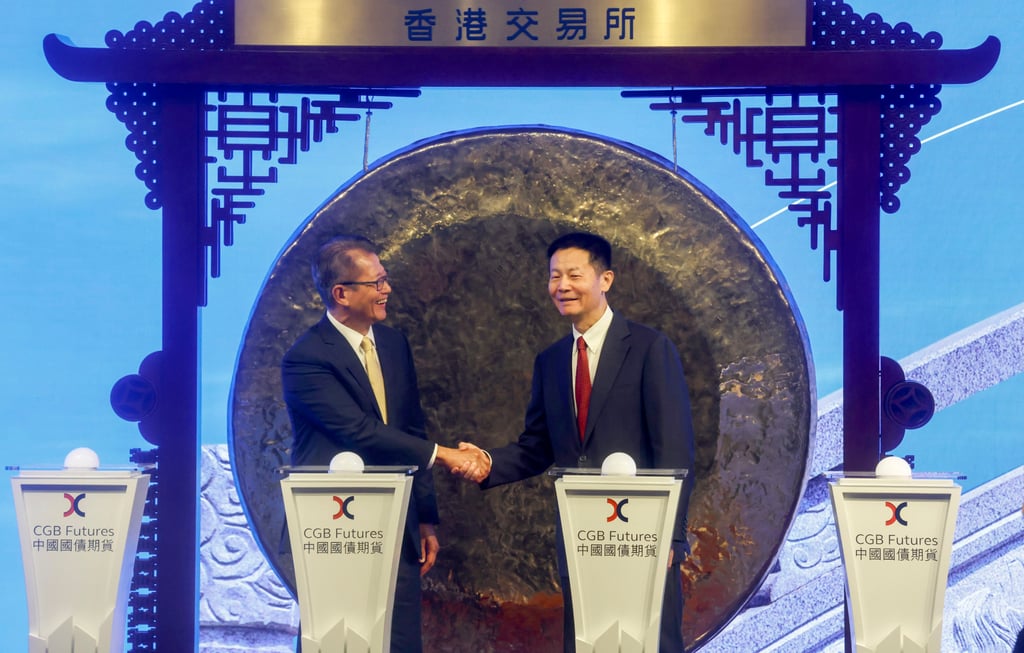
Hong Kong Financial Secretary Paul Chan Mo-po and China Securities Regulatory Commission Wu Qing at the Hong Kong exchange’s launch of China government bond futures on August 3. Photo: Jonathan Wong
Advertisement
Select Voice
Select Speed
1.00x