Veronica Lukito, a senior partner for the Hong Kong-based TransAsia Private Capital Fund, has closely followed developments in Indonesia for the past two decades.
Whether China is good for Asia is a pertinent question, given that attempts to contain the country have failed. Today, the only way to stop its rise would be through a globally ruinous war. So, let’s assume that we have entered a new period of Sino-centric Asian history, one that is possibly even more powerful than when the Tang dynasty represented the face of Asia to the world.
Will a rejuvenated China be good for Asia? It is difficult to agree with Western pessimists such as William Bratton, author of the 2021 book China’s Rise, Asia’s Decline, who argues that “China’s ascendancy to regional hegemonic status will result in the decline of its neighbours’ political independence, economic dynamism, and future growth potential. Any short-term benefits of China’s growth, such as increased trade, will be transitory.”
Even if we accept his argument, it would be necessary to ask: has the rise of any regional hegemon in history resulted in anything other than a decline of political independence on its periphery?
Didn’t the rise of the United States constrain the political and economic options of nations around the globe until its power was contested by the countervailing rise of another global heavyweight – the Soviet Union? Should China replace the US today, after the departure of the Soviet Union from the world stage, why should different historical laws be applied to its rise?
However, China says it has no desire to be the next global hegemon. This is not because of an outpouring of international goodwill but because Beijing does not wish to repeat the cautionary experiences of the US and the Soviet Union.
The latter fell in 1991 after failing to compete with the US. The end of the Cold War produced a gilded unipolar moment of American triumphalism embedded in the fanciful idea that history had ended with the triumph of liberal capitalism. The 2008 global economic crisis concluded that phase of extravagant American self-congratulation.
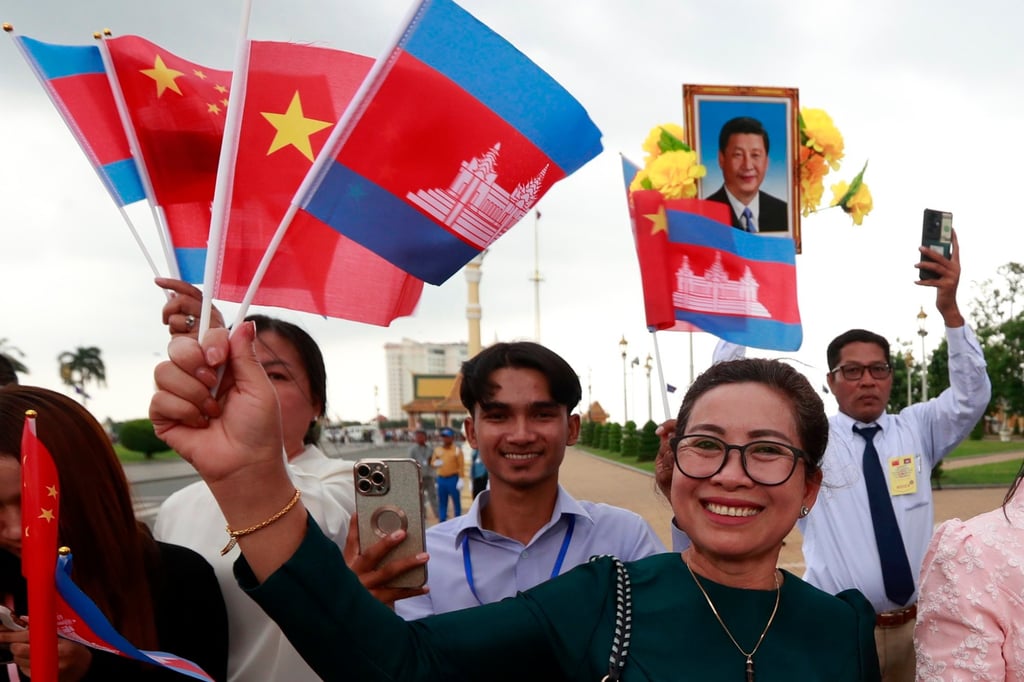
People hold flowers, national flags and portraits of Chinese President Xi Jinping at the Royal Palace in Phnom Penh, Cambodia, on April 17. Photo: EPA-EFE