Yang Yao is Liberal Arts Chair Professor at the China Centre for Economic Research and the National School of Development at Peking University.
The provisional trade deal reached by China and the United States in Geneva last month exceeded expectations, with the two sides agreeing to roll back for 90 days most tariffs and other countermeasures they had imposed in the preceding weeks.
To be sure, a number of tariffs remain – including all those the US imposed on China during Donald Trump’s first presidency – and little progress was made in resolving underlying disagreements, such as over fentanyl flows into the US. But with more talks set to take place (amid and despite accusations by both sides that the provisional agreement has been violated), a robust agreement may well be in the offing.
To understand what such an agreement might look like, it is worth considering the grievances behind Trump’s tariff policy. Conventional economic theory holds that, in a flexible exchange-rate system, changes in a currency’s value should lead to a stable trade balance in the issuing economy. But, as experience shows, a number of factors can disrupt this dynamic. In the case of the dollar, it is very easy to pin down the main one: its status as the world’s dominant reserve currency.
As the economist Robert Triffin explained in 1960, unless the country that provides the world’s reserve currency runs a current account deficit, the world loses its largest source of liquidity for reserves, with catastrophic consequences for economic growth and stability. But the ever-expanding deficit can undermine confidence in the reserve-issuing country – what is known as the Triffin dilemma.
The Trump administration’s chief complaint is that permanent demand for dollars keeps the currency strong, even when the US Federal Reserve pursues very accommodative interest rate policies, as was the case for well over a decade after the 2008 global financial crisis. Given this, improving America’s export competitiveness – and, thus, its trade balance – requires policy intervention.
To this end, the Trump administration has floated the idea of a “Mar-a-Lago Accord” inspired by the 1985 Plaza Accord, under which the five largest industrialised economies agreed to devalue the US dollar relative to the Japanese yen and the German Deutschmark. The new iteration – the brainchild of Stephen Miran, now the chair of Trump’s Council of Economic Advisers – would be negotiated at Trump’s Mar-a-Lago resort in Florida, rather than the Plaza Hotel in New York City.
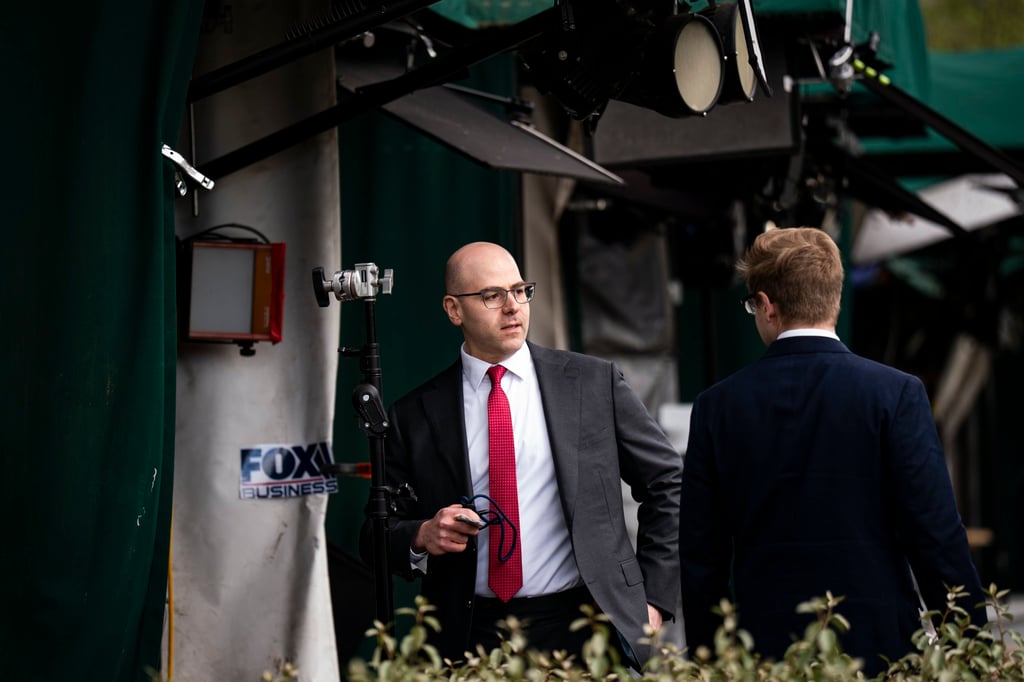
Stephen Miran, chairman of US President Donald Trump’s Council of Economic Advisers, is seen following a Fox Business interview outside the White House in Washington on April 16. Photo: EPA-EFE