
Advertisement
SCO
OpinionAsia Opinion
Nikola Mikovic

Opinion | Beijing expands its influence in Eurasia as Trump triggers geopolitical shifts

While US policies are pushing China, Russia and India closer to each other, Eurasia is still marked by differences and contradictions

Reading Time:3 minutes
Why you can trust SCMP
2
Chinese Foreign Minister Wang Yi shakes hands with Indian Foreign Minister S. Jaishankar in New Delhi, India on August 18, ahead of the Indian prime minister’s first visit to China in seven years. Photo: Indian Foreign Ministry via AP

While United States President Donald Trump aims to end – or at least freeze – the Ukraine conflict and portray himself as a peacemaker, China seems to be quietly expanding its influence in Eurasia – a region that Halford Mackinder, “the father of geopolitics”, viewed as the key to global power.

The coming Shanghai Cooperation Organisation summit, scheduled to start on August 31 in Tianjin, is expected to provide another opportunity for Beijing to strengthen its political, economic and military ties with the Global South – including nations that have maintained strong relations with Washington.

Trump’s tariff policies have not only led to a deterioration in economic ties between the US and China, but have also pushed India – Beijing’s regional rival – to improve relations with its fellow Asian power.

Advertisement
Last year, Indian Prime Minister Narendra Modi skipped the SCO summit in Astana, Kazakhstan. But this year, after Trump’s extra tariffs on India over its purchase of Russian oil, Modi confirmed his participation in the event. From Beijing’s perspective, this clearly represents a diplomatic victory.
India has long been a defence partner of the US. It’s also played an important role in the Quadrilateral Security Dialogue, the US-dominated organisation that Chinese officials have reportedly labelled as a “military alliance aimed against China’s resurgence.” To this day, the US remains India’s largest trade partner. However, Trump’s recent moves could push India to deepen ties with alternative partners like China and Russia.
Advertisement

The fact that the trade between India and China in 2023 reached US$136 billion, and that Russia became a major exporter of both natural gas and crude oil to China, indicates that there is room for a broader strategic realignment across Eurasia – one that may gradually reduce American influence in the region.
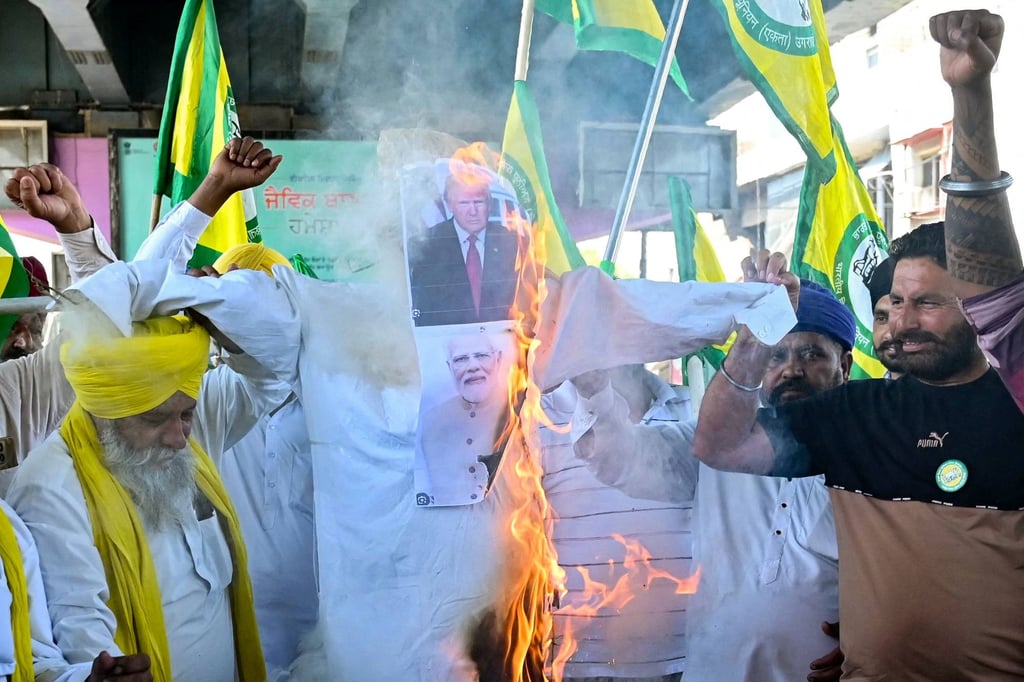
Farmers burn an effigy of US President Donald Trump and Indian Prime Minister Narendra Modi during a protest in Amritsar, India on April 4. Photo: AFP
Advertisement
Select Voice
Choose your listening speed
Get through articles 2x faster
1.25x
250 WPM
Slow
Average
Fast
1.25x