Nasa’s Juno finds Jupiter is a tiny bit smaller than previously thought
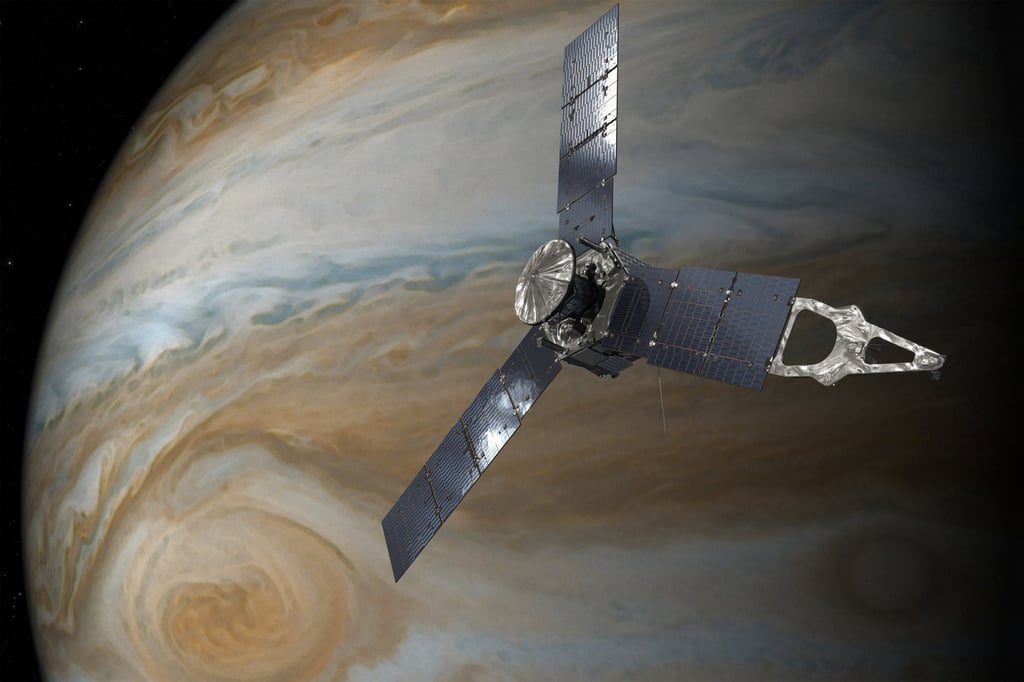
The robotic spacecraft was launched in 2011 and has been orbiting the gas giant since 2016, transmitting raw data back to Earth

Jupiter, without a doubt, is the biggest planet in our solar system. But it turns out that it is not quite as large – by ever so small an amount – as scientists had previously thought.
Using new data obtained by Nasa’s robotic Juno spacecraft, scientists have obtained the most precise measurements to date of Jupiter’s size and shape. This is important information to gain a fuller understanding of this gas giant, including studying its complex interior structure.
The Juno observations showed that Jupiter has an equatorial diameter of 142,976 km (88,841 miles), which is about 8km (five miles) smaller than previous measurements had indicated.
The observations also showed that Jupiter’s diameter from north pole to south pole is 133,684 km, about 24km smaller than previously estimated.
The planet, like our own, is not a perfect sphere, but rather a bit flattened – and, based on the new data, slightly more so than previously known. Jupiter is about 7 per cent larger at the equator than at the poles. For comparison, Earth’s equator is only 0.33 per cent larger than its diameter at the poles.
The previous measurements of Jupiter were based on data gathered by Nasa’s Voyager and Pioneer robotic spacecraft in the late 1970s.