Advertisement
Science
ChinaScience

China-led moon mission’s water probe will be ‘first for humanity’: space agency

Seven international partners deliver experiments for Chang’e-7 as authorities report smooth progress towards 2026 launch

Reading Time:3 minutes
Why you can trust SCMP
26
After winning the race to bring back samples from the moon’s far side, China’s mission to confirm the presence of water ice at the lunar south pole is likely to be another world first. Photo: Xinhua
Ling Xinin Ohio
China could beat the United States to become the first country to find water on the moon, with all international payloads already handed over for its next robotic lunar mission which is slated for launch in August.
Tang Yuhua, deputy chief designer for the Chang’e-7 mission, said the spacecraft’s development was progressing smoothly, with scientific instruments from six national partners and one NGO delivered to the China National Space Administration.
The instruments have been provided by China’s traditional partner Russia along with Egypt and a number of US space allies including Bahrain, Thailand, Italy and Switzerland, as well as Hawaii-based NGO the International Lunar Observatory Association.
Advertisement

The mission will focus on studying the environment and searching for water ice near the moon’s south pole – a vital resource for future crewed space exploration because of its potential to be converted into drinking water, breathable oxygen and even rocket fuel.

The Chang’e-7 spacecraft is the most complex ever built for China’s lunar programme, Tang told state broadcaster CCTV on Saturday. It would consist of an orbiter, lander, rover, hopper and a relay satellite, she said.
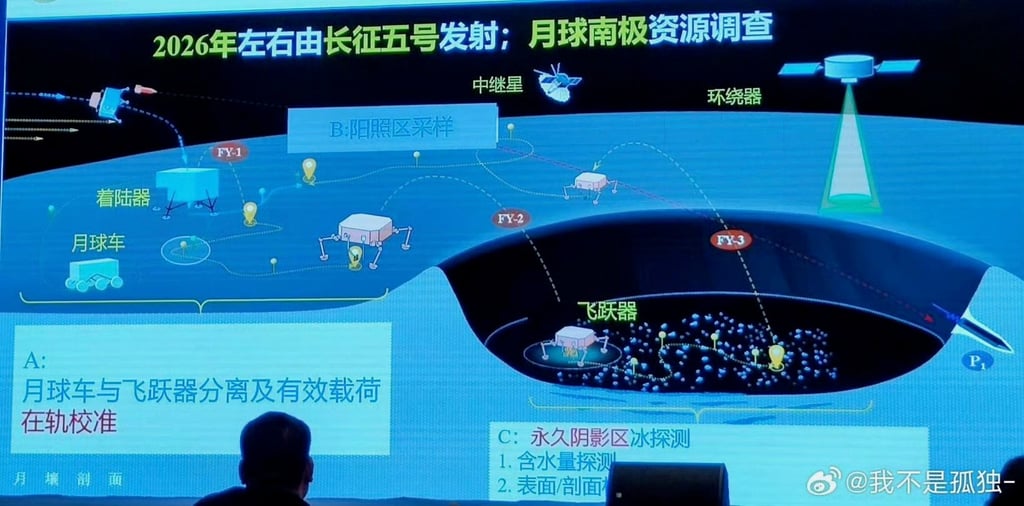
A presentation slide shared on Chinese social media illustrates the Chang’e-7 mission architecture, showing the orbiter, lander, rover and hopper working together to explore the moon’s south pole and search for water ice in permanently shadowed craters. Photo: Weibo

Wu Weiren, chief designer of the country’s lunar exploration programme, said Chang’e-7 was likely to touch down “at a spot with more than 100 days of continuous sunlight” – ideal for long-term operations.

Advertisement
Select Voice
Choose your listening speed
Get through articles 2x faster
1.25x
250 WPM
Slow
Average
Fast
1.25x