Scorch marks at Deep Blue’s test site in China point to reusable rocket failure
The company has not commented on satellite imagery showing launch pad burn marks or the outcome of VTVL tests in Inner Mongolia

Publicly available satellite images suggest an explosion took place at Deep Blue Aerospace’s test site near Ejin Banner, Inner Mongolia, some time between late July and early August.
Dramatic scorch marks can be seen east of the launch pad – on the opposite side from where the rocket was supposed to land – indicating it may have veered off course shortly after lift-off before crashing during its attempted touchdown.
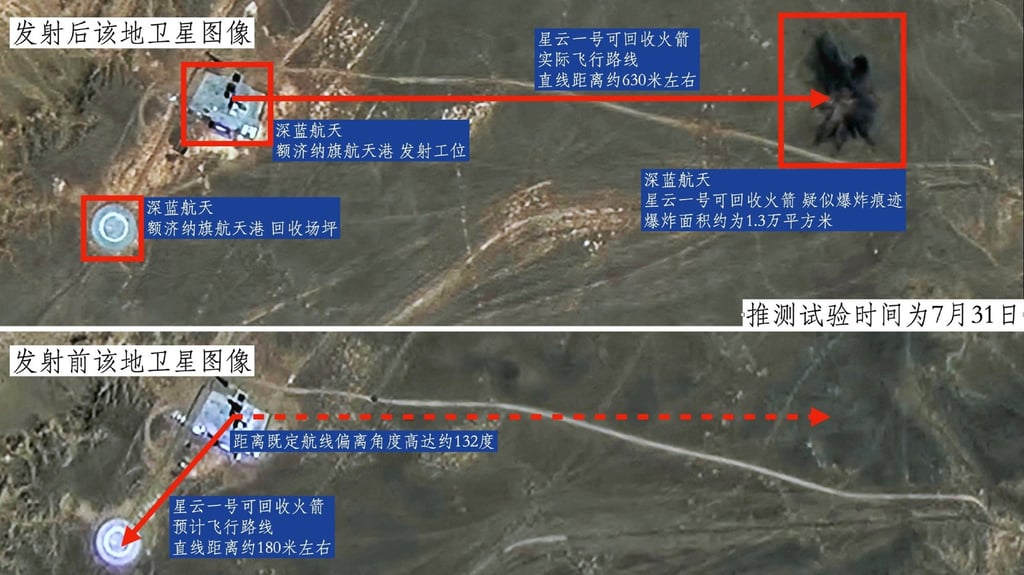
The company did not respond to inquiries from the South China Morning Post. However, a source familiar with the matter who asked not to be named confirmed that the flight had “ended in failure”.
The test was believed to be a vertical take-off, vertical landing (VTVL) flight, similar to one carried out by Deep Blue about a year ago, according to the source. In a VTVL, a prototype rocket lifts off vertically and tries to land back at or near the same spot, a crucial step in developing reusable launch systems.
In that September 2024 flight, the rocket completed most of its planned manoeuvres but lost control during the final descent, crash-landing on the recovery pad and damaging its upper section.
If confirmed by the company, the more recent flight would be a step backwards in terms of control and precision.