Advertisement

How China’s HQ-29 mid-course missile interceptor stacks up against US rivals

The HQ-29 has been compared to the American sea-based SM-3 and the silo-based Ground-Based Interceptor

Reading Time:4 minutes
Why you can trust SCMP
9
Military vehicles transport the PLA’s new HQ-29 anti-aircraft missiles during China’s Victory Day parade, in Beijing on September 3. Photo: China News Service via Getty Images
Alcott Weiin Beijing
After 15 years of testing, China unveiled the HQ-29 at its Victory Day parade in September, showcasing the land-based air-defence missile system that is capable of intercepting targets in the near region of space outside the Earth’s atmosphere.

The HQ-29, also known as the Red Flag-29, is considered a key supplement to the top layer of China’s multilayered ballistic missile defence system.

The missile is mounted on a six-axle launcher, according to the Chinese military magazine Ordnance Science and Technology, although Beijing has not revealed the specifications of the HQ-29 anti-ballistic missile system.
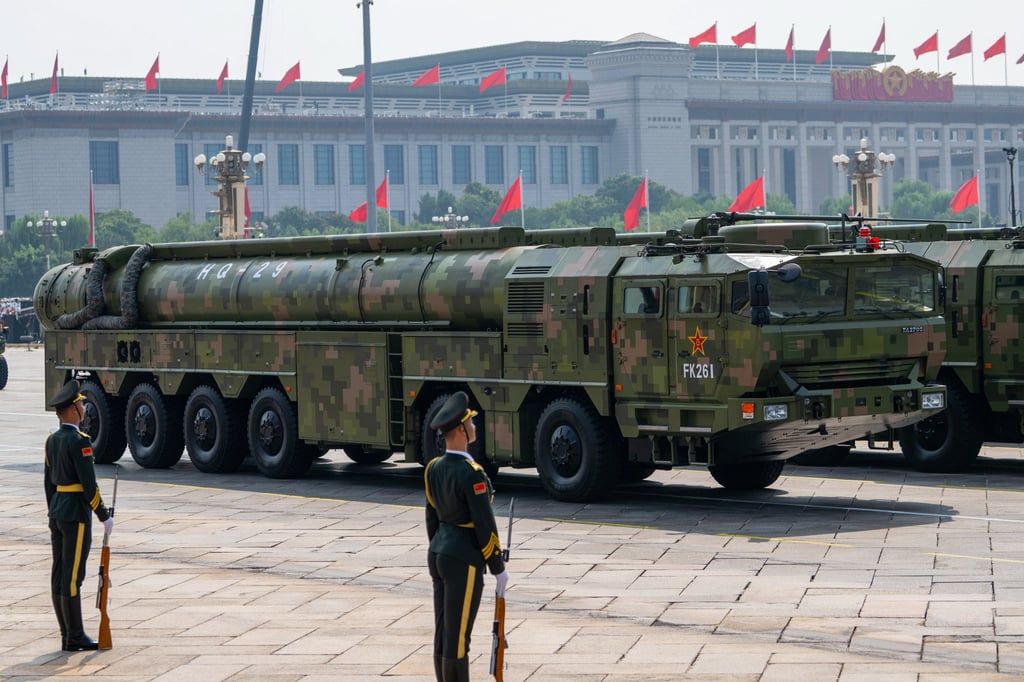
HQ-29 anti-aircraft missiles are displayed during China’s V-Day military parade on September 3. Photo: VCG via Getty Images

In September, the magazine, which is supervised by the Shaanxi Association for Science and Technology and mainly reports on popular science and China’s latest military developments, said the system was believed to be equipped with two launch tubes around 1.3 metres (4.3 feet) in diameter, and was capable of carrying two 10.5 metre-long, 1.2-metre-diameter interceptor missiles.

Advertisement

According to state broadcaster CCTV, the HQ-29 is designed for mid-course interception of medium and long-range intercontinental ballistic missiles from outside the atmosphere, at altitudes above 100km (62 miles).

On the day of the parade, CCTV highlighted the mobile deployment and kinetic energy interception capabilities of the system, saying it represented China’s world-leading mid-course anti-missile technology.

Advertisement

In the lead-up to the parade, the French military news website War Wings Daily said it believed the HQ-29 could strike intercontinental ballistic missiles (ICBMs) at an altitude of at least 500km, while Ordnance Science and Technology said the anti-missile system was expected to target long-range or ICBMs above the Karman line space boundary at altitudes up to 2,000km.

SCMP Series
[ 21 of 21 ]
Advertisement
Select Voice
Choose your listening speed
Get through articles 2x faster
1.25x
250 WPM
Slow
Average
Fast
1.25x