Huawei Technologies’ 5.5G can power digital growth in the modern world
Also known as ‘5G-Advanced’, new network capabilities offer significantly higher throughput, lower latency and more reliable communication

Today, many of us take for granted the convenience of working remotely and managing daily tasks via smartphones. But in the early 2000s, using handheld devices to browse the web, send emails and post on social media via 3G (third-generation) mobile network technology was groundbreaking.
The advent of 4G offered internet speeds that were up to 10 times faster, enhancing high-definition video streaming and online gaming.
This era also saw the rise of the Internet of Things (IoT) – the way computing devices embedded in everyday objects are interconnected via the internet, which enables them to share data – allowing people to control appliances and machines remotely, among many other uses.
The introduction of 5G networks at the end of the last decade brought even more transformative changes with ultra-reliability and low latency, paving the way for things such as smart cities and autonomous vehicles. This technological leap has affected various sectors, including banking, retail and healthcare. In some cases, it largely eliminated the need for bricks-and-mortar business operations.
Increased speeds and larger scales of connectivity, combined with cloud technology, have also unlocked great potential in wearables. These gadgets have gone beyond tracking heart rates and calorie burns for fitness enthusiasts to helping healthcare providers to monitor patients’ conditions and provide real-time intervention when needed.
In logistics, workers equipped with wearable scanners, or radio-frequency-identification-enabled devices, can streamline inventory tracking and reduce errors. In industrial environments, wearables can enable employers to keep track of workers wearing protective equipment to ensure safety.
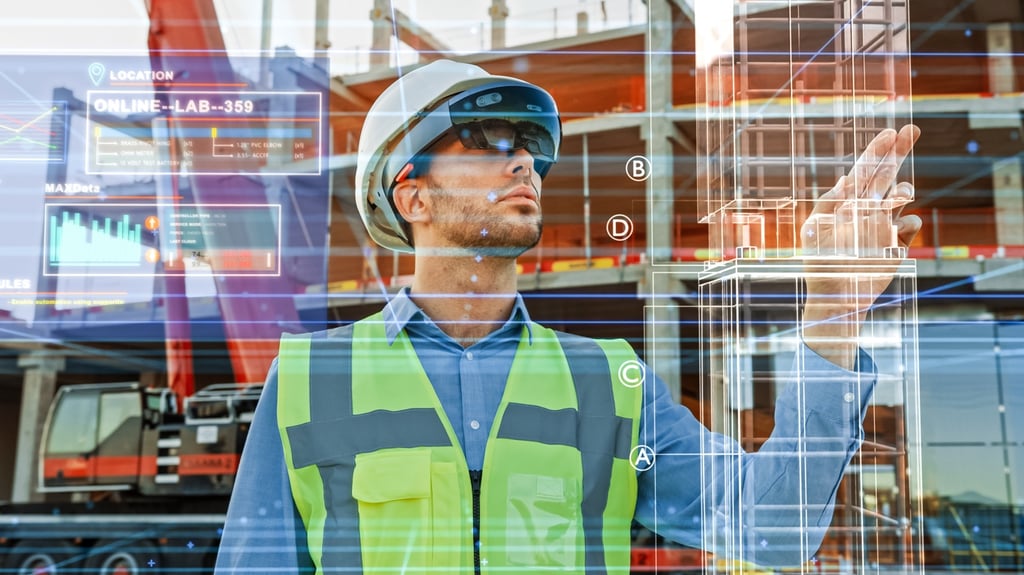
As connectivity continues to improve, artificial intelligence (AI) and augmented reality will come into play, to allow wearables, including smart glasses, to offer predictive analytics, real-time decision making and personalisation.
This year, the official arrival of 5.5G is an important event for the telecommunications industry. It can help to power digital development around the world and enhance all previous 5G capabilities via significantly higher throughput, much lower latency and more reliable communication.
The improved connectivity it offers also heralds the era of the Internet of Everything (IoE), which involves not only a network of interconnected physical devices, but also people, processes and data.
5.5G will help drive GenAI advances
Late 2022 saw the emergence of generative AI (GenAI) – computer systems that can not only copy intelligent human behaviour, but also produce new content, especially text, images, music and code by learning from vast data sets, effectively mimicking human creativity.
Many industries, including marketing, financial services and software development, have recognised its potential for sparking changes in how content is generated and personalised, which will help to redefine productivity and creativity.

GenAI’s debut not only showcased its use as a powerful tool for both businesses and consumers, but also set the stage for discussions about its implications for the future of work and life as we know it.
The growing use of AI worldwide has shown that society and industries need 5.5G for two main purposes: high upstream speed for uploading vast amounts of data for training, and low latency for immediate interactions.
In China, for example, Apollo Go is Baidu’s autonomous ride-hailing service, part of the company’s broader Apollo autonomous driving project. The service provides a robotaxi experience, where users use an app to summon self-driving cars, just as they might use traditional app-based ride-sharing transport such as DiDi or Meituan.
Autonomous driving relies on immense data processing, with each robotaxi uploading 100 gigabytes (GB) of data daily from its 12 4K cameras and eight light detection and radar sensors to construct real-time environmental models and enable decision-making.
This data-intensive process demands advanced 5G networks capable of near-instantaneous, lossless transmission with uplink speeds of 100 megabits per second and latency under 50 milliseconds, ensuring seamless operation and safety in complex urban environments.
In the near future, Apollo Go can rely on the 5.5G network for transferring real-time data as well as integrating the latest AI technology to enhance its perception, localisation, decision-making, and control features.
Its service processes real-time data and high-definition maps for navigation. Advanced machine learning and deep learning techniques also allow it to learn from vast data sets and continuous real-world driving scenarios, thereby improving its response to dynamic road situations.
AI-embodied world part of our future
In recent years, the telecommunications industry at large has achieved remarkable progress with the roll-out of next-generation networks around the world, representing an important moment in the evolution of connectivity.
China Mobile offers an interesting example. In this year’s first quarter, the company announced the deployment of commercial 5.5G networks (5G-Advanced) in 100 cities, with many more to come. This supports cutting-edge applications such as ultra-high-definition (UHD) streaming and interactive gaming, both of which are a major step forward in China’s telecoms sector.
The International Data Corporation, a market research and analytical company, has forecast that by 2028, global shipments of AI-enabled smartphones will surpass 900 million units, with more than 1,000 AI-native devices available on the market.
For regions with diverse telecoms sectors, the strategies of China Mobile can offer a practical blueprint for macroeconomic growth.
The future of mobile technology will rely on the use of AI and seamless connectivity so we can interact with devices in new ways, including voice, gestures – even emotions.
New-generation AI glasses can read lips – achieving an accuracy of more than 95 per cent in noisy environments. Ultra-connectivity will also enable humanoids to be integrated into our daily lives, assisting us in the commercial and industrial sectors, and offering potential roles in areas such as care of the elderly.

To meet growing demands in this rapidly evolving landscape, network operators in various markets need to invest in 5.5G solutions. By proactively upgrading their technology stacks, they will not only enhance user experiences, but also drive industry advancement.
Vast, integrated and intelligent network
Beijing Unicom and Huawei recently announced the deployment of the world’s first large-scale integrated 5G-Advanced intelligent network.
It is a vast three-component carrier network, covering key locations such as stadiums, schools, scenic areas, metro stations and residential zones. This network ensures full 5G coverage and 85 per cent 5G-Advanced coverage within Beijing’s 4th Ring Road and the Beijing Municipal Administrative Centre, supporting services such as immersive videos, UHD streaming and cloud gaming.
Additionally, renovated phone booths connected to the 5G-Advanced network now offer convenient one-click access to navigation, ride-hailing and emergency services, enhancing daily life for Beijing residents.
Li Peng, Huawei’s corporate senior vice-president, said: “In this new era, we will also see new changes in how information is created, shared and used. These changes will pose new challenges for networks, but also open the doors for huge new opportunities.”