Mongolia hopes to get on track to economic prosperity with new rail links
Amid growing demand for its coal resources, the country is building out its railway network to boost efficiencies in its trade with China

When talking about Mongolia, what may first come to mind are its vast steppes, traditional yurts and nomadic culture. While all those elements continue to represent much of this expansive country, signs of its future evolution can be found beneath the surface.
Mongolia sits on top of massive mining wealth, which includes 61.4 million tonnes of copper, 1.84 billion tonnes of iron ore and 33.4 billion tonnes of coal, according to government figures. Although its first major modern mine, the Nalaikh coal mine, was established back in 1922 near the capital city of Ulaanbataar, it was not until the early 1990s – when Mongolia transitioned from a socialist country closely aligned with the now-defunct Soviet Union to a democratic free market – that large-scale mining truly began to flourish.
Coal, in particular, has emerged as a vital resource, in no small part because about one-third of that is coking coal, which is essential for steel production because of its ability to act as both an energy source and reducing agent during the blast furnace process.
Coal contributes an estimated 12 per cent of Mongolia’s GDP and accounts for more than half of the country’s total exports.
Mongolia shares a long border with China, the world’s largest steel producer that generates over half of global output and relies heavily on imported coking coal to do so. Not surprisingly, this makes it the top buyer of Mongolian coal, and demand continues to grow.
In the first half of 2025, China exported more than 58 million tonnes of steel, marking a 9.2 per cent year-over-year increase that is largely attributed to increasing urbanisation and construction of infrastructure in developing Asian nations.
Last year, Mongolia exported nearly 84 million tonnes of coal, which was the first time ever that the total volume exceeded the 80 million mark. In September this year, its exports to China set a new monthly record with 9.29 million tonnes delivered, representing a 33 per cent year-over-year increase.
The strategic importance of coal exports to both countries was underscored during a September meeting in Beijing between Mongolian President Ukhnaagiin Khurelsukh and Chinese President Xi Jinping, where the two leaders emphasised deepening their commitment to the coal trade.
Those high-level talks were followed by a meeting between Mongolian Prime Minister Gombojav Zandanshatar and Chinese Premier Li Qiang in November. There, Zandanshatar highlighted China’s long-term valuable assistance with the economic and social development of his country, as well as the importance of bilateral cooperation in areas such as connectivity, infrastructure construction and mining.
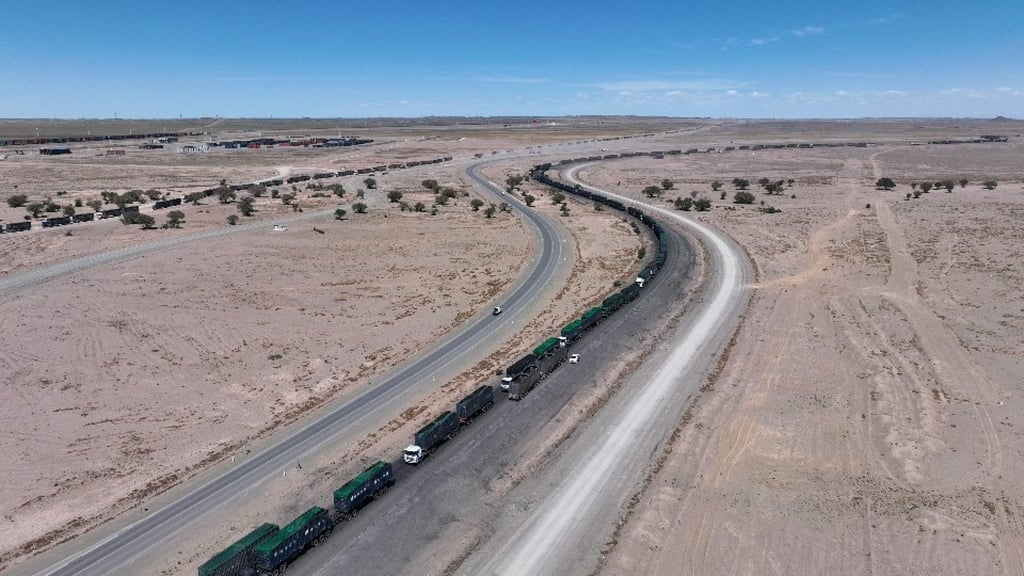
Such discussions have also brought to light a challenge faced by Mongolia’s mining industry: its reliance on trucking to transport coal across the border. Using a two-lane highway, a truck towing up to four containers of coal – about 130 tonnes in total – takes six to eight hours to deliver a full load in favourable traffic conditions.
Factor in queuing and unloading at border facilities, plus the return journey, and it means one truck typically makes only three delivery trips per fortnight at most. This limitation is driving up costs and hampering the growth of coal exports.
One solution that has been identified is expanding Mongolia’s rail network, which can not only provide economy of scale, but also reduce carbon emissions and environmental disturbances. For 70 years, the Trans-Mongolian Railway – which runs from the city of Sukhbaatar on the Russian border through Ulaanbaatar and then to the Zamyn-Uud port on the southern border, which neighbours the northern Chinese port of Erlian – has served as Mongolia’s main rail route for moving goods. But it is now at capacity, with its ageing facilities unable to meet modern demands.
Under the New Revival Policy, a 10-year programme adopted by the Mongolian parliament in December 2021, the country has been working to establish five border crossings with rail connections. In the last four years, some 900km (559 miles) of new railway construction across the Gobi region has been completed to connect key mining zones to two border ports.
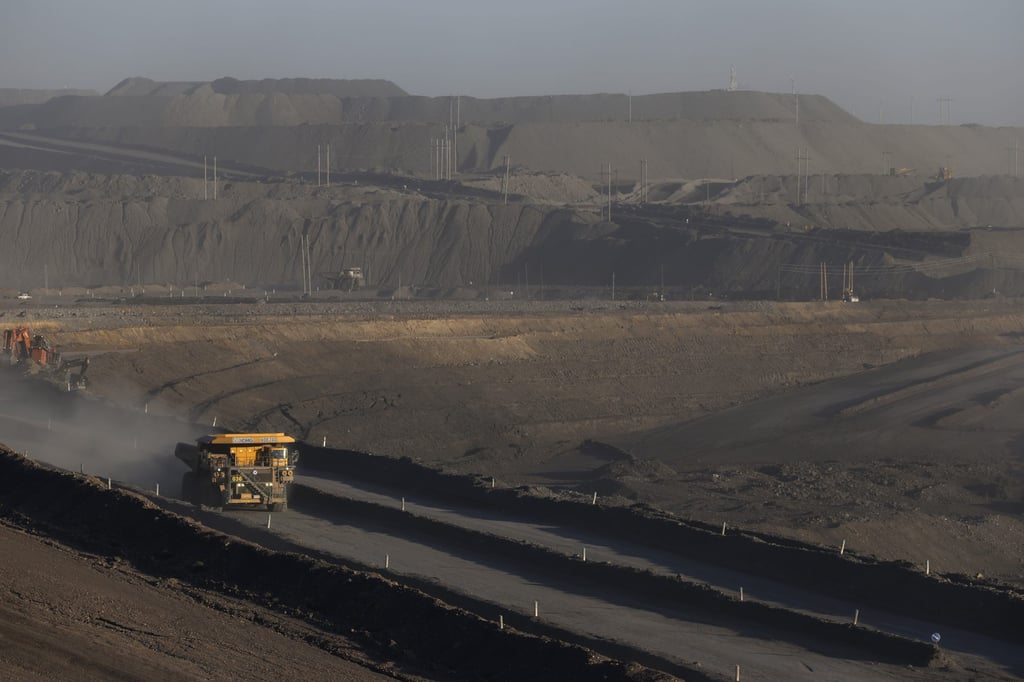
One of these pivotal projects is the government-funded Gashuunsukhait-Gantsmod railway, originally proposed in 2008 and commissioned in 2022. It links the Tavan Tolgoi mine, one of the world’s largest untapped deposits of coking coal located in Mongolia’s south Gobi region, to the Chinese border.
“The current capacity of the mine itself could easily produce 50 million tonnes, but because of transportation bottlenecks at the border ports, we are keeping production at 30 million tonnes per year,” says Altanbagana Ch, director of the mining and technology department at Erdenes Tavantolgoi, a state-owned company with operations at Tavan Tolgoi. “With rail, we could reach 50 million annually.”
The railway runs about 240km, with a transport time of only four hours from Tavan Tolgoi to Gashuunsukhait. This border crossing provides closer access to Chinese cities that are major consumers of coal, such as Wuhai.
However, work on cross-border linkage – including the construction of cargo transfer terminals and a 7km bridge to resolve the 36-metre (118-foot) height difference between the two sides – is still ongoing, with completion expected by the end of 2027. Until then, short-distance trucking across the Mongolian-Chinese border remains necessary.
The private sector’s participation has proven to be vital to growing Mongolia’s railway network. Gobi Mining and Transport Group (GMT), a local company that provides mining and heavy industry services, including infrastructure projects and geological exploration, initiated the building of a rail link to the Khangi border crossing.
The new line has added a convergence point to an existing railway between Tavan Tolgoi and Zuunbayan, a branch station feeding traffic to the Zamyn-Uud port. That allows trains to choose a 227km short cut to Khangi, connecting to China’s Mandal port, which is the closest customs entry point to the major steel production hub of Baotou, 290km away.
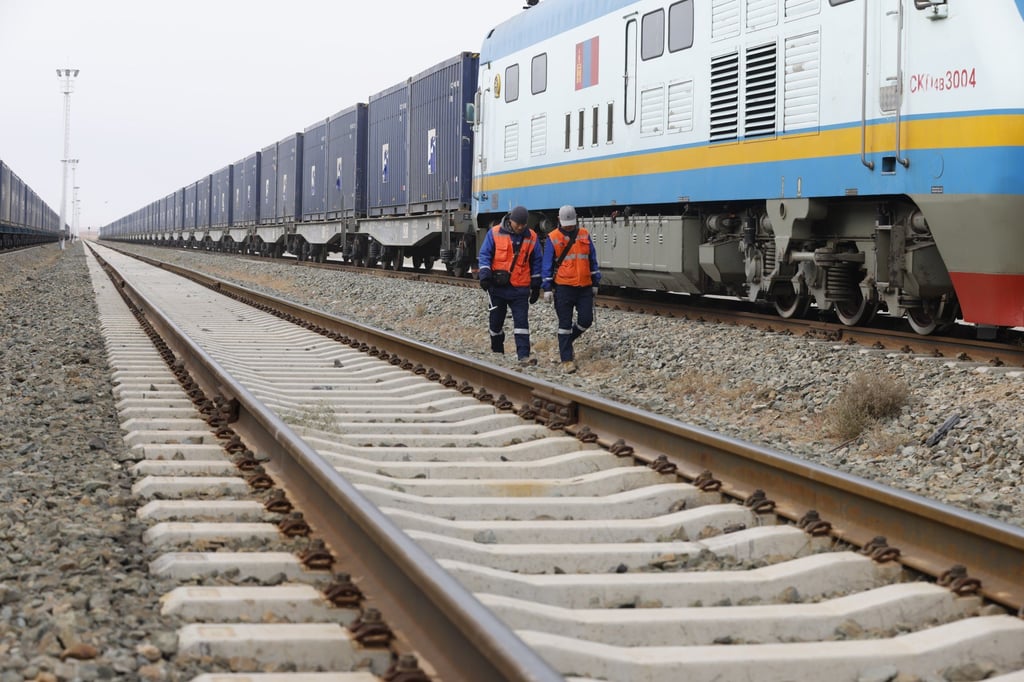
GMT, through its wholly owned business Mongolian Trans Line (MTL), completed the project in a record eight months in 2022 despite constraints posed by the Covid-19 pandemic, providing dual-gauge tracks that would be ready for direct connectivity with China’s rail network.
“We had to address multiple issues related to weather conditions, geographical characteristics, the supply of construction materials, domestic and international logistics, and workforce management,” says Batbold Sukhbaatar, the head of MTL’s railroad department.
“Geographically, the Khangi line lies in the Gobi region, characterised by highly variable soil conditions and strong winds. Therefore, we placed particular emphasis on soil stabilisation and the design of the drainage system.”
But, like the Gashuunsukhait-Gantsmod railway, facilities for full cross-border linkage are still in progress, with trucks continuing to be used as a stopgap measure.
However, the impact is already apparent. After MTL’s new rail line started operations in 2023, cargo volumes handled at Khangi en route to Mandal surged to 8.5 million tonnes, compared with 3 million tonnes in 2022.
In addition, since these new railway lines were put into service, Tavan Tolgoi’s output – and, in turn, the country’s overall coal exports – have recorded new highs for two consecutive years.
And perhaps no one is more looking forward to the future possibilities delivered by these railways than Byambadavga Bayaraa, president of the Mongolian Coal Association, which represents 25 coal producers accounting for over 90 per cent of all coal produced in Mongolia.
“Economies with mature mining industries, including Australia and Canada, depend on rail as the primary mode of transport of these mining products to the international markets,” he says. “Rail infrastructure is not only efficient but also increases the bandwidth of movement of goods over distances and across borders.”
This is the first episode of a two-part series about Mongolia’s rail network expansion, the challenges to be overcome during its development and the expected benefits. Stay tuned for the upcoming multimedia infographic episode.