94% of Southeast Asia’s e-commerce sellers see AI’s potential
E-commerce platform Lazada’s report offers insights that help cautious online sellers use smart technology to enhance business practices

The growing use of artificial intelligence (AI) – smart technology that enables computers to copy human behaviour such as learning, problem-solving and decision-making – is helping to transform industries worldwide.
While some businesses have begun to adopt AI, many remain hesitant to fully integrate it into their operations. Research shows high training costs, as well as the time and expense of implementation, are key barriers to its broader adoption.
Globally, about half of e-commerce sellers are experimenting with AI, while around 30 per cent are fully integrating it into their businesses, according to last year’s “State of Commerce” study, published by the American software firm Salesforce.
However, AI’s adoption in Southeast Asia remains more cautious, with research carried out by Lazada Group, a leading online shopping platform in the region, showing that 61 per cent of retailers are sceptical about AI’s practical benefits – even though 89 per cent admit it is crucial to boost efficiency.
Its report, “Bridging the AI Gap: Online Seller Perceptions and Adoption Trends in SEA”, was published earlier this month in partnership with marketing data and analytics company Kantar Singapore.
The survey of more than 1,200 online sellers in Indonesia, Malaysia, the Philippines, Singapore, Thailand and Vietnam shows that, while 68 per cent of online sellers in Southeast Asia demonstrate a strong familiarity with AI and regularly use these tools in their daily lives, only just over one third of respondents have actually adopted AI in their business operations.
Lazada, which is part of Alibaba Group, the Chinese e-commerce conglomerate that owns South China Morning Post, says its report highlights this reluctance among a number of sellers, with only 24 per cent of respondents fully embracing AI on their platform.
“The findings from our research reveal a fascinating gap in Southeast Asia’s e-commerce ecosystem,” James Dong, CEO of Lazada, says. “While most sellers understand AI’s transformative potential, many are still navigating the path from recognition to implementation.”
Key barriers to AI adoption remain
Its report reveals some of the key barriers to AI adoption among e-commerce sellers include familiarity bias and the perceived high costs of implementation and training.
Three-quarters of sellers say their employees prefer to use familiar tools rather than new AI-based solutions, while 73 per cent cite high training costs as a big concern. Additionally, 64 per cent of the sellers say that they are worried that AI integration may be costly and time-consuming.
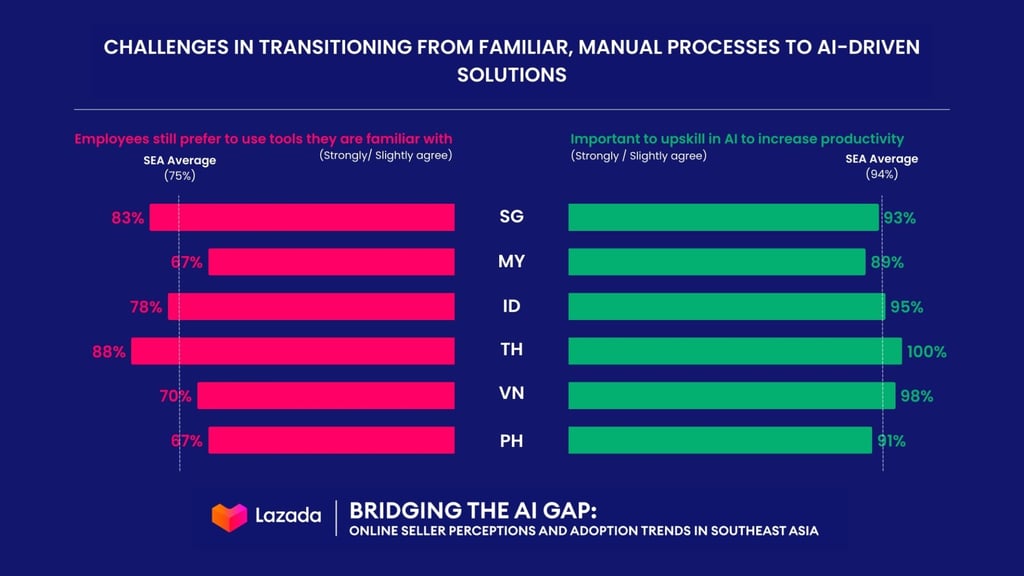
Nevertheless, respondents overwhelmingly agree that adopting AI could lead to substantial efficiency gains (89 per cent of respondents) and long-term savings for their businesses (94 per cent).
Lazada says it offers a range of accessible tools on its platform to help its online sellers overcome such concerns. Its “Artificial Intelligence Readiness Playbook for Online Sellers”, developed with Kantar, provides resources so sellers can integrate AI into their operations without the need for a big investment or extensive training.
Dong says: “As a leading e-commerce platform in Southeast Asia, we aim to bridge the knowledge and adoption gap by developing accessible AI solutions that address the unique challenges faced by sellers across different markets, ultimately making technology more accessible and driving sustainable business growth regardless of a seller’s size or technical expertise.”
Lazada’s playbook outlines the resources available on its platform that use generative AI (GenAI) – smart technology that not only allows computers to copy human behaviour, but also create new content, especially text or images – so sellers can easily improve and streamline their business operations.
Platform provides AI-enhanced support tools
To support its online sellers in adapting to the rapidly evolving digital landscape, Lazada has introduced a suite of upgraded GenAI tools designed to enhance product listings, streamline operations and improve customer engagement.
One such tool, AI smart product optimisation, guides sellers using its platform so they can refine their content and images to enhance their existing product listings. It builds on the success of the AI smart listing tool, which can instantly generate compelling, market-ready product listings from images or keywords.

Lazada says this dual approach helps to simplify the GenAI user experience for hesitant adopters while also enabling experienced sellers to sharpen their competitive edge in an increasingly tech-savvy marketplace.
Up to 41 per cent of sellers in the survey say they seek additional support, so Lazada’s playbook also showcases one of its platform’s newest tools, Lazzie Seller. This AI-powered chatbot addresses common seller queries and simplifies platform management without any added training costs.
Lazada has also integrated Marco MT, Alibaba’s advanced e-commerce machine translation tool, to develop AI-powered translations. The tool, designed to help sellers simplify cross-border communication and target new markets, automatically translates product content into Bahasa Indonesia, Bahasa Malaysia, Chinese, English, Tagalog, Thai and Vietnamese.
Only 24 per cent of sellers ‘fully embrace’ AI
The report also offers valuable insights into the level of e-commerce AI integration in the region after grouping the sellers into three distinct categories – depending on how they are using it in their core business operations. The different categories help sellers identify where they stand compared with their peers and how they can best use the playbook to stay competitive.
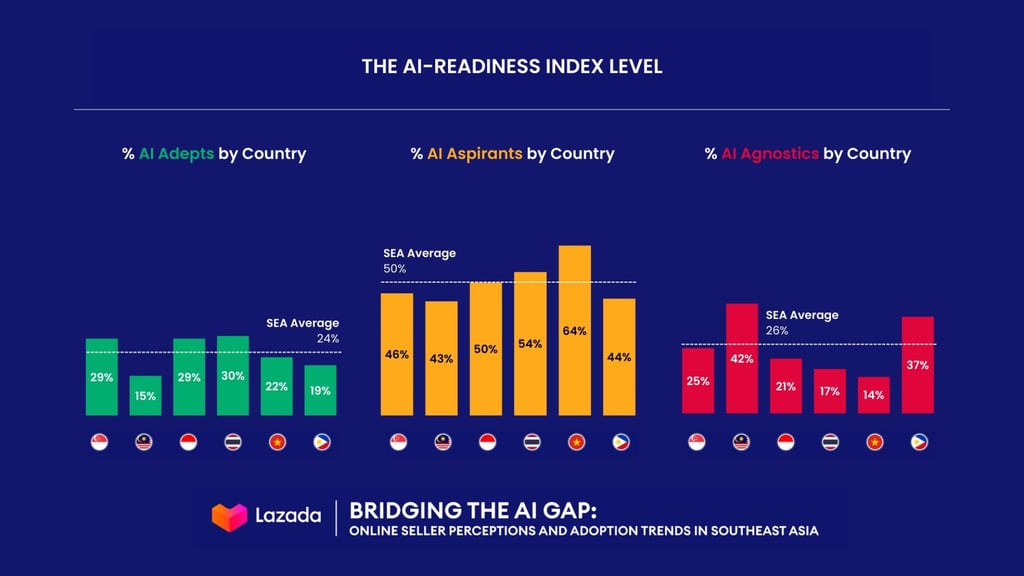
The most advanced group, called “AI adepts”, which accounts for 24 per cent of sellers, represents those who have comprehensively embraced AI by integrating it into at least 80 per cent of their operations. They fully appreciate AI’s competitive advantages and are actively using the technology to stay ahead in the rapidly evolving e-commerce industry. Sellers from Thailand, Singapore and Indonesia outperform the average with about 30 per cent of sellers from each country falling into this category.
The largest group, “AI aspirants”, comprises half of all sellers in the survey. These sellers have adopted AI in some operational areas, but face significant challenges because of their limited technical expertise, and continuing concerns about the costs of implementation and resistance from staff who are more accustomed to traditional business practices. Sellers from Vietnam and Thailand have the largest representation in this category, with 64 per cent and 54 per cent respectively.
Finally, members of the “AI agnostics” group, who make up the other 26 per cent of sellers in the survey, still rely mostly on manual processes. They remain sceptical about AI’s long-term merits – and are deterred by fears over the initial investments required and their unfamiliarity with AI technology. Sellers from Malaysia and the Philippines are most widely represented in this category, with 42 per cent and 37 per cent respectively. Without targeted support or intervention, they risk falling behind as regional AI adoption accelerates.
The report also highlights that 76 per cent – three quarters of all sellers – fall into the two ‘AI aspirants’ and ‘AI agnostics’ categories, underscoring the region’s readiness gap.
With AI-driven solutions projected to contribute over US$1 trillion to Southeast Asia’s economy by 2030, there is a growing urgency for online sellers to increase their understanding and application of these smart tools. Practical frameworks, such as the one outlined in Lazada’s playbook, offer a starting point for businesses exploring how to make AI part of their operational toolkit.