Environmental breakthroughs take centre stage in Hong Kong start-up pitch competition
Innovative ideas from 2025 EQT Impact Challenge’s five finalists include mutant algae for carbon capture and compact hydropower units

Every early-stage company entering the 2025 EQT Impact Challenge recognised the need to come up with a business concept that could meet three key criteria: it had to be investible, scalable, and hold promise for the long term.
The task was to convey that potential to a panel of expert jurors and demonstrate how the company’s innovation could drive meaningful change.
The pitch competition, which has held previous editions in Japan, South Korea and Singapore, aims to identify and support early-stage companies with their breakthrough concepts, business plans, financial models, and ambitions to scale for long-term growth.
It is organised by EQT, one of the world’s largest investment firms, with its philanthropic arm, EQT Foundation, providing the winning start-up capital to fuel growth, and access to a global network of potential industry partners and investors. The event is being held in partnership with the South China Morning Post.
The competition focuses on novel, deep tech solutions and scientific breakthroughs related to climate and nature, as well as health and well-being.
Many leading contenders were prepared to think big, putting forward ideas and solutions that, given the right backing and once scaled, have the potential to change lives on a global scale.
Two of those companies, which have now advanced to the competition’s top five, are taking innovative approaches to tackling problems associated with climate change and renewable energy.
The goal Alcarbo Technologies has set itself is to address the critical issue of rising carbon dioxide emissions, caused mainly by the burning of fossil fuels, such as coal and oil, and deforestation.
The scientific evidence is clear that these emissions, which trap heat in the atmosphere and warm the planet, pose significant threats to the natural environment through global warming and climate change.
Human activities have increased the atmosphere’s carbon dioxide content by 50 per cent in less than 200 years, and the effects are being observed in countries all around the world. Reversing this trend is a matter of concern for everyone.
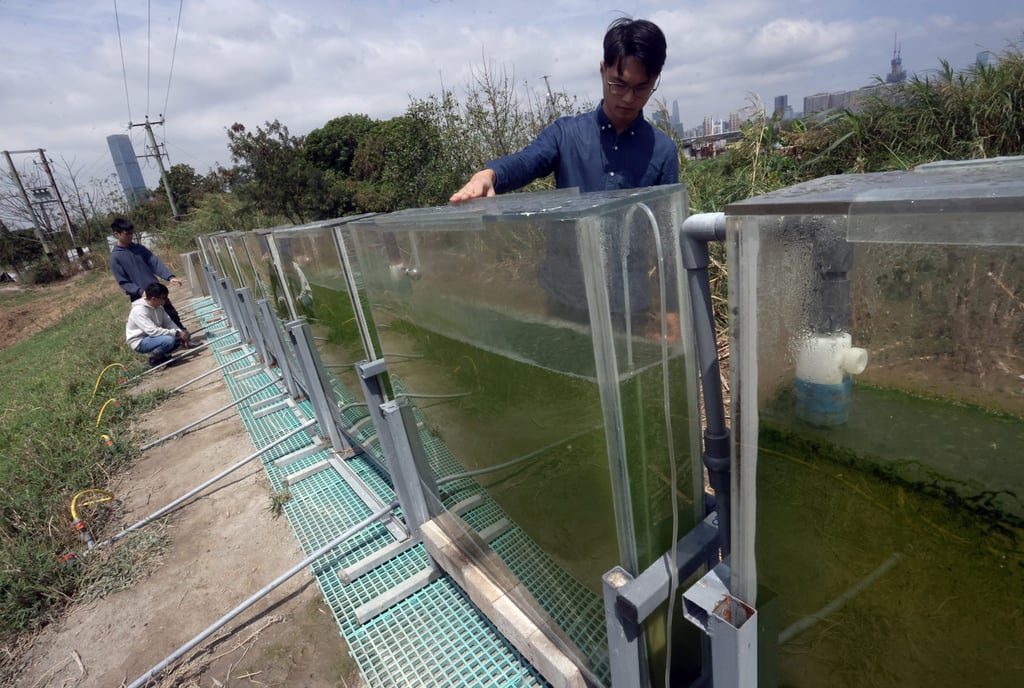
The solution proposed by Alcarbo during the competition’s Finalist Showcase – where the top 10 start-ups presented business pitches and five progressed to the next stage of public voting – is an outdoor photobioreactor system. It uses specially cultivated mutant algae strains to facilitate photosynthesis and efficiently capture CO2 from the atmosphere.
Yet it does not stop there. Alcarbo then converts the captured CO2 into valuable biomass products – food and biofuel – that can form the basis for a system of carbon credits between companies and economies looking to offset their own emissions.
The system is designed to be scalable and sustainable, and can be adapted to fit almost any local context or meet specific client requirements.
The start-up is looking at ways to enhance efficiency and shorten production cycles. It already has been tested and a certified prototype facility has been set up at a pilot site in Yuen Long, in Hong Kong’s western New Territories. It has the capacity to capture 75kg (165lbs) of carbon a year, and has patents for its algae mutation technology and “nanobubble” photobioreactor.

“Just planting more trees is not a viable solution to reduce the current level of emissions,” Bill Chan, one of Alcarbo’s co-founders, said. “Our technology can absorb carbon 70 times faster than trees and turn it into usable products. The ultimate goal is to contribute significantly to global decarbonisation efforts and enable clients to make a profit.”
He said that meeting the EQT Impact Challenge jurors had been very instructive because their questions showed how potential investors assess companies and evaluate the teams behind them.
“It is important to understand how such people think about the launch, management and operations of a start-up,” Chan said. “Knowing that will help when we talk to clients about things like the rate of growth of algae, temperatures, water sources and system automation.”
Green Vigor, a pre-seed company that has also made the top five, has come up with a solution that appears simple, yet is highly effective.
The concept is to generate renewable energy in urban areas by installing a customised device attached to the inflow pipes of water tanks. In effect, this turns water tanks into mini hydropower plants, and is a solution that can be rolled out to homes, offices, commercial premises, factories, swimming pools and many other locations.
The device designed to do this is the HydroVigor. It is activated when water flows and is made of durable materials that are resistant to the possibly corrosive effects of seawater and the grey water that circulates in certain systems.

The energy produced can be used to meet some, or perhaps all, of a building’s electricity needs, while at the same time reducing costs, enhancing efficiencies and contributing to a cut in overall carbon emissions.
The concept has many advantages compared with other renewables such as wind power and solar panels. Installation of the devices is quick and easy; the system can function 24 hours a day; it is modular and scalable; operating and maintenance costs are low; there are no unwanted by-products; and few expenses for modifying existing structures.
With the approval of Hong Kong’s Water Supplies Department, Green Vigor has successfully installed a device in a primary school in Sha Tin, in eastern New Territories. It runs eight to 12 hours a day, generating green electricity as water flows into a glass fibre tank with a capacity of 2,000 litres (4,278 US pints). Estimates indicate that this alone could produce up to 17,520 kWh per year.
Other continuing projects include six HydroVigor devices for a 38,000-litre surge water tank at a residential complex in Kai Tak and three for a shopping mall in Singapore. A combination of recurring revenue models is being considered, among them power purchase agreements, energy as a service, feed-in tariffs, renting out the product and sharing carbon credits with clients.

“Our product can be fitted in any tank in any building,” said Adrian Li, a 16-year-old intern who presented the case before the EQT Impact Challenge jurors and fielded all the follow-up questions. “We will arrange annual checks and have sensors to warn of any problems. We are using the power of water to create a better future.”
The grand finale takes place in July, where the winner will receive €100,000 (about US$117,000) investment from the EQT Foundation. In addition, the winning start-up gets access to EQT’s global network of industry advisers and portfolio companies, as well as strategic guidance and further introductions to potential investors.
The second- and third-place finishers will each receive €50,000 from Central Cove Group, the private investment office of Jean Eric Salata, a jury member and chairman of EQT Asia. Salata, recognising the strength of this year’s entries and eager to champion Hong Kong’s emerging talent, has opted to support the initiative directly.