How David Hon followed his dream to create Dahon, the world’s biggest folding bicycle maker
Former aerospace scientist became successful entrepreneur thanks to innovative business idea that continues to thrive after over 40 years
Physicist and aerospace engineer Dr David Hon, who was a keen cyclist throughout his student days, turned his back on a highly successful career researching laser energy for a leading American company to follow his dream – and launch his own business.
Today his company Dahon, which he set up in 1982 and named after himself, is the world’s largest manufacturer of folding bicycles. Hon’s contribution to innovation in the industry has led him to be described as the “father of modern folding bicycles”.
Known for the ingenious high-quality design of its easily stored and transported bicycles, the brand’s subsidiary, Dahon Tech, officially debuted on the main board of Hong Kong’s stock exchange in September.
Dahon Tech’s initial public offering, trading under the stock code 02543.HK, was more than 7,550 times oversubscribed.
It attracted a total investment of US$127.6 million from companies including Allianz Global Investors Asia Pacific, Greater Bay Area Development Fund Management, Harvest and Veken Hong Kong.
Hon said the listing, which marked a new chapter for the company, had provided funds that would be used to boost its production capacity, advance research and development projects, and support initiatives to help build greater awareness of its brand.

“We will leverage the listing as an opportunity to advance new trends, expand our presence in the Chinese and international markets, and deliver sustainable returns for our investors,” he said.
Hon, who was born in Shaoguan, in Southern China’s Guangdong province in 1941, moved to Hong Kong at the age of nine with his family before leaving at 19 to study in the United States. He earned his bachelor’s degree from the University of California, Berkeley, and a PhD in physics from the University of Southern California.
He launched Dahon in California with the aim of transforming urban mobility and encouraging eco-friendly recreation. The decision was sparked by rocketing petrol prices brought on by the global oil crisis in 1975, which led Hon to start thinking not only about sources of cleaner energy, but also a better alternative to the use of polluting, increasingly expensive cars as a form of mass urban transport.
He says his “eureka” moment was inspired by his time as a university student when he had to dismantle his bicycle to fit it inside a car so that later he could cycle it around the campus.
That led him to spend seven years self-funding his dream of designing and building a high-quality portable folding bicycle. His first-generation version of the product attracted plenty of investors who shared his belief in its potential as a business idea with mass appeal.
“When I quit my job … the plan was to license my invention to manufacturers,” Hon said. “I visited factories in the US, Japan, Taiwan and mainland China, but none of them was willing to take it on. So finally I started a business, which was quite a big jump for a scientist without business experience.”
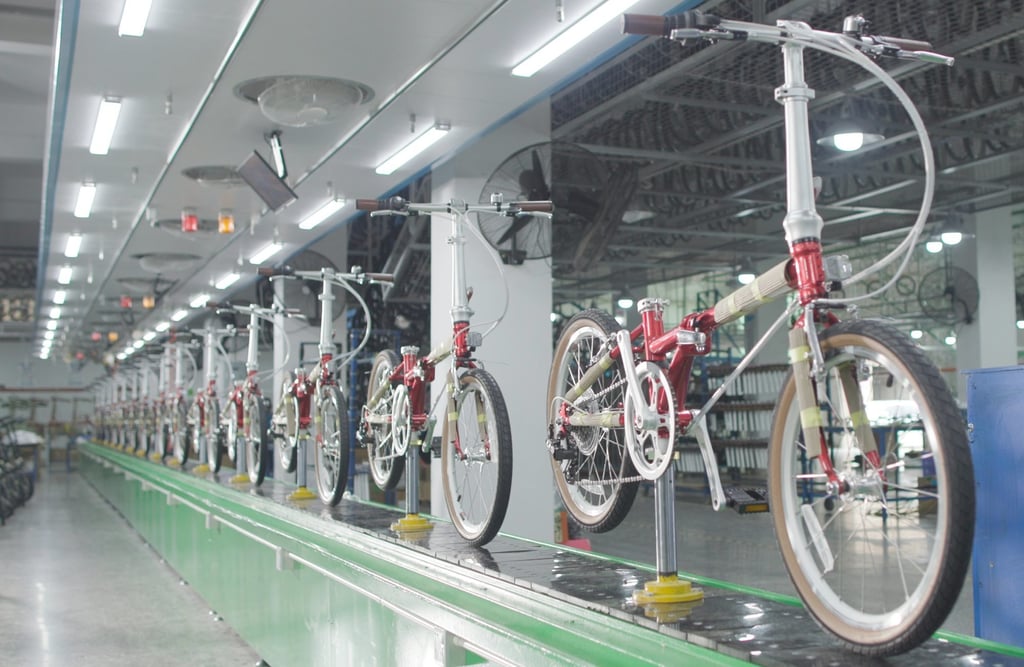
About 30 years ago, after rising costs had forced him to leave his initial factory base in Taiwan, he set up a new operation in Shenzhen, which is now home to its headquarters and main manufacturing facilities, just as the southern Chinese city was becoming the place for “everything about bicycles”, he said.
Sales took off as its range of offerings was expanded to include mountain bicycles and children’s models. Deals have been signed to license his patented technologies as a way to prevent intellectual property infringement, which have further boosted the company’s revenues and helped to raise overall industry standards.
Dahon has built its success on an enviable reputation for its technological prowess, commitment to product quality and – like its founder Hon, himself – its spirit of innovation.
Today the company, which offers more than 70 different models, including road and electric-assisted bicycles, has held more than 500 bicycle patents for design features and components over the years, many of which have become industry standards.
“Nowadays, with the strengthening of rules on intellectual property rights, other companies can license, but cannot copy our products; that is part of the reason for our growth,” Hon said.
He said a newly opened production base had started operations in Tianjin, in northern China, while plans had been approved for building an additional factory near its existing facility in Huizhou, Guangdong province.

This extra facility would enable Dahon to integrate supply chains with long-term suppliers and partners and operate specialised profit centres for components, frame welding, painting and assembly, he said. Production is expected to begin in early 2027, with a target annual capacity of 200,000 units.
Check out the video to learn more about Dahon’s major achievements from David Hon.